











 Secure payments
Standard refund policy
Trade Assurance
Secure payments
Standard refund policy
Trade Assurance
| Product Type | Memory Module |
|---|---|
| Compliance Standards | CE,WEEE,RoHS |
| Memory Capacity | 1 GB |
| Memory Technology | DDR3 |
| RAM Speed | 1066 |
| RAM Standard | DDR3-1066/PC3-8500 |
| Error Identifying | Non-ECC |
| Signal Type | Unbuffered |
| Column Access Strobe (CAS) | CL7 |
| Rank | Single Rank x8 |
| Quantity of Pins | 204-pin |
| RAM Genre | SoDIMM |
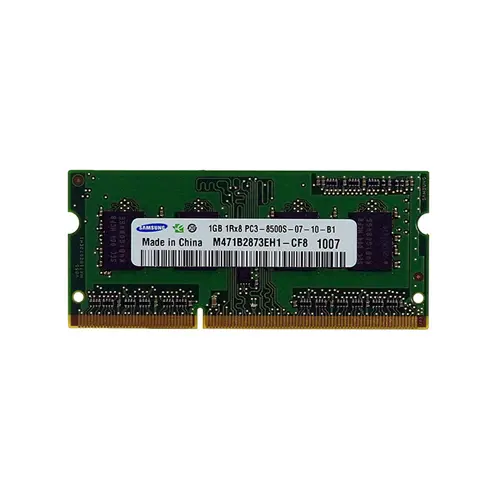
This DDR3-1066 SoDIMM is a non-ECC, unbuffered notebook memory module ideal for upgrading mobile workstations and everyday laptops. Its single-rank x8 organization combined with a low CL7 latency delivers responsive application performance, while the 204-pin form factor ensures broad plug-and-play compatibility with portable systems and helps maintain energy-efficient operation.
1. SoDIMM form factor ensures a seamless drop into compact notebook chassis, providing instant compatibility across a broad range of mobile platforms with no clearance issues.
2. The modest capacity is purpose-fit for lightweight operating systems and cloud-centric tasks, keeping page-file overhead low and battery consumption minimal during travel.
3. DDR3 technology maintains a power-efficient signaling profile that curbs heat generation, helping fanless ultrabooks stay cool under sustained daily workloads.
4. Standard data rate delivers fluid HD streaming and responsive office multitasking at the baseline voltage, avoiding the thermal spikes tied to higher-clocked modules.
5. CL7 latency shortens the wait for data fetches, giving legacy productivity apps a perceptible snappiness boost without pushing the memory controller beyond its low-power envelope.
Designed specifically for notebook platforms, the Samsung M471B2873EH1-CF8 is a 1GB DDR3-1066 SODIMM whose four key characteristics directly address the real-world frustrations of mobile users. Its non-ECC, unbuffered architecture eliminates the latency and additional power draw of error correction and register logic, which means every milliamp of battery budget is directed toward actual productivity rather than overhead. Coupled with a CAS latency of just CL7, the module delivers snappy command response that keeps everyday applications feeling instant when you are working unplugged, translating to noticeably smoother multitasking and faster wake-from-sleep transitions.
In a compact business ultraportable being revived for field sales duties, this standard-voltage module guarantees universal plug-and-play compatibility across countless DDR3-era laptops without BIOS tuning or driver headaches. The 204-pin SODIMM form factor fits perfectly into cramped chassis, making physical installation a snap—simply pop the back cover and click it home. Meanwhile, for a mobile workstation repurposed to run a lightweight Linux virtual machine and spreadsheet analysis side by side, the single-rank x8 configuration provides stable electrical signaling that minimizes strain on the memory controller, helping the notebook run cooler and preserving precious battery life during prolonged meetings away from an outlet. By delivering responsive, low-power, and hassle-free expansion, this memory module lets you extend the usable life of trusted notebooks with confidence, avoiding sluggish performance that can stall your workflow at exactly the wrong moment.
Laptop Upgrade
A typical laptop shipped with a single 1 GB DDR3‑1066 SO‑DIMM leaves an open slot for dual‑channel. Adding a second, identical 1 GB module (same single‑rank x8, CL7) doubles bandwidth, but total capacity is only 2 GB—insufficient for modern workloads. A far more effective upgrade is to replace the original module with a matched pair of 4 GB or 8 GB DDR3‑1066 SO‑DIMMs, yielding 8–16 GB while maintaining dual‑channel performance. If the system has only one slot, a single 8 GB module of the same speed and timing provides a meaningful capacity jump.
Mobile Workstation
Mobile workstations running CAD, simulation, or large in‑memory datasets require maximum stable capacity. Populate both SO‑DIMM slots with matched 8 GB DDR3‑1066 modules (single‑rank x8, CL7) to build a 16 GB dual‑channel configuration, which handles complex assemblies and moderate virtualization. For systems that support it, validated 16 GB modules can push total system memory to 32 GB while preserving identical rank and CAS latency, reducing the risk of signal integrity issues during sustained professional applications.
Ultrabook Power Saving
Battery‑constrained ultrabooks gain significant runtime by using low‑voltage DDR3L (1.35 V) SO‑DIMMs, even when the original module is standard 1.5 V, as most chipset platforms accept both. A 2×4 GB DDR3L‑1066 kit with CL7 consumes roughly 20 % less memory power than standard‑voltage equivalents while maintaining the same snappy response. Enabling deep power‑down and self‑refresh modes on such modules further extends idle battery life, making them the preferred choice for always‑on portable devices.
Rigorously tested, guaranteed compatible with laptops like Lenovo ThinkPad X220, Dell Latitude E6420, HP EliteBook 8460p.
Q: Can I mix this M471B2873EH1-CF8 with other memory modules of different brands or speeds?
A: Mixing is possible but not recommended. The system will default to the slowest module's speed and timings, potentially causing instability. For best results, use identical modules.
Q: Is this memory compatible with my laptop?
A: This DDR3 SoDIMM fits most laptops with 204-pin slots supporting 1066MHz. Verify your system's chipset, maximum capacity, and that it accepts 1.5V non-ECC unbuffered modules.
Q: What is the recommended DIMM population order for optimal performance?
A: For dual-channel capable laptops, install identical modules in pairs (e.g., both slots). If only one module, install in the primary slot; performance will be single-channel but fully functional.
Q: Does this module support overclocking or XMP profiles?
A: No, this is a standard JEDEC-compliant module. It does not support XMP or overclocking and operates at fixed DDR3-1066 CL7 timings as specified.
Q: What warranty and typical failure rate can I expect?
A: It comes with a 1-year warranty. As a genuine Samsung module built to stringent standards, the typical annualized failure rate is well below 0.5% under normal operation.