











 Secure payments
Standard refund policy
Trade Assurance
Secure payments
Standard refund policy
Trade Assurance
| Product Type | Memory Module |
|---|---|
| Compliance Standards | CE,WEEE,RoHS |
| Memory Capacity | 1 GB |
| Memory Technology | DDR3 |
| RAM Speed | 1333MHz |
| RAM Standard | DDR3-1333/PC3-10600 |
| Error Identifying | Non-ECC |
| Signal Type | Unbuffered |
| Column Access Strobe (CAS) | CL9 |
| Rank | Single Rank x8 |
| Quantity of Pins | 240-pin |
| RAM Genre | UDIMM |
Given its UDIMM form factor and non-ECC design, this 1GB DDR3-1333 module is a desktop-class memory best suited for legacy system upgrades and basic productivity workloads on aging office PCs. The single-rank x8 organization and CL9 latency reduce memory controller load while delivering responsive performance, and the unbuffered signal path ensures straightforward compatibility with consumer-grade chipsets.
1. Operating at a mainstream DDR3 data rate, it supplies sufficient throughput for smooth HD video playback and responsive office multitasking on older desktop platforms.
2. An aggressive CAS latency accelerates command-to-data turnaround, sharpening system reactivity for split-second actions in casual gaming and UI navigation.
3. Unbuffered architecture strips away register overhead, granting the memory controller direct access that shaves precious nanoseconds off desktop workloads.
4. Single Rank design reduces electrical strain on the memory bus, ensuring plug-and-play stability across a wide range of aged desktop motherboards without manual tuning.
5. The modest capacity serves as an ideal upgrade to resurrect aging desktop builds, restoring usability for web browsing, document editing, and light entertainment without excess cost.
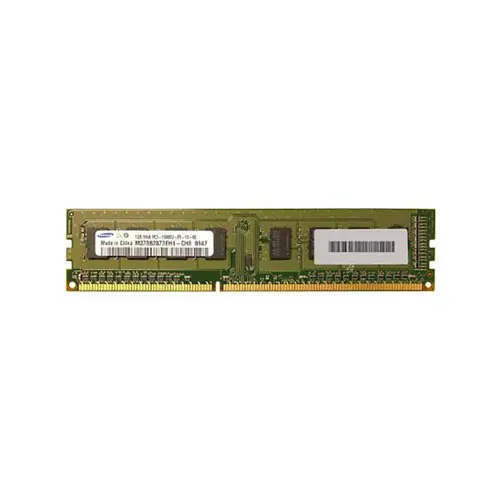
The M378B2873EH1-CH9 is a desktop UDIMM engineered for users who demand responsive system performance without compromise. Built with an unbuffered, Non-ECC design and a tight CL9 latency at 1333MHz, this single-rank x8 DDR3 module directly feeds the CPU with minimal delay. For gamers diving into AAA titles, that means every texture load and real-time physics calculation occurs with less micro-stutter. The quick column access strobe ensures that during chaotic multiplayer matches, your input isn’t lost to memory lag, preserving the split-second edge you depend on. In media production scenarios like rendering a 4K video timeline, the 240-pin form factor’s efficient signal path prevents data bottlenecks, allowing your compositing application to fluidly cache frames. Because stress comes not just from size but from consistency, its CE, WEEE, and RoHS compliance signals dependable manufacturing so your build stays stable during overnight encode sessions. This is memory that translates specifications into a quieter, faster, and more predictable creative workflow.
Gaming Build
A single 1 GB DDR3-1333 UDIMM is insufficient for modern gaming. For a basic dual-channel configuration, install two of these modules for 2 GB total — only viable for retro or undemanding titles. A practical 16 GB gaming setup requires eight identical 1 GB sticks across all DIMM slots, but we strongly recommend replacing them with 4 GB or 8 GB DDR3 DIMMs to avoid slot exhaustion and stability issues.
Content Creation
Content creation workloads demand large capacity and wide memory buses. Pair four 1 GB modules in dual-channel mode for just 4 GB, which severely limits video editing or 3D rendering. Scaling to 64 GB would need 64 such modules — physically impossible on standard motherboards. Instead, use this 1 GB DIMM only for testing or legacy systems; procure high-density DDR3 kits (8 GB or 16 GB per stick) to meet 64 GB requirements with fewer modules and lower latency.
General Productivity
For web browsing, office suites, and email, two 1 GB modules in dual-channel (2 GB total) can run lightweight 32-bit operating systems acceptably. If the board supports it, populate four slots for a 4 GB dual-channel configuration, enabling smooth multitasking on older DDR3 platforms. This cost-optimized approach reuses existing low-capacity UDIMMs while providing basic performance for everyday tasks.
Rigorously tested, guaranteed compatible with desktops supporting DDR3-1333 UDIMM, including Dell OptiPlex 790, HP 8200 Elite, Lenovo M72e.
Q: Can I mix this M378B2873EH1-CH9 with other memory modules of different brands or speeds?
A: Mixing brands or speeds is not recommended as it may cause instability or boot failure. For guaranteed compatibility, use identical part number modules with the same CAS latency (CL9) and voltage.
Q: Is this memory compatible with my system?
A: This UDIMM is compatible with desktop motherboards using DDR3 non‑ECC unbuffered slots, such as Intel 6/7‑series or AMD 9‑series chipsets. Verify your board supports DDR3‑1333 at 1.5V.
Q: What is the recommended DIMM population order for optimal performance?
A: For a single module, install it in the slot closest to the CPU (typically DIMM1). For dual‑channel, use identical pairs in the paired slots as marked on your motherboard to enable interleaved access.
Q: Does this module support overclocking or XMP profiles?
A: No. This is a standard JEDEC DDR3‑1333 module running at CL9. It does not include XMP and is not designed for overclocking. It operates reliably at the rated 1333MHz speed only.
Q: What warranty and typical failure rate can I expect?
A: This module includes a 1‑year warranty. With mature DDR3 technology and strict testing, the annualized failure rate (AFR) is typically below 0.5% under normal operating conditions.