











 Secure payments
Standard refund policy
Trade Assurance
Secure payments
Standard refund policy
Trade Assurance
| Product Type | Memory Module |
|---|---|
| Compliance Standards | EU RoHS,FCC |
| Memory Capacity | 1 GB |
| Memory Technology | DDR3 |
| RAM Speed | 1333MHz |
| RAM Standard | DDR3-1333/PC3-10600 |
| Error Identifying | Non-ECC |
| Signal Type | Unbuffered |
| Column Access Strobe (CAS) | CL9 |
| Rank | Single Rank x8 |
| Quantity of Pins | 240-pin |
| RAM Genre | UDIMM |
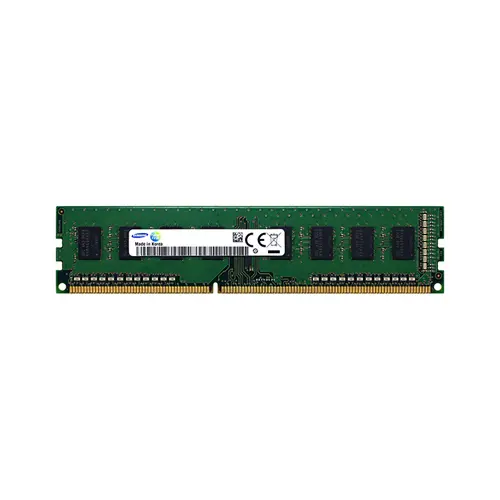
This DDR3-1333 UDIMM is optimized for mainstream desktop platforms, delivering reliable performance for productivity workloads and light gaming. Its Single Rank x8 organization and CL9 latency ensure stable, responsive operation at 1333MHz with minimal signal loading on the memory controller.
1. A single-gigabyte capacity provides just enough headroom for essential background tasks on a legacy desktop, keeping basic multitasking responsive without excessive disk swapping.
2. The 1333 MHz clock speed delivers sufficient bandwidth to accelerate game asset loading in older titles, minimizing stutter during texture-heavy scenes.
3. CL9 low-latency timing sharpens command-to-data turnaround, translating to snappier in-game reactions and reduced input lag for competitive budget gaming.
4. Single rank x8 architecture eases the electrical load on the memory controller, giving overclockers more room to push base clocks while maintaining rock-solid stability.
5. DDR3 technology ensures seamless compatibility with a wide range of aging desktop platforms, enabling a simple plug-and-play upgrade that revives everyday performance.
Based on the UDIMM form factor and Non-ECC unbuffered signaling, the M378B2873FH0-CH900 is a desktop memory module. Its four standout traits—Non-ECC, unbuffered, DDR3-1333 CL9, and single-rank x8—translate directly into perceptible gains for gamers and content creators. In a AAA gaming rig, the absence of ECC and register chips slashes latency, so CL9 delivers near-instantaneous first-word access that eliminates micro-stutter during rapid scene transitions. The single-rank design also lightens the memory controller’s load, ensuring plug-and-play stability across motherboards and headroom for timing tuning. For video editors exporting 4K projects, the unbuffered Non-ECC path dedicates full bandwidth to rendering without error-correction interruptions, resulting in smoother scrubbing and faster encodes. Single-rank’s low thermal footprint prevents throttling through overnight renders. Whether you’re aiming for competitive frame pacing or a crash-free creative session, this memory strips server overhead to give desktop users pure, low-latency responsiveness where it matters most.
General Productivity
For everyday office tasks and multitasking on a DDR3 desktop platform, a cost-effective 8GB (2x4GB) dual-channel kit strikes the best balance between performance and budget. A 2x4GB configuration enables interleaved memory access, which improves responsiveness when running multiple browser tabs, office suites, and communication apps. Avoid single-module setups to prevent leaving memory bandwidth on the table, and stick with 1333MHz CL9 UDIMMs for consistent, compatible operation.
Gaming Build
A dual-channel 16GB kit (2x8GB) is the sweet spot for DDR3 gaming rigs, covering modern titles and background tasks without excessive paging. For memory-hungry open-world games or streaming, stepping up to a 32GB kit (4x8GB or 2x16GB if the motherboard supports high-density modules) prolongs system relevance. Always install matched pairs in the correct DIMM slots to enable dual-channel mode, and favor single‑rank x8 modules when populating all four slots to reduce electrical load and maintain stable 1333MHz timings.
Content Creation
Video editing, 3D rendering, and large photo workflows benefit from a 32GB (4x8GB) or 64GB (4x16GB) configuration, leveraging the maximum capacity typical DDR3 desktop boards allow. Populate all channels with identical, unbuffered non-ECC UDIMMs to ensure symmetric memory access, which accelerates preview generation and multi-layered timeline scrubbing. When pushing capacity limits, verify that your motherboard and CPU memory controller support rank‑interleaving and the desired DIMM density, as single‑rank x8 modules ease signal integrity concerns in fully loaded configurations.
Rigorously tested, this desktop DDR3 UDIMM is compatible with Dell OptiPlex 790, HP Compaq 6200 Pro, and Lenovo ThinkCentre M71e.
Q: Can I mix this M378B2873FH0-CH900 with other memory modules of different brands or speeds?
A: Mixing is possible but not recommended. The system will downclock all modules to the slowest speed, potentially causing instability. For best reliability, use identical modules.
Q: Is this memory compatible with my Intel-based desktop motherboard?
A: It is compatible with desktop motherboards supporting DDR3 UDIMMs and Intel chipsets such as H55, P67, Z68, or 7-series. Please verify your board supports 240-pin DDR3-1333 and 1.5V operation.
Q: What is the recommended DIMM population order for optimal performance?
A: Refer to your motherboard manual. Generally, populate the slots of the same memory channel first (e.g., blue slots) to enable dual-channel mode, then fill the remaining channels.
Q: Does this module support overclocking or XMP profiles?
A: No, this standard JEDEC-compliant module does not support XMP or overclocking. It runs at fixed DDR3-1333 CL9 timings for maximum compatibility and stability.
Q: What warranty and typical failure rate can I expect?
A: This module includes a 1-year warranty. Typical failure rates for such reliable, non-ECC UDIMMs are very low under normal operating conditions, ensuring long-term stability.