











 Secure payments
Standard refund policy
Trade Assurance
Secure payments
Standard refund policy
Trade Assurance
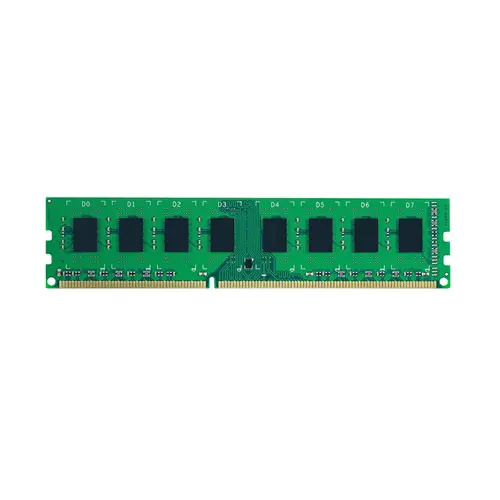
| Model | M391B2873DZ1-CH9 |
|---|---|
| Product Type | Memory Module |
| Compliance Standards | EU RoHS,FCC |
| Memory Capacity | 1 GB |
| Memory Technology | DDR3 |
| Product Voltage | 1.5V |
| RAM Speed | 1333MHz |
| RAM Standard | DDR3-1333/PC3-10600 |
| Error Identifying | ECC |
| Signal Type | Unbuffered |
| Column Access Strobe (CAS) | CL9 |
| Rank | Single Rank x8 |
| Quantity of Pins | 240-pin |
| RAM Genre | UDIMM |
This DDR3-1333 UDIMM with ECC is ideally suited for entry-level servers and single-socket workstations, where its unbuffered design and error-correcting code deliver reliable data integrity for light virtualization, file serving, and small database workloads. Leveraging a single-rank x8 configuration and CL9 latency, it provides balanced electrical loading and responsive timing, optimizing stability in platforms that require error protection without the higher capacity of registered memory.
1. ECC protection corrects single-bit errors in real time, preserving data integrity for mission-critical microserver and NAS workloads where silent corruption is unacceptable.
2. Unbuffered signal architecture eliminates register buffering overhead, delivering lower command-to-response latency that benefits latency-sensitive edge computing services.
3. UDIMM form factor ensures drop-in compatibility with mainstream single-processor server platforms, streamlining deployment and sparing IT staff from compatibility troubleshooting.
4. The 1GB capacity optimally matches lightweight OS and single-application embedded server environments, avoiding stranded resources and minimizing per-node power consumption.
5. Single Rank x8 chip organization imposes a lighter electrical load on the memory controller, enabling fully populated channel configurations without sacrificing signal integrity in space-constrained servers.
When deploying a virtualization cluster or an in-memory database, the Samsung M391B2873DZ1-CH9 UDIMM proves that true reliability is engineered, not just specified. Its ECC error correction silently detects and corrects single-bit flips caused by background radiation or electrical noise—a silent threat that can corrupt a hypervisor’s memory state or skew a Redis dataset, turning hours of processing into garbage. Without ECC, a single bit flip in a financial transaction cache could go unnoticed until it triggers a costly logical error. The unbuffered architecture, meanwhile, keeps signal paths short and latency low, a critical advantage for latency-sensitive database lookups where every nanosecond counts. In a dense virtualized host running dozens of VMs, stable memory timing is non-negotiable, and the single‑rank x8 organization minimizes the electrical load on the memory controller, ensuring your server boots predictably across diverse motherboard populations and maintains signal integrity under continuous 1333MHz operation. Finally, the standard 1.5V voltage avoids the training complications of low‑voltage DIMMs, delivering consistent power delivery in multi-slot configurations. This module does not just meet a spec sheet—it protects the runtime integrity of your critical workloads.
General Virtualization
Populate both memory channels symmetrically with identical M391B2873DZ1-CH9 modules to maintain balanced performance. For light-duty hypervisors running a handful of VMs, install at least 8 modules (8 GB total) across dual channels. If the server board allows, increase to 16 modules (16 GB) to accommodate more guests and basic failover overhead, always matching DIMMs in each channel.
In-Memory Database
Maximize capacity by filling every available DIMM slot with these 1 GB UDIMMs—on a typical single-socket platform with 4 slots, that yields only 4 GB, which suits very small caching instances. For a meaningful dataset, target a board with 12–18 slots to reach 12–18 GB, and enable memory interleaving to reduce latency. Given the modest per-module size, consider clustering nodes for larger in-memory workloads.
High-Performance Computing (HPC)
Prioritize peak bandwidth: install one module per memory channel (e.g., 2 or 3 modules for 2–3 GB) to drive full dual- or triple-channel mode. If the job set needs more capacity, install a second matched DIMM per channel while preserving rank symmetry. Because 1 GB per stick constrains large-scale simulations, plan for scale-out across multiple nodes, using identical kits in every server to guarantee reproducible performance.
Rigorously validated for server use; compatible with Dell PowerEdge R210 II, T110 II, and HP MicroServer Gen8.
Q: Can I mix this M391B2873DZ1-CH9 with other memory modules of different brands or speeds?
A: Mixing is not advised. For ECC integrity, use identical modules. Mixed speeds force all DIMMs to the lowest common clock, and different ranks or timings may cause signal issues and instability in server environments.
Q: Is this memory compatible with my system? Does it support Intel or AMD server platforms?
A: This DDR3 ECC unbuffered UDIMM is validated for Intel Xeon E3 series and C202/C204/C206 chipsets, as well as AMD AM3+ / Opteron 3000 platforms that explicitly support ECC unbuffered memory. Check your motherboard’s qualified vendor list.
Q: What is the recommended DIMM population order for optimal performance?
A: For this single-rank x8 module, populate the first slot in each memory channel per the server board manual, usually DIMM_A1 and DIMM_B1 blue slots. Matching pairs enable dual-channel mode for peak bandwidth and minimal CPU memory latency.
Q: Does this module support overclocking or XMP profiles?
A: No. This is a JEDEC-standard DDR3-1333 ECC module designed for server reliability. It has no XMP profile and does not support overclocking. Operating beyond 1333MHz would compromise error correction and data protection guarantees.
Q: What warranty and typical failure rate can I expect?
A: The module is backed by a 1-year warranty. Built with Samsung original DRAM, its annualized failure rate is well below 0.5% in nominal environments. Active ECC also detects and corrects single-bit errors, reducing effective downtime.