











 Secure payments
Standard refund policy
Trade Assurance
Secure payments
Standard refund policy
Trade Assurance
| Model | M312L2920CZ3-CB3 |
|---|---|
| Product Type | Memory Module |
| Compliance Standards | EU RoHS,FCC |
| Memory Capacity | 1 GB |
| Memory Technology | DDR |
| Product Voltage | 2.5V |
| RAM Speed | 333MHz |
| RAM Standard | DDR-333/PC-2700 |
| Error Identifying | ECC |
| Signal Type | Registered |
| Column Access Strobe (CAS) | CL2.5 |
| Rank | Single Rank x4 |
| Quantity of Pins | 184-pin |
| RAM Genre | RDIMM |
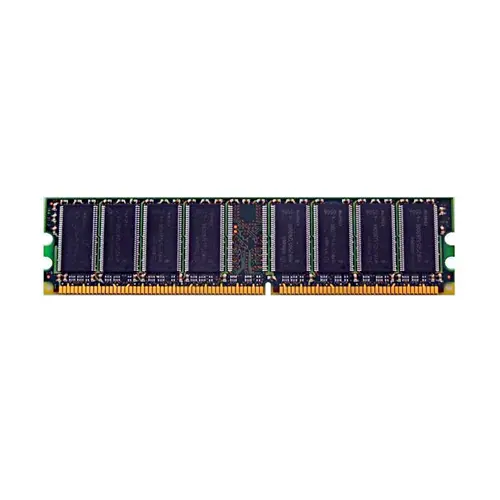
This RDIMM with ECC and registered signal type is specifically engineered for legacy server platforms, ensuring data integrity in mission-critical applications like virtualization or in-memory databases. Its CL2.5 low latency and Single Rank x4 organization optimize signal stability and command efficiency on aging chipsets that mandate strict loading rules.
1. ECC memory detects and corrects single-bit errors in real time, safeguarding transactional data integrity in always-on server environments.
2. Registered signal buffering stabilizes electrical loading on the memory bus, enabling dense server configurations to scale without compromising reliability.
3. Single Rank x4 organization optimizes per-channel access granularity, improving memory bandwidth utilization under heavy multi-threaded server workloads.
4. 1GB capacity per module suits targeted legacy server applications and lightweight virtualized services where deterministic performance matters more than raw density.
5. 333MHz clock speed delivers 2.7 GB/s peak throughput, providing predictable response times for steady-state enterprise workloads that prioritize consistency over peak burst rates.
The Samsung M312L2920CZ3-CB3 is a 1GB DDR-333 Registered ECC DIMM engineered for legacy server environments, where reliability is the foundation of every business operation. In a multi-virtual-machine host running a hypervisor, an uncorrected memory error can silently flip a bit inside a guest operating system, corrupting financial data or causing an entire virtual cluster to fail. The module’s ECC technology actively detects and corrects single-bit errors, preserving the integrity of your critical applications without draining the memory’s 2.5V operating budget. Its Registered architecture employs an on-chip buffer that stabilizes the electrical load on the memory controller, letting you fully populate all 184-pin slots on a server board. This means a dense virtualization host can scale memory capacity without signal degradation, directly safeguarding uptime for database-centric services. The CL2.5 latency and single-rank x4 organization deliver fast, clean access to data, which is crucial for an in-memory database like a real-time inventory cache: even minor latency jitter can stall hundreds of queries per second. Together, these features turn a basic hardware specification into an assurance that your aging but indispensable ERP platform or caching layer will continue to serve accurate results under continuous load, protecting your operational continuity.
General Virtualization
For legacy DDR-333 registered ECC memory, capacity is the primary constraint. With only 1 GB per module, a hypervisor host must be populated with the maximum number of identical RDIMMs—typically six to eight modules on older dual-socket boards—to reach 6–8 GB total. This minimal footprint can support a handful of lightweight VMs, but overcommitment should be avoided due to the slow 333 MHz speed and CL2.5 latency; strict ECC error logging is critical on aging hardware.
In-Memory Database
In-memory workloads demand both capacity and data integrity. An in-memory database using 1 GB single-rank x4 DIMMs is severely restricted—even a full bank of eight modules yields only 8 GB, which is insufficient for modern datasets. Where legacy platforms are unavoidable, configure all available slots with these identical registered ECC modules to maximize interleaving and ensure reliable in-memory table storage. Treat any uncorrectable ECC event as a critical alert that may corrupt the dataset.
High-Performance Computing
HPC clusters built around this memory era must prioritize node uniformity. Each node should be equipped with a balanced set of RDIMMs—typically four or eight—to enable dual-channel or comparable interleaving on the chipset, although raw bandwidth (2.7 GB/s per module) is a bottleneck for floating-point intensive codes. Given the age, strict spares and proactive replacement policies are essential; a single ECC-correctable failure cascade can invalidate long-running simulation results.
Rigorously tested server memory, compatible with Dell PowerEdge 2850, HP ProLiant DL380 G4, IBM xSeries 346.
Q: Can I mix this M312L2920CZ3-CB3 with other memory modules of different brands or speeds?
A: Mixing brands or speeds in a server is not recommended. Mismatched registered ECC modules may cause instability, ECC errors, or boot failure. Use identical part numbers to guarantee signal integrity and full compatibility.
Q: Is this memory compatible with my Intel or AMD server platform?
A: This DDR-333 Registered ECC RDIMM suits servers that accept PC-2700 at 2.5V. Please confirm your motherboard or OEM server’s qualified vendor list includes this SKU, as chipset and BIOS support are essential.
Q: What is the recommended DIMM population order for optimal performance?
A: Follow your server board’s slot numbering and color scheme. Install matched pairs in the farthest slots from the CPU first to enable dual-channel mode. Always populate identical modules per channel for balanced ECC operation.
Q: Does this module support overclocking or XMP profiles?
A: No. This is a server-grade Registered ECC DIMM, locked to JEDEC DDR-333 (PC-2700) at CL2.5. It prioritizes 24/7 stability and data integrity over overclocking; XMP profiles are not supported.
Q: What warranty and typical failure rate can I expect?
A: A one-year warranty is provided. Built with premium components, this module typically achieves an annualized failure rate well below 0.5% in properly cooled server environments, ensuring dependable long-term operation.