











 Secure payments
Standard refund policy
Trade Assurance
Secure payments
Standard refund policy
Trade Assurance
| Model | M312L2828ET0-CA2 |
|---|---|
| Product Type | Memory Module |
| Compliance Standards | EU RoHS,FCC |
| Memory Capacity | 1 GB |
| Memory Technology | DDR |
| Product Voltage | 2.5V |
| RAM Speed | 266MHz |
| RAM Standard | DDR-266/PC-2100 |
| Error Identifying | ECC |
| Signal Type | Registered |
| Column Access Strobe (CAS) | CL2.5 |
| Rank | Single Rank x4 |
| Quantity of Pins | 184-pin |
| RAM Genre | RDIMM |
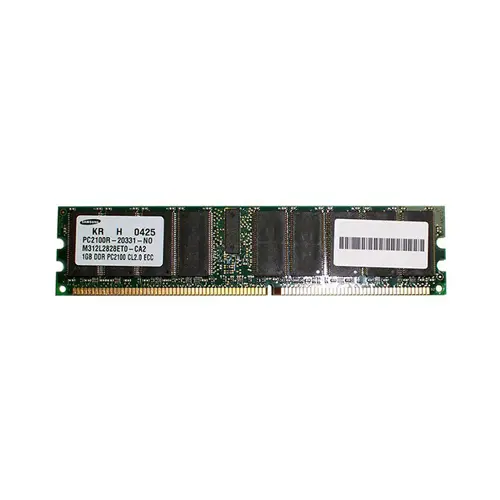
This Samsung M312L2828ET0-CA2 is a 1GB DDR-266 Registered ECC RDIMM engineered for legacy server platforms where data integrity and system stability are paramount, making it well-suited for memory-intensive virtualization and always-on database applications. The module’s registered signal architecture buffers command and address lines to reduce electrical loading on the memory controller, while its single-rank x4 organization and CL2.5 latency ensure predictable, error-corrected performance in multi-DIMM configurations.
1. ECC protection silently detects and corrects single-bit memory errors, safeguarding transactional integrity in databases and preventing silent data corruption in long-running virtualization hosts.
2. Registered signal buffering decouples the memory controller from the electrical load of multiple DIMMs, enabling high-capacity configurations that keep dense VM fleets running without signal degradation.
3. Single Rank x4 organization places just one set of memory chips per bus segment, lowering electrical loading to preserve clean signal timing across fully populated server boards.
4. PC-2100 throughput supplies 2.1 GB/s of consistent bandwidth per module, matching the sustained data ingestion needs of legacy network appliances and archival storage servers.
5. CL2.5 latency shrinks the delay between column addressing and data delivery, giving in-memory caches and low-latency trading systems a measurable responsiveness edge.
In virtualized clusters and in-memory databases, the Samsung M312L2828ET0-CA2 DDR Registered ECC DIMM transforms raw server-grade specifications into tangible uptime and data accuracy where any mistake cascades into revenue loss. Its ECC error correction actively defends against silent data corruption: a single cosmic-ray-induced bit flip can crash a hypervisor or poison a financial transaction inside an in-memory cache like Redis without warning, yet this module corrects those errors on the fly, preserving transaction integrity. The registered buffer architecture re-drives address and command signals so you can fully populate every DIMM slot across a server channel without signal degradation, achieving the massive, stable memory footprint that dense virtual machines or high-velocity database tables demand. A fast CL2.5 latency then ensures that each memory request completes with minimal delay, directly boosting responsiveness when hundreds of competing VMs query shared resources or when a cache miss stalls a real-time analytics query. Finally, the x4-wide DRAM organization built into this single-rank module limits the impact of a chip-level failure to only a quarter of the data bits, a reliability advantage that keeps critical workloads alive during hardware faults. Together, these four design pillars deliver uninterrupted operation, absolute data fidelity, and consistent performance in environments that tolerate nothing less.
General Virtualization
For general virtualization hosts running multiple VMs, balance memory capacity and cost. This 1 GB DDR-266 registered ECC module is too small for modern hypervisors; use it only to populate legacy test labs. In production, plan for at least eight identical modules per server to enable multi-channel interleaving and provide a reliable ECC footprint, but know that total capacity will be severely limited by the 1 GB density.
In-Memory Database
In-memory databases demand both capacity and data integrity, making ECC mandatory. A single 1 GB RDIMM cannot satisfy even a modest Redis or Memcached instance. If this module must be used, deploy it solely for embedded or appliance-style databases where the dataset fits within a few hundred megabytes and use multiple modules for memory mirroring to safeguard against uncorrectable errors.
High-Performance Computing (HPC)
HPC clusters require maximum bandwidth and low latency, favoring fully populated memory channels. This DDR-266 module operates at only 2.7 GB/s per channel, so modern HPC workloads will bottleneck instantly. Consider using it in a minimal cluster node for light controller functions or in legacy system extensions where the node count is high; always install modules in matched sets of four or eight to sustain registered signal integrity and reduce command bus contention.
Verified compatible with Dell PowerEdge 2650, HP ProLiant DL380 G3, and similar servers after rigorous testing.
Q: Can I mix this M312L2828ET0-CA2 with other memory modules of different brands or speeds?
A: Mixing is not advised for this registered ECC server DIMM. Identical part numbers ensure matching ranks, timings, and signal integrity. Mismatched modules often cause POST failures or memory errors in servers.
Q: Is this memory compatible with my system?
A: Compatibility requires a server board supporting DDR-266 registered ECC DIMMs. Check your motherboard's qualified vendor list for this Samsung 1GB PC2100R module. Targets legacy Intel/AMD server platforms.
Q: What is the recommended DIMM population order for optimal performance?
A: Follow your server manual. Typically, populate identical DIMMs in paired slots per memory channel for dual-channel interleaving. For single-rank x4 modules, fill the first bank of each channel to maximize throughput.
Q: Does this module support overclocking or XMP profiles?
A: No. As a JEDEC-compliant registered ECC server module, it runs at fixed 266MHz with CL2.5. Overclocking and XMP are not supported; reliability and 24/7 stability are paramount for enterprise environments.
Q: What warranty and typical failure rate can I expect?
A: This module includes a one-year warranty. Server-grade DDR ECC memory exhibits extremely low failure rates under normal operating conditions, ensuring stable long-term deployment when kept within specified voltage and thermal limits.