











 Secure payments
Standard refund policy
Trade Assurance
Secure payments
Standard refund policy
Trade Assurance
| Model | M312L2920BG0-CCC |
|---|---|
| Product Type | Memory Module |
| Compliance Standards | EU RoHS,FCC |
| Memory Capacity | 1 GB |
| Memory Technology | DDR |
| Product Voltage | 2.5V |
| RAM Speed | 400MHz |
| RAM Standard | DDR-400/PC-3200 |
| Error Identifying | ECC |
| Signal Type | Registered |
| Column Access Strobe (CAS) | CL3 |
| Rank | Single Rank x4 |
| Quantity of Pins | 184-pin |
| RAM Genre | RDIMM |
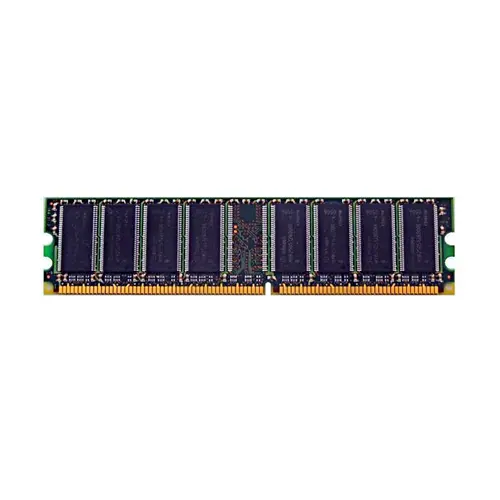
Designed for legacy server platforms and workstations requiring uncompromised data integrity, this 1GB DDR-400 RDIMM with ECC is ideally suited for virtualization, in-memory databases, and always-on transactional workloads. Its registered signal buffering stabilizes multi-DIMM configurations, while the single-rank x4 architecture minimizes electrical loading on the memory controller and the CL3 latency ensures rapid column access for consistent, low-latency performance.
1. ECC error correction detects and fixes single-bit memory faults in real time, preserving data integrity for financial transactions and long-running server workloads where even a single silent corruption is unacceptable.
2. Registered signal buffering decouples the memory bus from the DRAM loads, enabling large-capacity memory configurations that keep virtualization hosts stable under heavy multi-VM memory pressure.
3. The 1 GB foundational capacity serves as a reliable building block for entry-level enterprise servers, allowing IT to provision just enough memory for dedicated lightweight services without wasting budget.
4. PC-3200 bandwidth of 3.2 gigabytes per second sustains smooth throughput for web serving and light database operations, preventing memory bottlenecks that would otherwise stall concurrent user requests.
5. Single Rank x4 organization reduces electrical loading on the memory channel, helping maintain signal integrity when populating all DIMM slots to maximize total system memory in dense racks.
Engineered for legacy server platforms where uptime and data fidelity are non-negotiable, the M312L2920BG0-CCC is a 1GB DDR-400 Registered ECC DIMM that directly addresses the pain points of aging yet critical enterprise infrastructure. Its first decisive feature is ECC error correction: in a memory-resident database like Redis, a single undetected bit-flip can silently corrupt transactional records and cascade into financial inaccuracies. This module catches and corrects those errors in real time, transforming a silent threat into a non-event.
The second differentiator is the Registered buffer. In a virtualization cluster running multiple VMs on a dual-socket host fully populated with DIMMs, unbuffered memory quickly suffers signal degradation and unpredictable crashes. The onboard register stabilizes the command bus, letting you achieve maximum density without sacrificing stability, so hypervisor workloads stay resilient under heavy memory pressure. Third, the DDR-400 speed and CL3 latency offer predictable, synchronous performance vital for non-stop services — when a thick-provisioned SQL Server instance performs synchronous index scans, every nanosecond of consistent access time prevents execution-plan timeouts. Finally, the single-rank x4 organization reduces electrical load, preserving signal integrity even in older chipsets. For IT teams extending the lifecycle of proprietary industrial controllers or telco call-state platforms, this module means prolonged ROI and mission-critical reliability that a generic desktop DIMM can never deliver.
General Virtualization
For legacy DDR-400 server platforms hosting light virtual machines, populate all available DIMM slots with these 1 GB Registered ECC modules to maximize total capacity rather than speed. Aim for a balanced configuration, typically 4 to 8 identical modules, to ensure stable memory interleaving and sufficient headroom for multiple VMs. Always install in matched pairs per memory channel to maintain ECC data integrity under sustained loads.
In-Memory Database
An in-memory database demands absolute reliability and low latency, making Registered ECC mandatory. Deploy the maximum number of these single-rank modules supported by your server board—often 6 or 8—to reach 6–8 GB total, which is substantial for lightweight datasets on this era’s hardware. Distribute modules evenly across all memory banks to reduce bus contention and keep database response times predictable.
High-Performance Computing (HPC)
HPC clusters built around DDR-400 nodes rely on sustained throughput and fault tolerance. Install identical kits of these CL3, PC-3200 RDIMMs across every node to guarantee uniform performance in parallel jobs. Populate both channels on dual-channel boards with 4 modules to double bandwidth, and prioritize ECC protection to prevent silent data corruption during days-long simulation runs.
Rigorously tested server memory, compatible with Dell PowerEdge 2850, HP ProLiant DL380 G4, IBM xSeries 346.
Q: Can I mix this M312L2920BG0-CCC with other memory modules of different brands or speeds?
A: Mixing is not recommended for server environments. All modules should be identical in speed, rank, and organization to ensure ECC and registered operation stability. Mismatched DIMMs may cause POST failures or data corruption.
Q: Is this memory compatible with my server system?
A: This RDIMM is designed for server boards with 184-pin DDR-400 slots supporting registered ECC. Verify your system accepts PC-3200, 2.5V, single-rank x4 modules. Compatible with many Intel E7520/E7320 and AMD 8-series chipsets.
Q: What is the recommended DIMM population order for optimal performance?
A: Follow your motherboard manual. Typically, populate DIMM slots in pairs per channel, starting with the farthest slot from the CPU. For single-rank x4 modules, balance channels to maximize interleaving and bandwidth.
Q: Does this module support overclocking or XMP profiles?
A: No. This is a server-grade DDR-400 registered ECC module operating at JEDEC standard CL3 timings. Overclocking or XMP is not supported; stability and data integrity are prioritized over performance tuning.
Q: What warranty and typical failure rate can I expect?
A: We provide a 1-year warranty. Typical annualized failure rate (AFR) for this enterprise memory is below 0.5% under normal operating conditions, ensuring high reliability in 24/7 server environments.