











 Secure payments
Standard refund policy
Trade Assurance
Secure payments
Standard refund policy
Trade Assurance
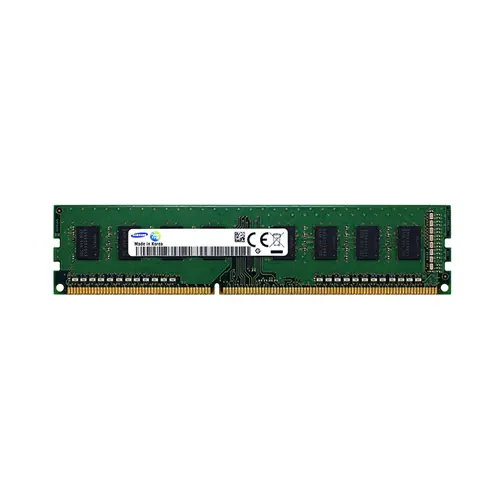
| Model | M393B3G70DV0-YH9 |
|---|---|
| Product Type | Memory Module |
| Compliance Standards | EU RoHS,FCC |
| Memory Capacity | 24 GB |
| Memory Technology | DDR3 |
| Product Voltage | 1.35V |
| RAM Speed | 1333MHz |
| RAM Standard | DDR3-1333/PC3-10600 |
| Error Identifying | ECC |
| Signal Type | Registered |
| Column Access Strobe (CAS) | CL9 |
| Rank | Triple Rank x4 |
| Quantity of Pins | 240-pin |
| RAM Genre | RDIMM |
The M393B3G70DV0-YH9 is a server-grade DDR3 RDIMM engineered for virtualization and in-memory database workloads, where its registered signal type and ECC ensure data integrity under sustained memory stress. Its triple-rank x4 organization and low 1.35V operating voltage deliver high capacity density and improved power efficiency in dual-socket platforms requiring reliable 1333MHz performance at CL9 latency.
1. The generous per-module capacity enables higher consolidation ratios in virtualized servers, cutting hardware footprint while seamlessly scaling memory-hungry workloads.
2. ECC protection eliminates silent data corruption, a non-negotiable safeguard for mission-critical databases and financial transaction systems running around the clock.
3. Registered signaling strengthens signal integrity across fully populated memory channels, preserving stability in multi-socket platforms where unexpected downtime carries steep cost.
4. Triple Rank x4 organization keeps memory banks deeply interleaved, sustaining high bandwidth under heavy virtualization I/O and large in-memory analytics.
5. The efficient operating frequency delivers steady, power-conscious throughput tuned for dense data center environments where cooling overhead directly impacts operational budgets.
The M393B3G70DV0-YH9 is an RDIMM engineered for enterprise servers, where continuous uptime and data accuracy are non-negotiable. Its defining characteristics directly answer the most pressing pain points of data center operators and IT architects.
The integrated ECC technology silently detects and corrects single-bit memory errors before they cascade into database corruption or application crashes. In a large-scale virtualized cluster hosting dozens of mission-critical VMs, a random bit flip caused by background radiation doesn’t just scramble one workload—it can force an entire hypervisor to fail, translating into minutes of revenue-impacting downtime. Registered buffering with a triple-rank x4 architecture is equally critical: it stabilizes the signal path between the CPU and dozens of DIMMs, allowing a server to reliably populate 24GB per module across all channels without electrical loading issues. This means you can scale an in-memory database like Redis or SAP HANA to hold larger working sets, accelerating real-time analytics with zero compromise in signal integrity. The 1.35V low-power specification dramatically reduces thermal output across thousands of nodes, lowering cooling OPEX in a hyperscale data center. Meanwhile, the native 1333MHz speed and CL9 latency deliver balanced throughput ideal for consolidating mixed enterprise applications—from transactional processing to heavy virtualization—ensuring predictable performance under consistent load. For the platform architect, this module is less a component and more an insurance policy against silent data corruption, memory errors under dense configurations, and runaway energy costs.
This memory module, M393B3G70DV0-YH9, is a server-grade 24 GB DDR3-1333 Registered ECC RDIMM operating at 1.35V. Its triple-rank x4 organization, ECC, and registered signaling suit multi-socket servers.
General Virtualization
Populate all memory channels evenly to maximize interleaving and bandwidth. A common configuration uses one 24 GB DIMM per channel in a dual-socket system, yielding 192–384 GB total. This balances capacity and cost while ensuring consistent VM density and failover headroom.
In-Memory Database
Maximize capacity per socket by filling all DIMM slots with 24 GB RDIMMs, achieving 384–768 GB or more depending on platform. Enable ECC and memory mirroring if uptime is critical. The 1.35V operation reduces power and cooling, allowing denser deployments without exceeding thermal limits.
High-Performance Computing (HPC)
For bandwidth-sensitive workloads, install one DIMM per channel in a balanced configuration—for example, 12 identical modules across a dual-socket, six-channel system. The triple-rank design offers higher capacity at slightly lower speed; use identical ranks across channels to avoid performance penalties. The low voltage benefits energy-conscious cluster environments.
Verified compatible with Dell PowerEdge R720, HP ProLiant DL380p Gen8, IBM System x3650 M4 after rigorous testing.
Q: Can I mix this M393B3G70DV0-YH9 with other memory modules of different brands or speeds?
A: Mixing this Registered ECC RDIMM with modules of other brands, speeds, or ranks is not recommended. It may cause system instability and invalidate platform vendor warranties due to strict signal integrity requirements.
Q: Is this memory compatible with my system?
A: This DDR3-1333 Registered ECC module is designed for dual-socket Intel Xeon E5-2400/E5-2600 v1/v2 and select AMD Opteron platforms. Confirm your server board requires 1.35V 240-pin Triple Rank x4 RDIMMs.
Q: What is the recommended DIMM population order for optimal performance?
A: Populate identical RDIMMs per channel, beginning with the farthest slot from the CPU (slot 3 or 6, per motherboard manual). This sequential fill pattern ensures balanced memory interleaving and maximum throughput.
Q: Does this module support overclocking or XMP profiles?
A: No. This is a JEDEC-standard server memory module designed for mission-critical stability. It does not support XMP profiles or user overclocking; it operates strictly at its rated 1333MT/s, CL9 timing.
Q: What warranty and typical failure rate can I expect?
A: This module is covered by a one-year warranty. With strict component selection and testing, its AFPR is typically below 0.2% per year under specified enterprise operating conditions.