











 Secure payments
Standard refund policy
Trade Assurance
Secure payments
Standard refund policy
Trade Assurance
| Model | M393B3G70DV0-YH9Q2 |
|---|---|
| Product Type | Memory Module |
| Compliance Standards | CE,WEEE,RoHS |
| Memory Capacity | 24 GB |
| Memory Technology | DDR3 |
| Product Voltage | 1.35V |
| RAM Speed | 1333MHz |
| RAM Standard | DDR3-1333/PC3-10600 |
| Error Identifying | ECC |
| Signal Type | Registered |
| Column Access Strobe (CAS) | CL9 |
| Rank | Triple Rank x4 |
| Quantity of Pins | 240-pin |
| RAM Genre | RDIMM |
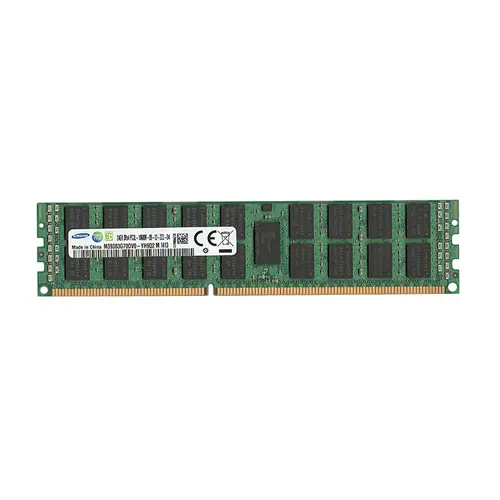
The M393B3G70DV0-YH9Q2 is a server-grade DDR3 RDIMM engineered for virtualization, in-memory databases, and data-integrity-sensitive workloads. Its registered signal architecture combined with ECC, a 24GB triple-rank x4 configuration, and low 1.35V operation delivers stable, error-resilient high-capacity memory expansion for legacy enterprise platforms.
1. A 24GB capacity per module enables higher memory density per server node, allowing more virtual machines to run concurrently without costly hardware expansion.
2. ECC protection detects and corrects single-bit errors in real time, preserving transactional data integrity for mission-critical enterprise applications.
3. Registered buffering stabilizes signal paths on fully loaded channels, ensuring reliable operation across large-scale memory configurations under constant load.
4. 1.35V low-voltage operation reduces datacenter power consumption and cooling demands, directly lowering operational expenditure in high-density deployments.
5. Triple Rank x4 interleaving sustains elevated bandwidth utilization, accelerating large dataset processing and in-memory database performance during peak workloads.
The Samsung M393B3G70DV0-YH9Q2 is a server-grade Registered DDR3 DIMM engineered for mission-critical enterprise environments where failure is simply not an option. Its most vital feature is Error Correcting Code (ECC) technology, which actively detects and corrects single-bit memory errors in real time, directly shielding virtualized clusters and in-memory databases like SAP HANA from silent data corruption that could crash dozens of virtual machines or poison a financial transaction. The Registered (RDIMM) design adds a hardware buffer on the address and command lines, stabilizing signal integrity when every slot across a 24-slot server is fully populated. This directly translates to the confidence of running 512GB or more of memory without intermittent boot failures or unexplained server hangs during peak loads. Operating at a low 1.35V, it significantly reduces the cumulative power draw and cooling overhead across a rack of hundreds of identical nodes, a tangible cost saving in a co-location data center. The Triple Rank x4 organization with CL9 latency strikes a deliberate balance between deep memory density and sustained bandwidth, ensuring your hypervisor can launch backup tasks or live-migrate large workloads without saturating the memory bus and choking primary application performance. For an IT manager, this module means predictable uptime and consistent latency under the heaviest multi-tenant workloads.
Server Memory Type Identified
Based on its RDIMM form factor, ECC, Registered signal type, 240-pin interface, and 1.35V low-voltage DDR3-1333 specification, part M393B3G70DV0-YH9Q2 is clearly a server-grade memory module. Below are capacity planning recommendations for three typical server workload scenarios using this 24 GB Triple Rank x4 module.
General Virtualization
Virtualized environments demand abundant, reliable memory to host numerous VMs without swapping. Deploy these 24 GB RDIMMs in a balanced, population-optimized configuration—typically six or eight identical modules per dual-socket server (one DIMM per channel) to achieve 144–192 GB of total capacity. The 1.35 V operation reduces data center power draw and cooling costs while ECC safeguards multi-tenant stability.
In-Memory Database
Databases like Redis or SAP HANA require maximum capacity and consistent latency. Populate every memory channel with at least one 24 GB module, and if the platform supports two DIMMs per channel, use matched pairs to reach 384 GB or more in a dual-socket system. The Registered ECC design ensures signal integrity at high capacities, and the low voltage helps manage thermals in dense 24/7 operation.
High-Performance Computing (HPC)
HPC clusters prioritize bandwidth and balanced per-node memory. Install one module per channel across all available memory channels to achieve symmetric interleaving—for a typical quad-channel platform, four 24 GB sticks yield 96 GB per node, avoiding performance penalties from over-population. The 1333 MHz speed is sufficient for many throughput-oriented workloads, while the large 24 GB capacity keeps core count-to-memory ratios favorable for parallel MPI jobs.
Rigorously tested for servers, compatible with Dell PowerEdge R720, HP ProLiant DL380p Gen8, IBM System x3650 M4.
Q: Can I mix this M393B3G70DV0-YH9Q2 with other memory modules of different brands or speeds?
A: Mixing brands or speeds is strongly discouraged for registered server memory. It risks instability, signal timing mismatches, and ECC errors. To maintain identical electrical loading, always install modules with the same part number, rank, and voltage.
Q: Is this M393B3G70DV0-YH9Q2 compatible with my server platform?
A: This is a 24GB DDR3-1333 registered ECC RDIMM (1.35V, triple rank x4). It suits dual-processor Intel/AMD servers that support low-voltage and high-rank loads. Please verify your motherboard's Qualified Vendor List and maximum rank per channel before purchasing.
Q: What is the recommended DIMM population order for optimal performance?
A: Populate balanced sets across memory channels, farthest slots from the CPU first. Follow your server manual's exact sequence to enable symmetric interleaving, balanced rank interleaving, and correct ECC functionality for maximum throughput and reliability.
Q: Does this module support overclocking or XMP profiles?
A: No. This is a JEDEC-compliant enterprise server RDIMM. Overclocking and XMP are not supported. It operates fixed at 1333MHz with CL9 timing to deliver predictable, stable performance and data integrity in mission-critical 24/7 environments.
Q: What warranty and typical failure rate can I expect?
A: This Samsung module carries a 1-year warranty. Built with rigorous enterprise-grade screening, its typical Annualized Failure Rate is well under 0.5% under specified server conditions, delivering high reliability for virtualized, database, and compute-intensive workloads.