











 Secure payments
Standard refund policy
Trade Assurance
Secure payments
Standard refund policy
Trade Assurance
| Model | M393B3G70BV0-YH9Q3 |
|---|---|
| Product Type | Memory Module |
| Compliance Standards | EU RoHS,FCC |
| Memory Capacity | 24 GB |
| Memory Technology | DDR3 |
| Product Voltage | 1.35V |
| RAM Speed | 1333MHz |
| RAM Standard | DDR3-1333/PC3-10600 |
| Error Identifying | ECC |
| Signal Type | Registered |
| Column Access Strobe (CAS) | CL9 |
| Rank | Triple Rank x4 |
| Quantity of Pins | 240-pin |
| RAM Genre | RDIMM |
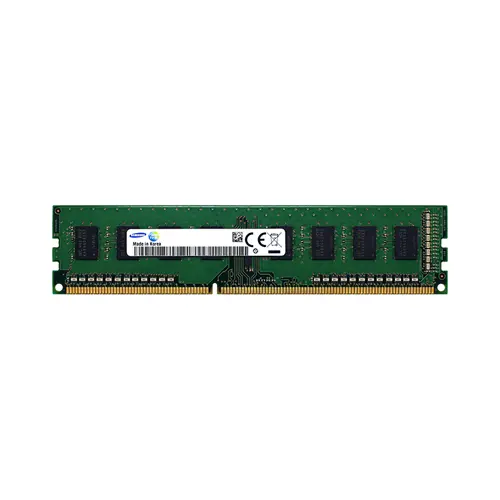
Designed as a server-grade DDR3-1333 Registered ECC module, this M393B3G70BV0-YH9Q3 is purpose-built for virtualization platforms and in-memory databases where data integrity and sustained uptime are non-negotiable. Its Triple Rank x4 organization, coupled with 1.35V low-voltage operation and CL9 latency, maximizes memory density per channel while maintaining signal stability in multi-DIMM configurations, ensuring reliable error correction under heavy enterprise workloads.
1. End-to-end error correction safeguards transactional data integrity, preventing silent data corruption in long-running enterprise databases and financial processing.
2. The registered signal architecture buffers command and address busses, maintaining electrical stability across fully populated server boards for maximum uptime.
3. Generous per-module capacity enables higher virtual machine consolidation ratios, optimizing licensing costs and floor space in dense data center racks.
4. Low-voltage operation drives down thermal dissipation and energy draw, measurably reducing cooling overhead in large-scale deployments.
5. Triple Rank x4 organization packs substantial density onto a single stick while balancing channel load, preserving consistent throughput for memory-intensive virtualization.
When you are running a dense virtualization cluster or an in-memory database, every bit of data matters. The Samsung M393B3G70BV0-YH9Q3 is engineered specifically for these mission-critical server environments. Its 24GB capacity, built on Triple Rank x4 organization, means you can pack more virtual machines or larger datasets onto a single node without sacrificing consistent latency, directly answering the pain of memory-bound database slowdowns.
The registered (RDIMM) architecture with ECC addresses two silent threats: signal degradation in fully-populated systems and cosmic-ray-induced bit flips. For a financial trading engine or a Redis cluster, a single undetected error can corrupt transactions or crash the entire service. The registered command buffer stabilizes signals across multiple DIMMs per channel, enabling reliable operation even with all 24 slots filled, while ECC actively corrects single-bit errors, preserving long-term computational integrity.
Additionally, the 1.35V ultra-low voltage serves dual purposes in a datacenter. It directly reduces power consumption and thermal load per DIMM, which, in a rack of hundreds of servers, translates to substantial energy savings and a wider margin against thermal throttling. Operating at DDR3-1333 with CL9 timings, this module offers the ideal balance of throughput and responsiveness, ensuring your SAP HANA instance or VMware farm maintains peak efficiency around the clock without compromising on stability.
General Virtualization
For hypervisor hosts running multiple VMs, memory capacity is key. Install six or eight identical 24GB RDIMMs per CPU to populate all memory channels, achieving 144–192 GB per socket for balanced density and bandwidth. Adhere to identical rank and part numbers to guarantee stable ECC and registered operation under mixed workloads.
In-Memory Database
In-memory databases demand maximum capacity and low latency. Deploy twelve 24GB modules in a dual-socket server to reach 288 GB or more, keeping channel symmetry for predictable performance. Triple-rank x4 modules provide high density per slot, but ensure BIOS supports the rank count at target speed to avoid clock-downs under full load.
High-Performance Computing (HPC)
HPC nodes favor bandwidth over pure capacity. Populate all available memory channels with one 24GB RDIMM per channel, delivering 1333 MHz with CL9 and registered signal integrity. For jobs sensitive to NUMA locality, distribute identical modules evenly across sockets to minimize remote access penalties and sustain peak floating-point throughput.
Rigorously tested server RAM, compatible with Dell PowerEdge R720/R620, HP DL380p Gen8, IBM x3650 M4.
Q: Can I mix this M393B3G70BV0-YH9Q3 with other memory modules of different brands or speeds?
A: Mixing is not recommended for server environments. All modules should be identical in brand, speed, rank, and timings to ensure signal integrity and prevent system instability.
Q: Is this memory compatible with my system?
A: This RDIMM is designed for Intel Xeon E5 series and AMD Opteron platforms supporting DDR3-1333 Registered ECC memory. Verify your server board supports 24GB Triple Rank x4 modules.
Q: What is the recommended DIMM population order for optimal performance?
A: Install identical DIMMs per memory channel, starting with the slots furthest from the CPU. Balance capacity across channels and populate in sets of three for Triple Channel architectures if supported.
Q: Does this module support overclocking or XMP profiles?
A: No. As a server-grade ECC Registered DIMM, it adheres to strict JEDEC standards for reliability. Overclocking and XMP are not supported nor advised in mission-critical environments.
Q: What warranty and typical failure rate can I expect?
A: This module carries a one-year warranty. Enterprise-class ECC memory typically exhibits an Annualized Failure Rate (AFR) well below 1% under specified operating conditions.