











 Secure payments
Standard refund policy
Trade Assurance
Secure payments
Standard refund policy
Trade Assurance
| Product Type | Memory Module |
|---|---|
| Memory Capacity | 256 GB |
| Memory Technology | DDR5 |
| Product Voltage | 1.1V |
| RAM Speed | 4800MHz |
| RAM Standard | DDR5-4800/PC5-38400 |
| Error Identifying | ECC |
| Signal Type | Registered |
| Column Access Strobe (CAS) | CL4 |
| Rank | Octal Rank x4 |
| Quantity of Pins | 288-pin |
| RAM Genre | RDIMM |
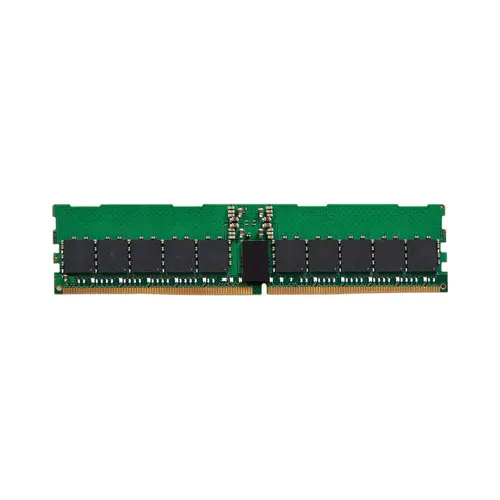
This 256GB DDR5-4800 Registered ECC RDIMM, with its octal-rank x4 organization and exceptionally low CL4 latency, is engineered for high-density enterprise servers and memory-intensive workloads such as large-scale virtualization and in-memory databases where data integrity and low access latency are paramount. The registered signal buffering ensures stable operation across high-capacity memory channels, while end-to-end ECC provides critical error correction to maintain reliability in mission-critical deployments.
1. The massive memory capacity per module enables exceptional virtual machine density, allowing data centers to consolidate heavy workloads without sacrificing performance.
2. DDR5 technology doubles the burst length and improves power efficiency, delivering higher sustainable bandwidth for in-memory databases and real-time analytics.
3. The Registered signal type stabilizes command and address signals across heavily populated server boards, ensuring reliable operation even with all DIMM slots filled.
4. ECC protection autonomously corrects single-bit memory errors, preserving data integrity in mission-critical financial transactions and preventing silent corruption in long-running compute tasks.
5. Octal Rank x4 organization maximizes capacity while maintaining adequate bank interleaving, keeping background refresh overhead minimal under demanding multi-tenant cloud environments.
When deploying dense virtualization clusters or running in-memory databases like SAP HANA, server memory is pushed to its absolute limits—and that’s where the M321RBGA0B40-CWK RDIMM proves its worth. This DDR5 module packs 256GB of capacity, enabling you to allocate massive memory pools to hundreds of VMs on a single host without swapping to slower storage. The registered architecture buffers command and control signals, preserving signal integrity even when all 16 DIMM slots are populated—critical for maintaining stability in scale-up database servers. Its ECC engine constantly corrects single-bit errors, a non-negotiable safeguard for financial transaction processing where a silent bit-flip can corrupt ledger data. Meanwhile, the octal-rank design and 4800MT/s bandwidth keep latency low under concurrent access patterns, such as dozens of analytics queries hitting an in-memory column store simultaneously. At just 1.1V, the module also trims power and cooling costs across a rack full of nodes—meaning a virtualized private cloud can scale without thermal headaches. In short, this memory turns unpredictable workloads into reliable, always-consistent outcomes.
General Virtualization
For dense virtualization hosts, populate all available memory channels with identical 256GB RDIMMs to maximize capacity while maintaining balanced interleaving. A typical dual-socket server with 16 DIMM slots can reach 4TB using sixteen modules, comfortably supporting hundreds of virtual machines. Favor 4800MHz speed but be prepared to step down to one DIMM per channel if the platform enforces lower frequencies at higher capacities.
In-Memory Database
In-memory databases such as SAP HANA or Redis demand both massive capacity and uncompromised reliability. Deploy these ECC Registered modules in a fully mirrored or sparing configuration, using at least two modules per channel for redundancy if the platform supports memory mirroring. Target 2TB per socket as a baseline, scaling linearly with data volume, and ensure every module is identical to avoid NUMA imbalances.
High-Performance Computing (HPC)
HPC workloads require peak bandwidth; install exactly one 256GB RDIMM per memory channel to maintain the highest possible 4800MT/s speed and eight-channel interleaving. For a dual-socket server with sixteen channels, this yields 4TB of balanced, low-latency memory. Avoid populating additional DIMMs per channel, as the Octal Rank x4 design already provides deep rank interleaving, and adding a second module would force a frequency drop on most platforms.
Strictly tested DDR5 ECC RDIMM. Compatible with Dell PowerEdge R760, HPE ProLiant DL380 Gen11, Lenovo ThinkSystem SR650 V3, and Supermicro servers.
Q: Can I mix this M321RBGA0B40-CWK with other memory modules of different brands or speeds?
A: Mixing is not recommended for registered server memory. Mismatched brands, ranks, or speeds can cause signal integrity issues and system instability. Always use identical modules for validated reliability.
Q: Is this memory compatible with my system?
A: This DDR5-4800 ECC RDIMM is designed for server platforms supporting registered DIMMs. Verify your Intel Xeon or AMD EPYC motherboard’s QVL and ensure it accepts 256GB Octal Rank x4 modules.
Q: What is the recommended DIMM population order for optimal performance?
A: Populate identical modules per channel, starting with the farthest slot from the CPU. For Octal Rank modules, follow your server vendor’s population guide to balance memory channels and avoid capacity downgrades.
Q: Does this module support overclocking or XMP profiles?
A: No. This registered ECC server DIMM adheres strictly to JEDEC DDR5-4800 specifications. It does not support XMP or overclocking, as server environments prioritize data integrity over speed.
Q: What warranty and typical failure rate can I expect?
A: This module includes a one-year warranty. Enterprise-grade ECC RDIMMs maintain an annualized failure rate (AFR) typically below 0.5%, ensuring high reliability for 24/7 operation.