











 Secure payments
Standard refund policy
Trade Assurance
Secure payments
Standard refund policy
Trade Assurance
| Product Type | Memory Module |
|---|---|
| Memory Capacity | 256 GB |
| Memory Technology | DDR5 |
| Product Voltage | 1.1 V |
| RAM Speed | 6400 MHz |
| RAM Standard | DDR5-6400/PC5-51200 |
| Error Identifying | ECC |
| Signal Type | Registered |
| Column Access Strobe (CAS) | CL40 |
| Rank | Quad Rank x4 |
| Quantity of Pins | 288-pin |
| RAM Genre | DIMM |
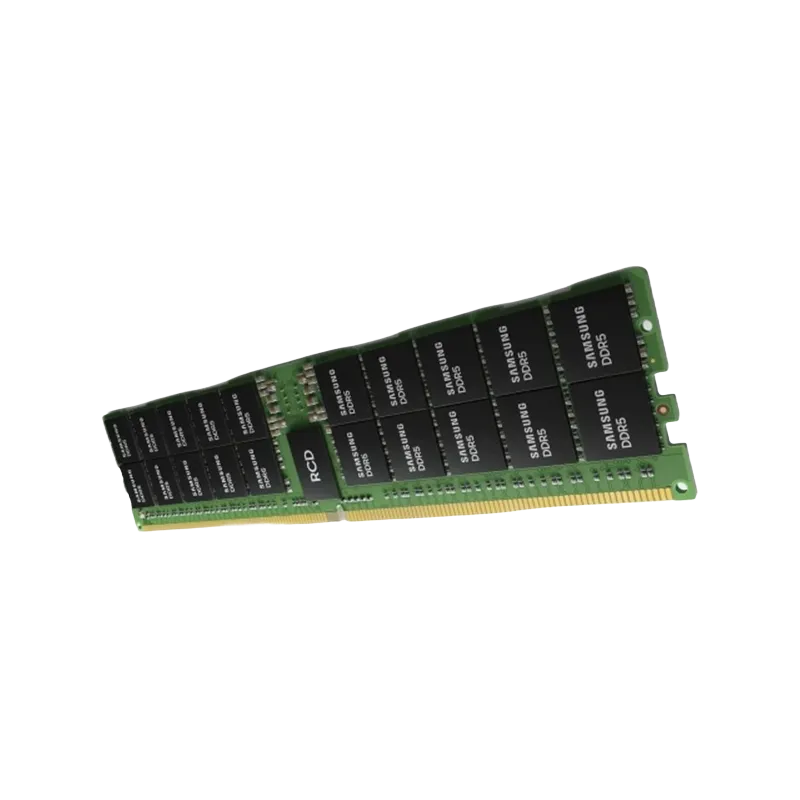
This 256GB DDR5-6400 Registered ECC DIMM is purpose‑built for enterprise servers handling memory‑intensive workloads such as virtualization, large‑scale in‑memory databases, and mission‑critical data analytics where data integrity cannot be compromised. The quad‑rank x4 configuration maximizes per‑channel capacity within tight power budgets, while the registered interface stabilizes signal integrity in high‑density deployments and on‑die ECC corrects single‑bit errors to safeguard long‑running operations.
1. A massive 256GB capacity per module enables entire databases and hypervisor pools to reside in memory, accelerating transaction processing and eliminating disk swap latency under heavy virtualization.
2. Operating at 6400MT/s, this module delivers the elevated bandwidth needed to feed multi-core CPUs in parallel, keeping real-time analytics and AI inference pipelines running without data starvation.
3. Integrated ECC actively corrects single-bit faults and detects multi-bit errors, ensuring silent data corruption never compromises mission-critical financial or medical records.
4. Registered signal buffering decouples the memory controller from raw DIMM loading, allowing multiple modules to operate reliably in dense server nodes without signal integrity collapse.
5. Quad Rank x4 design packs maximum bit density into a single slot, giving hyper-converged and cloud-native platforms the headroom to support hundreds of virtual machines per host without sacrificing channel balance.
The M321RBJA0M22-CLPWF is a DDR5 Registered DIMM engineered for enterprise servers, where uptime and data integrity are non‑negotiable. Its four defining characteristics translate directly into real‑world resilience and performance.
The 256 GB capacity built from Quad Rank x4 organization lets you consolidate more virtual machines per host in a VMware or KVM cluster. Instead of adding physical nodes, you can scale dense workloads on a single server, reducing licensing and floor space costs. Registered signaling buffers the command and address buses, so even when you fully populate all memory channels, signal integrity remains pristine—critical for multi‑socket platforms running in‑memory databases like SAP HANA or Redis, where every module must communicate without timing errors.
Meanwhile, ECC scrubs single‑bit errors on the fly, preventing silent data corruption that could crash a financial transaction or a real‑time analytics pipeline. This is not just about crash protection; it preserves the trustworthiness of your results over months of continuous operation. The DDR5‑6400 speed with CL40 latency ensures that massive datasets flow swiftly to the CPU, cutting query response times in data‑intensive applications. For the IT manager, this means higher consolidation ratios, bulletproof stability, and the bandwidth to keep latency‑sensitive services fast under load.
General Virtualization
For a balanced virtualized host, install two 256GB RDIMMs (512GB total) in a dual-channel or eight-channel configuration, populating one DIMM per channel to maintain the rated DDR5‑6400 speed. This provides ample capacity for dozens of VMs while preserving full memory bandwidth, avoiding the speed downgrade that occurs when running multiple quad‑rank DIMMs on the same channel.
In‑Memory Database
Maximize capacity and parallelism by populating all available memory channels with one 256GB quad‑rank RDIMM each—yielding 2TB or more on an 8‑channel server. The Registered ECC ensures data integrity under constant write pressure, and the large rank count per DIMM delivers high bank‑level parallelism for low‑latency, high‑throughput in‑memory workloads. Avoid dual‑DIMM‑per‑channel configurations to prevent clock speed penalties.
High‑Performance Computing
Fill every memory channel with a single 256GB module to extract peak sustained bandwidth at DDR5‑6400, critical for simulation and modeling codes. The ECC RDIMMs eliminate silent data corruption during week‑long runs, while the CL40 latency and quad‑rank x4 organization offer predictable access patterns. For extremely bandwidth‑sensitive HPC clusters, consider limiting capacity per node and scaling out horizontally instead of relaxing clock frequencies.
Rigorously tested server memory compatible with Dell PowerEdge R760, HPE ProLiant DL380 Gen11, Lenovo ThinkSystem SR650 V3, and Supermicro SYS-220U-MTNR.
Q: Can I mix this M321RBJA0M22-CLPWF with other memory modules of different brands or speeds?
A: Mixing with other modules is not recommended for registered server memory. It can cause system instability, signal integrity issues, and may force all DIMMs to the lowest common speed, negating the 6400MT/s performance.
Q: Is this memory compatible with my system?
A: This 256GB DDR5-6400 registered DIMM targets current-gen AMD EPYC and Intel Xeon Scalable server platforms. Please verify your motherboard supports 288-pin DDR5 RDIMMs with 256GB quad-rank x4 capacity specifically.
Q: What is the recommended DIMM population order for optimal performance?
A: Populate identically across memory channels, following your server board's guidelines. Typically, install one DIMM per channel first, balancing Quad Rank loads. Consult your platform’s memory population guide for symmetric channel configuration.
Q: Does this module support overclocking or XMP profiles?
A: No, this registered ECC server memory does not support overclocking or XMP 3.0 profiles. It operates exclusively at JEDEC standard DDR5-6400 timings with CL40, prioritizing data integrity and mission-critical stability over speed tuning.
Q: What warranty and typical failure rate can I expect?
A: This module includes a one-year warranty. Enterprise-grade DDR5 RDIMMs exhibit very low annualized failure rates (typically <0.5%) under proper conditions, backed by rigorous testing for 24/7 operation and ECC protection against single-bit errors.