











 Secure payments
Standard refund policy
Trade Assurance
Secure payments
Standard refund policy
Trade Assurance
| Product Type | Memory Module |
|---|---|
| Memory Capacity | 256 GB |
| Memory Technology | DDR5 |
| Product Voltage | 1.1 V |
| RAM Speed | 6400 MHz |
| RAM Standard | DDR5-6400/PC5-51200 |
| Error Identifying | ECC |
| Signal Type | Registered |
| Column Access Strobe (CAS) | CL40 |
| Rank | Quad Rank x4 |
| Quantity of Pins | 288-pin |
| RAM Genre | DIMM |
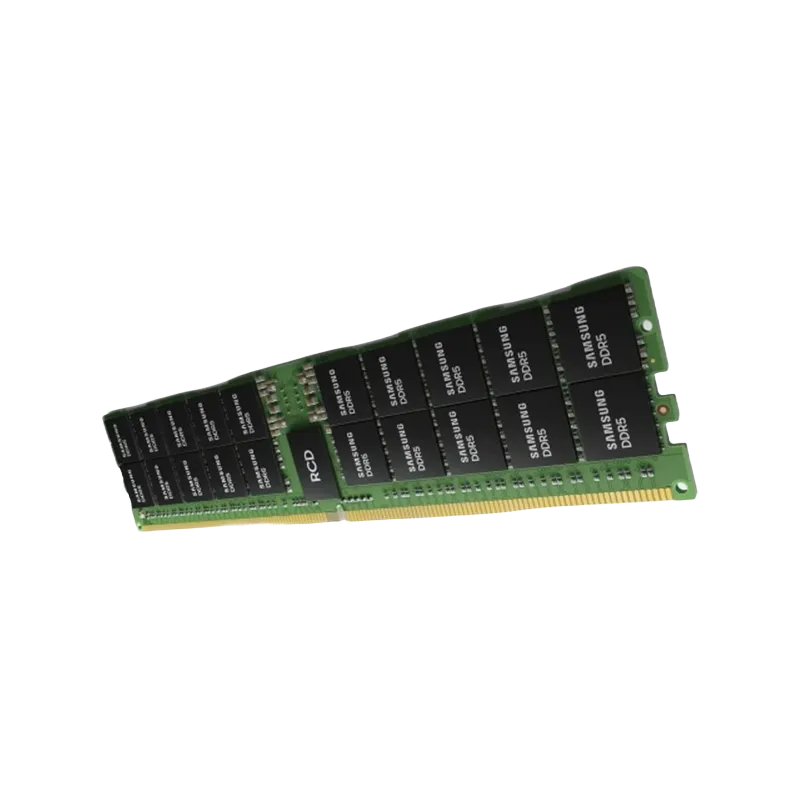
Designed specifically for enterprise servers and high-density computing platforms, this 256GB DDR5-6400 Registered DIMM with ECC ensures uncompromised data integrity for memory-intensive workloads such as large-scale virtualization, in-memory databases, and real-time analytics. Its quad-rank x4 configuration maximizes capacity per channel while the registered signal type maintains robust signal integrity across fully populated memory banks, delivering both massive memory footprint and reliable, low-latency performance at CL40.
1. Massive per-module density empowers a single server to host expansive in-memory databases and extreme VM consolidation, directly reducing licensing and hardware footprint.
2. DDR5 architecture multiplies bank groups and integrates on-die ECC, hardening data integrity for latency-sensitive enterprise workloads that cannot tolerate downtime.
3. Blazing transfer rates unlock the full throughput required for real-time analytics and AI inference, ensuring processors are never starved of data.
4. Proprietary ECC scrubbing eliminates silent bit flips in financial transactions and scientific computations, turning undetected errors into measurable trust.
5. Registered clocking buffers decouple the command bus from heavy load, preserving crisp signal timing across densely populated multi-socket servers.
Based on its 288-pin DIMM form factor, Registered signal type, and ECC, the M321RBJA0M22-CLPGL is unequivocally a server-class memory module built for mission-critical enterprise workloads. Its four defining characteristics directly address the real pain points of data center operators and system architects.
The 256GB capacity, achieved through quad-rank x4 organization, means a single stick can shrink memory-hungry virtualization clusters. Instead of populating every slot for a basic hypervisor host, you can allocate massive memory pools to dozens of VMs without sacrificing density, leaving room for growth. ECC becomes non-negotiable here: in a 24/7 virtualized environment, a single bit flip in a guest’s kernel memory space can cascade into silent data corruption or node failure. ECC scrubbing catches and corrects these errors in real time, safeguarding uptime. The Registered signal buffer then stabilizes this enormous capacity, re-driving address and command signals so the CPU’s memory controller can reliably drive multiple quad-rank DIMMs per channel without signal degradation—critical when you need to scale to terabytes in a single chassis.
Meanwhile, the DDR5-6400 speed with CL40 latency delivers tangible performance for in-memory databases like SAP HANA or Redis. Analytical queries and real-time transactions feast on the 51.2 GB/s peak bandwidth, where quad-rank interleaving stealthily reduces latency by pipelining accesses across internal banks. This combination means faster financial simulations, real-time fraud detection, and smooth concurrent user loads. Your database does not just fit in memory; it flies, making every microsecond of latency reduction count toward faster business decisions.
General Virtualization
This 256GB DDR5-6400 Registered DIMM with ECC is ideal for dense virtualization hosts. Populate servers with at least one module per memory channel to maximize bandwidth, then scale to multiple modules as VM counts grow. For a dual-socket system, installing eight such modules provides 2TB of fault-tolerant capacity, comfortably supporting hundreds of moderate VMs while leaving headroom for memory overcommit.
In-Memory Database
In-memory databases like Redis or SAP HANA demand both high capacity and data integrity, making this Quad Rank x4 ECC module an excellent fit. Deploy modules in sets that saturate the platform’s memory channels to achieve the lowest latency and highest throughput. For a 4‑channel server, a balanced configuration of four 256GB DIMMs delivers 1TB, enabling large dataset caching without swapping and ensuring continuous availability through error correction.
High-Performance Computing
HPC workloads benefit from the massive bandwidth of this DDR5-6400 module when installed in a fully balanced, identical‑module configuration across all channels. Use six or eight modules per node to deliver several terabytes of memory with uniform access latency for parallel simulations and large‑scale data analysis. The Registered ECC signaling maintains stability through long‑running computational jobs, reducing silent data corruption risks in cluster environments.
Rigorously tested, compatible with Dell PowerEdge R760, HPE ProLiant DL380 Gen11, Lenovo ThinkSystem SR650 V3, and more.
Q: Can I mix this M321RBJA0M22-CLPGL with other memory modules of different brands or speeds?
A: Mixing is not recommended. Combining Registered DIMMs of different brands, speeds, or ranks can cause signal integrity issues and system instability in server environments. For optimal reliability, use identical modules across all channels.
Q: Is this memory compatible with my system?
A: This 256GB DDR5-6400 Registered ECC DIMM is designed for server platforms supporting DDR5 Registered DIMMs, such as AMD EPYC 9004/9005 or Intel Xeon Scalable (4th Gen and later). Please verify the motherboard’s qualified vendor list to confirm support.
Q: What is the recommended DIMM population order for optimal performance?
A: Always follow your server board’s population guide. Generally, populate the first DIMM slot in each memory channel (often marked white or blue) to balance load across controllers. This Quad Rank x4 module performs best with one DIMM per channel.
Q: Does this module support overclocking or XMP profiles?
A: No. As a server-class Registered ECC DIMM, it operates strictly at JEDEC standard DDR5-6400 with a fixed CL40 latency. Overclocking and XMP profiles are not supported; the focus is on stability and data integrity.
Q: What warranty and typical failure rate can I expect?
A: This module includes a 1-year warranty. Enterprise-grade Registered ECC memory exhibits very low failure rates under normal operating conditions, typically an annualized failure rate (AFR) well below 0.5% when properly cooled.