











 Secure payments
Standard refund policy
Trade Assurance
Secure payments
Standard refund policy
Trade Assurance
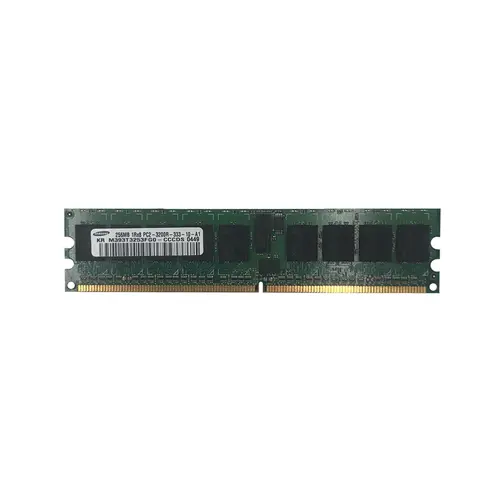
| Model | M393T3253FG0-CCCDS |
|---|---|
| Product Type | Memory Module |
| Compliance Standards | EU RoHS,FCC |
| Memory Capacity | 256 MB |
| Memory Technology | DDR2 |
| Product Voltage | 1.8V |
| RAM Speed | 400MHz |
| RAM Standard | DDR2-400/PC2-3200 |
| Error Identifying | ECC |
| Signal Type | Registered |
| Column Access Strobe (CAS) | CL3 |
| Rank | Single Rank x8 |
| Quantity of Pins | 240-pin |
| RAM Genre | RDIMM |
Designed for legacy server platforms, this Samsung M393T3253FG0-CCCDS 256MB DDR2-400 Registered ECC DIMM ensures data integrity in memory-intensive enterprise workloads such as virtualization and in-memory databases thanks to its registered signal buffering and single-rank x8 organization, which reduces electrical loading on the memory bus. Its CL3 latency and 240-pin RDIMM form factor deliver predictable, stable operation on systems requiring ECC protection for mission-critical data.
1. ECC protection eliminates silent data corruption at the hardware level, a critical safety net for financial ledgers and patient databases where even a single-bit error is unacceptable.
2. Registered buffering decouples the memory chips from the system bus, ensuring stable signal integrity when populating all available DIMM slots in a mission-critical multi-processor server.
3. Compact capacity fits dedicated appliance or embedded server roles, keeping the trusted computing base small and maximizing reliability for single-function workloads like VPN gateways.
4. Single-rank architecture minimizes electrical loading on the memory channel, which helps maintain consistent command timing and error-free operation in densely populated rack configurations.
5. Aggressive CAS latency reduces the cycle penalty on cache misses, delivering faster random data access for low-latency database queries and time-sensitive virtualized services.
The Samsung M393T3253FG0-CCCDS is a server-class DDR2-400 Registered ECC DIMM engineered for legacy infrastructures where every calculation counts. In a virtualization cluster, its Error-Correcting Code is not a luxury but a frontline defense: a single uncorrected bit flip in a hypervisor stack can silently corrupt multiple guest operating systems, turning routine server consolidation into a cascade of unexplained crashes. ECC catches and corrects those single-bit errors in real time, preserving workload integrity. Meanwhile, the Registered signal buffer addresses the density dilemma faced by aging virtualization hosts. By re-driving address and command signals, it enables stable population of all available slots, allowing older servers to reach maximum memory capacity for more virtual machines without signal degradation. In an in-memory database like Redis, that stability pairs with the module’s CL3 latency. Lower CAS latency means the CPU spends fewer cycles waiting for data; for a financial trading cache or session store, this directly translates into tens of thousands of additional transactions per second. Finally, the single-rank x8 layout and 1.8V operation keep power draw and heat generation in check within dense 1U or blade chassis, reducing throttling risk during sustained analytical workloads. For data center teams extending the life of mission-critical systems, this RDIMM transforms an aging platform into a still-dependable engine for virtualized services and high-speed data caching.
Server Memory – DDR2-400 ECC Registered RDIMMs (256 MB per module)
General Virtualization
Virtualization on this platform is limited to lightweight, isolated services. With only 256 MB per stick, you should populate all available DIMM slots to maximize total RAM. For a typical dual-socket server with 16 slots, 16 modules yield 4 GB — sufficient for a small hypervisor and a handful of minimal guests (e.g., 512 MB each). Always install modules in matching sets per memory channel to maintain balanced interleaving.
In-Memory Database
In-memory databases demand large, contiguous address space, so 256 MB modules constrain you to very small datasets. Install the maximum physical modules the board supports (e.g., 8–16 sticks) to reach 2–4 GB. Plan for data sets that fit entirely within this boundary, and use a single rank x8 configuration per channel to reduce electrical loading. Consider application-level sharding if more capacity is required.
High-Performance Computing
HPC workloads benefit from ECC reliability but need bandwidth. Populate all memory channels symmetrically — typically two RDIMMs per channel if the chipset allows — to enable dual-channel or quad-channel interleaving. This yields aggregate capacity of 2–4 GB per node. Keep the ranks identical (single rank x8) to avoid timing penalties. For memory-bound codes, the 400 MHz speed is the primary bottleneck; fill all slots first, then tune access patterns for cache reuse rather than raw capacity.
Rigorously tested server memory, validated for Dell PowerEdge 2950, HP ProLiant DL380 G5, IBM System x3650.
Q: Can I mix this M393T3253FG0-CCCDS with other memory modules of different brands or speeds?
A: Mixing is not recommended. This DDR2-400 ECC Registered RDIMM requires identical speed, rank, and timings to ensure signal integrity. Mismatched modules may cause boot failures or data corruption.
Q: Is this memory compatible with my system?
A: It fits legacy server platforms using DDR2-400 ECC Registered memory, such as Intel 5000 series chipsets or AMD Socket F. Always verify your board's qualified vendor list for 240-pin RDIMM support.
Q: What is the recommended DIMM population order for optimal performance?
A: Populate identical DIMMs in matching channels and use a balanced configuration. Typically, fill the slots farthest from the CPU first, then expand symmetrically across memory branches for optimal bandwidth.
Q: Does this module support overclocking or XMP profiles?
A: No. This server-grade registered DIMM adheres to JEDEC DDR2-400 standards (CL3) for stability. It does not support overclocking, XMP, or any non-standard voltage or frequency scaling.
Q: What warranty and typical failure rate can I expect?
A: It includes a one-year warranty. The module undergoes rigorous component screening and burn-in testing to ensure an extremely low annualized failure rate in 24/7 enterprise environments.