











 Secure payments
Standard refund policy
Trade Assurance
Secure payments
Standard refund policy
Trade Assurance
| Model | M393B5670DZ1-CH9 |
|---|---|
| Product Type | Memory Module |
| Compliance Standards | EU RoHS,FCC |
| Memory Capacity | 2 GB |
| Memory Technology | DDR3 |
| Product Voltage | 1.5V |
| RAM Speed | 1333MHz |
| RAM Standard | DDR3-1333/PC3-10600 |
| Error Identifying | ECC |
| Signal Type | Registered |
| Column Access Strobe (CAS) | CL9 |
| Rank | Single Rank x4 |
| Quantity of Pins | 240-pin |
| RAM Genre | RDIMM |
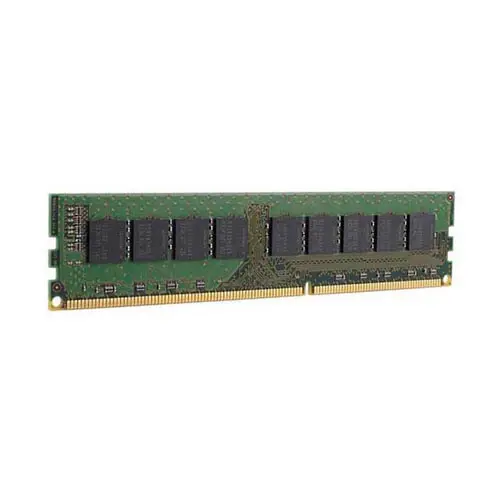
The M393B5670DZ1-CH9 is a DDR3-1333 registered ECC memory module designed for server platforms, making it ideal for mission‑critical workloads such as virtualization and in‑memory databases where data integrity is paramount. Its single‑rank x4 configuration and registered signal type reduce electrical loading on the memory bus, ensuring stable operation and reliable error correction across fully populated server systems.
1. ECC protection continuously detects and corrects single-bit memory faults, ensuring uncompromised data integrity for always-on financial ledgers and database transactions.
2. Register logic on the RDIMM buffers command and address signals, allowing dense multi-DIMM configurations that maximize memory capacity in virtualization hosts without signal degradation.
3. The balanced data rate supplies steady throughput for concurrent enterprise workloads, preventing memory bandwidth bottlenecks under moderate multi-threaded processing.
4. Single Rank x4 organization optimizes burst access granularity, sustaining higher command efficiency and lowering transactional latency during heavy VM consolidation.
5. Tight column access latency speeds up data retrieval directly, sharpening response times for latency-sensitive OLTP engines and real-time analytics platforms.
Designed for server workloads, the Samsung M393B5670DZ1-CH9 is a DDR3 Registered DIMM whose four defining attributes translate directly into operational resilience. ECC memory actively corrects single‑bit errors, preventing the silent data corruption that can crash a hypervisor hosting dozens of virtual machines or poison query results in an in‑memory analytics platform. The registered buffer re‑drives address and command lines, so you can populate every memory channel without signal degradation—critical when scaling a virtualization cluster to support hundreds of VMs with terabytes of RAM. Its 1333MHz speed and CL9 latency ensure consistent bandwidth, meaning a Redis or Memcached instance retrieves data with minimal delay and keeps transaction engines at peak throughput. Furthermore, the single‑rank x4 organization lowers bus loading and enables efficient rank interleaving, boosting concurrent access speeds as you install multiple modules. Together, these characteristics deliver the data integrity, massive scalability, and responsive performance that enterprise data centers rely on to run critical services uninterrupted.
Memory Type: Server (DDR3-1333 ECC Registered RDIMM)
General Virtualization
Populate all memory channels with identical 2GB RDIMMs for optimum stability. A baseline configuration of 8 modules (16GB total) supports light VM workloads with interleaving enabled. For moderate consolidation, scale to 16–18 modules (32–36GB) evenly across channels, maintaining ECC protection and balanced access. Avoid mixing capacities to prevent clocking penalties.
In-Memory Database
Capacity is paramount for in‑memory databases. Maximize module count by filling every available slot, often 18 or 24 DIMMs (36–48GB total), while respecting platform population rules. With single‑rank 2GB sticks, populate three per channel only if the system retains 1333MHz; otherwise, use two per channel for consistent latency. Configure NUMA‑aware interleaving on multi‑socket nodes to avoid remote memory hotspots.
High-Performance Computing (HPC)
Bandwidth and error resilience drive HPC designs. Install 6–12 modules (12–24GB) in symmetric, one‑DIMM‑per‑channel arrangements to sustain full DDR3‑1333 speed. The registered ECC safeguards data during extended parallel runs. For memory‑bound workloads, fill all slots while observing down‑clocking limits; this 2GB capacity suits compute‑dense, capacity‑light simulations where many threads share modest memory footprints.
Rigorously tested server memory, compatible with Dell PowerEdge R720, HP DL380p Gen8, and similar systems.
Q: Can I mix this M393B5670DZ1-CH9 with other memory modules of different brands or speeds?
A: Mixing brands or speeds is not advised in server environments. Mismatched DIMMs can degrade ECC protection, cause system instability, and increase the risk of undetected memory errors. Identical modules are strongly recommended.
Q: Is this memory compatible with my system?
A: This DDR3-1333 Registered ECC RDIMM targets server boards based on Intel Xeon 5500/5600 or AMD Opteron 6100 series platforms. Please consult your motherboard's qualified vendor list to confirm full compatibility and population rules.
Q: What is the recommended DIMM population order for optimal performance?
A: Populate memory channels symmetrically, installing identical DIMMs per channel in the slots furthest from the CPU first. For three-channel platforms, use matched triplets; for quad-channel, populate four modules to maximize bandwidth.
Q: Does this module support overclocking or XMP profiles?
A: No. This server-grade module adheres strictly to JEDEC DDR3-1333 standards at CL9 and 1.5V. Overclocking and XMP are not supported to maintain absolute data integrity and 24/7 operational reliability.
Q: What warranty and typical failure rate can I expect?
A: It carries a 1-year warranty. Built to enterprise-grade specifications, typical annualized failure rates are below 0.5%, ensuring robust, long-term dependability in demanding server environments.