











 Secure payments
Standard refund policy
Trade Assurance
Secure payments
Standard refund policy
Trade Assurance
| Model | M393B5673DZ1-CH9Q1 |
|---|---|
| Product Type | Memory Module |
| Compliance Standards | EU RoHS,FCC |
| Memory Capacity | 2 GB |
| Memory Technology | DDR3 |
| Product Voltage | 1.5V |
| RAM Speed | 1333MHz |
| RAM Standard | DDR3-1333/PC3-10600 |
| Error Identifying | ECC |
| Signal Type | Registered |
| Column Access Strobe (CAS) | CL9 |
| Rank | Dual Rank x8 |
| Quantity of Pins | 240-pin |
| RAM Genre | RDIMM |
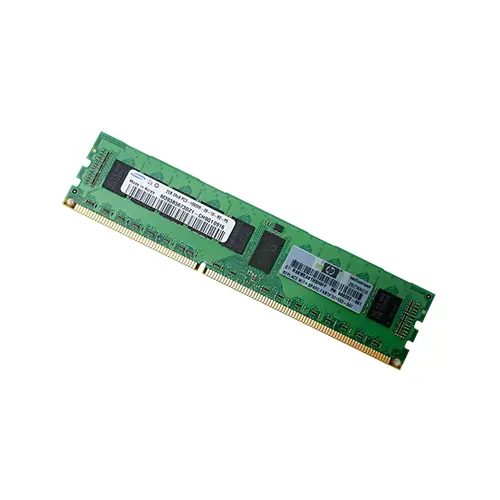
This M393B5673DZ1-CH9Q1 is a DDR3-1333 registered ECC RDIMM optimized for server platforms running memory-intensive workloads such as virtualization and in-memory databases, where its dual-rank x8 organization enhances bandwidth utilization while the ECC engine ensures end-to-end data integrity. The registered signal type stabilizes high-density memory configurations by reducing electrical loading on the memory controller, and the CL9 latency delivers responsive performance under sustained enterprise loads.
1. On-the-fly error correction prevents single-bit memory faults from escalating into system crashes, a non-negotiable requirement for mission-critical database servers.
2. A register driver buffers address and command signals, stabilizing signal integrity when populating all DIMM slots in a rack-dense server chassis.
3. Dual ranks of x8 DRAM devices enable rank interleaving that reduces row conflict latency, boosting throughput for heavily consolidated hypervisor environments.
4. Operating at 1333 MHz, this RDIMM supplies consistent PC3‑10600 bandwidth to keep latency-sensitive financial transaction engines running smoothly.
5. A 2 GB capacity per stick allows IT operators to fine-tune memory allocation for lightweight container hosts without over-provisioning costly capacity.
The Samsung M393B5673DZ1-CH9Q1 is a DDR3-1333 Registered ECC RDIMM purpose-built to resolve the most unforgiving reliability challenges in server environments. Its four defining characteristics—ECC error correction, registered signal buffering, dual-rank interleaving, and standard 1333MHz CAS 9 timing—translate directly into tangible uptime and performance that IT professionals demand. ECC is non-negotiable in virtualized clusters and in-memory databases like Redis: a single bit-flip can silently corrupt hypervisor states or transactional records, triggering cascading VM failures or data integrity disasters. Registered signaling buffers the command and address bus, allowing a 24‑slot server to populate all DIMMs with clean signals and maintain unshakable stability even under heavy virtualization density. The dual‑rank x8 architecture leverages interleaving to boost bandwidth, which means when multiple VMs or database queries contend for memory, you experience lower latency and consistent throughput without bottlenecks. The verified 1333MHz speed and CL9 latency deliver validated, worry‑free operation on legacy platforms still running mission‑critical workloads. With its 2GB capacity, this module represents a sensible, cost‑effective upgrade that safeguards uptime and preserves data integrity for aging but indispensable infrastructure.
General Virtualization
For a typical dual-socket virtualization host, populate at least six to twelve of these 2GB RDIMMs evenly across memory channels to deliver 12–24GB of RAM. This capacity supports 8–15 light to moderate virtual machines, balancing density and cost. If higher consolidation ratios are required, supplement with larger-capacity RDIMMs in the remaining slots rather than exceeding 16 modules of this 2GB type, as that can limit upgrade headroom.
In-Memory Database
In-memory databases demand low latency and high capacity. Use these 2GB Registered ECC modules to fill all available DIMM slots on a platform that supports large module counts—for example, 18 modules yielding 36GB for a small Redis or Memcached instance. For production-grade workloads exceeding 128GB, replace these with 8GB or 16GB RDIMMs in the same 240-pin DDR3 footprint, but retain a few of the 2GB modules for low-cost test or staging environments where absolute capacity is secondary.
High-Performance Computing
HPC nodes benefit from balanced memory bandwidth. Install one 2GB DIMM per memory channel (e.g., six modules for a triple-channel platform, eight for quad-channel) to populate all channels symmetrically, achieving 12–16GB with maximum throughput. This configuration suits moderate-scale MPI tasks or GPU offload nodes where memory per core is modest. For memory-bound HPC applications, prefer higher-density RDIMMs to reach 32GB or more without sacrificing channel population rules.
This rigorously tested server memory is compatible with Dell PowerEdge R710, HP ProLiant DL380 G7, and Lenovo ThinkServer RD430.
Q: Can I mix this M393B5673DZ1-CH9Q1 with other memory modules of different brands or speeds?
A: Mixing modules of different brands or speeds is not recommended in server environments. For guaranteed stability and ECC integrity, always populate with identical Samsung M393B5673DZ1-CH9Q1 DIMMs.
Q: Is this memory compatible with my system?
A: It is compatible with DDR3-1333 Registered ECC platforms, including Intel Xeon 5500/5600 series and AMD Opteron 6000 series. Please verify that your board supports RDIMM and consult the qualified vendor list.
Q: What is the recommended DIMM population order for optimal performance?
A: Populate DIMMs starting with the slots farthest from the CPU in each channel, balancing identical modules across channels. For detailed slot numbers, always follow your server motherboard’s population guide.
Q: Does this module support overclocking or XMP profiles?
A: No, this DDR3 Registered ECC module does not support XMP or overclocking. It runs strictly at the JEDEC standard 1333MHz with CL9 timing, prioritizing reliability and data integrity over performance tuning.
Q: What warranty and typical failure rate can I expect?
A: This module carries a 1-year warranty. As a Samsung enterprise-grade ECC RDIMM, it delivers excellent reliability with a very low annualized failure rate (AFR), typically well under 0.5% under normal operating conditions.