











 Secure payments
Standard refund policy
Trade Assurance
Secure payments
Standard refund policy
Trade Assurance
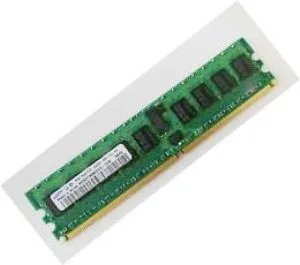
| Model | M395T5750CZ4-CE60 |
|---|---|
| Product Type | Memory Module |
| Compliance Standards | |
| Memory Capacity | 2 GB |
| Memory Technology | DDR2 |
| Product Voltage | 1.8V |
| RAM Speed | 667MHz |
| RAM Standard | DDR2-667/PC2-5300 |
| Error Identifying | ECC |
| Signal Type | Fully Buffered |
| Column Access Strobe (CAS) | CL5 |
| Rank | Dual Rank x4 |
| Quantity of Pins | 240-pin |
| RAM Genre | FB-DIMM |
This FB-DIMM module, with its Fully Buffered architecture and ECC, is engineered for legacy server platforms where data integrity and high memory capacity under heavy multi-rank configurations are critical. Its Dual Rank x4 organization and CL5 latency deliver stable, reliable throughput for memory-intensive workloads such as virtualization and in-memory databases on older Xeon-based systems.
1. ECC protection actively detects and corrects single-bit memory errors in real time, eliminating silent data corruption risks that would otherwise jeopardize financial transactions or database integrity.
2. Fully Buffered serial interface decouples the memory bus from electrical loading, allowing massive capacity scaling without signal degradation in densely consolidated server racks.
3. Dual Rank x4 organization interleaves accesses across internal banks, keeping data pipelines fully utilized and reducing latency spikes under heavy virtualization mix-loads.
4. A 2 GB module density hits the sweet spot for populating numerous DIMM slots, granting hypervisors ample headroom for safe guest overcommit without exhausting memory channels.
5. 667 MHz operating frequency furnishes a balanced memory bandwidth envelope, sustaining smooth simultaneous request streams for mid-tier enterprise application servers.
When you are managing a virtualized cluster or running an in-memory database, every memory transaction carries the weight of your entire workload. The Samsung M395T5750CZ4-CE60 is a Fully Buffered DIMM engineered for exactly these demanding server environments, and its four defining characteristics directly address real-world data center pain points. Its FB-DIMM architecture uses an Advanced Memory Buffer to decouple the memory bus from the controller, allowing you to populate all 240-pin slots without signal degradation. For a virtualization host, this translates to massive, stable memory pools so dozens of virtual machines can coexist without performance collapse. The integrated ECC engine means single-bit errors from background radiation are silently corrected before they corrupt a financial transaction or a database index, eliminating the data integrity nightmares that plague non-parity memory. The Dual Rank x4 organization enables sophisticated interleaving, which boosts sustained bandwidth during simultaneous VM migrations and large SQL query responses, preventing stuttering when multiple tenants hit the storage engine. Operating at a reliable DDR2-667 pace with CAS latency of 5, this module delivers predictable 5.3 GB/s throughput while its 1.8-volt specification keeps thermal stress low in dense rack deployments, preserving longevity. Upgrading your aging server with this module is a cost-effective way to solidify uptime, protect data, and extend the useful life of infrastructure that still needs to perform.
The M395T5750CZ4-CE60 is a 2 GB DDR2-667 Fully Buffered ECC DIMM, built exclusively for legacy server platforms. Its FB-DIMM architecture and hardware error correction suit reliability‑critical workloads. Below is the capacity planning guidance for typical server scenarios.
General Virtualization
Populate all available FB-DIMM slots with identical 2 GB modules to maximize addressable memory. On a dual‑socket server with 16 slots, a balanced 32 GB configuration (8 DIMMs per processor) enables smooth consolidation of moderate virtual machine densities while preserving NUMA locality and ECC protection.
In-Memory Database
Use fully buffered, single‑rank‑dual‑rank consistency across all channels to avoid latency penalties. A 16–32 GB pool (8–16 modules) can host small in‑memory datasets as a dedicated cache tier. Strict matching of module ranks and timings ensures that ECC scrubbing does not introduce stalls during heavy write‑through operations.
High Performance Computing
Memory bandwidth is paramount; install dual‑rank x4 modules in every populated channel to exploit bank‑level parallelism. A dual‑processor node should deploy eight 2 GB DIMMs per processor (32 GB total) spread symmetrically across the available FB‑DIMM channels. This arrangement minimizes channel contention for streaming HPC kernels, though DDR2‑667 peak throughput remains a gating factor.
Rigorously tested FB-DIMM server RAM, compatible with Dell PowerEdge 2950, HP DL380 G5, IBM x3650.
Q: Can I mix this M395T5750CZ4-CE60 with other memory modules of different brands or speeds?
A: Mixing FB-DIMMs of different brands or speeds is strongly discouraged. Mismatched modules can cause signal integrity issues, leading to system instability or failure to POST in compliant server platforms.
Q: Is this memory compatible with my system?
A: This DDR2-667 FB-DIMM is designed for Intel-based servers with chipsets such as the 5000P/5000X/5100/5400 series. It requires a motherboard that explicitly supports 1.8V Fully Buffered ECC memory.
Q: What is the recommended DIMM population order for optimal performance?
A: Populate identically matched DIMMs in sets of four or eight, following the motherboard's channel-interleaving guidelines. For dual-branch configs, fill the furthest slot from each channel first to balance rank loading and thermal distribution.
Q: Does this module support overclocking or XMP profiles?
A: No. As a server-grade Fully Buffered ECC module, it runs strictly at JEDEC-defined timings. Overclocking and XMP are not supported; operational stability and data integrity are prioritized.
Q: What warranty and typical failure rate can I expect?
A: This module is covered by a 1-year replacement warranty. It demonstrates an extremely low annualized failure rate under rated conditions, consistent with enterprise memory designed for 24x7 mission-critical environments.