











 Secure payments
Standard refund policy
Trade Assurance
Secure payments
Standard refund policy
Trade Assurance
| Model | M395T5750EZ4-CE65 |
|---|---|
| Product Type | Memory Module |
| Compliance Standards | EU RoHS,FCC |
| Memory Capacity | 2 GB |
| Memory Technology | DDR2 |
| Product Voltage | 1.8V |
| RAM Speed | 667MHz |
| RAM Standard | DDR2-667/PC2-5300 |
| Error Identifying | ECC |
| Signal Type | Fully Buffered |
| Column Access Strobe (CAS) | CL5 |
| Rank | Dual Rank x4 |
| Quantity of Pins | 240-pin |
| RAM Genre | FB-DIMM |
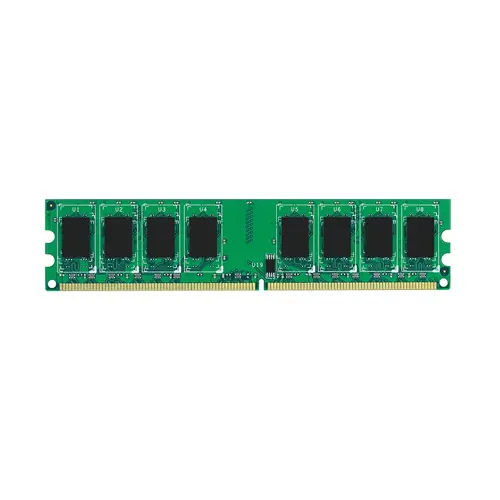
Designed for legacy server platforms requiring high memory capacity and reliability, this 2GB DDR2-667 Fully Buffered DIMM (FB-DIMM) with ECC is ideally suited for memory-intensive workloads such as virtualization and in-memory databases on older generation systems. Its dual-rank x4 organization and fully buffered architecture enhance signal integrity across large memory populations, while CL5 latency and ECC ensure deterministic performance and protection against single-bit data corruption.
1. FB-DIMM architecture buffers data signals across the Advanced Memory Buffer, enabling dense server memory populations without signal degradation that would disrupt multi-tenant hosting.
2. ECC error identification instantly contains single-bit memory faults, preserving ledger accuracy in financial databases where even a one-bit silent corruption is unacceptable.
3. Dual Rank x4 organization maximizes page hit rates through aggressive interleaving, slashing average memory latency for hypervisor-consolidated workloads under heavy contention.
4. With a footprint of 2GB, this module supplies an efficient, right-sized memory block for lightweight container hosts, keeping idle power low while fully servicing the orchestrator layer.
5. Running at 667MHz delivers steady, predictable transfer rates that match legacy enterprise bus speeds, preventing transaction timeouts in sustained batch processing windows.
The M395T5750EZ4-CE65 is a server-grade DDR2 Fully Buffered DIMM engineered specifically for legacy data center platforms where stability and data integrity are non-negotiable. Its ECC protection is foundational for virtualization clusters: a single bit-flip from background radiation can silently corrupt a hypervisor’s memory space and crash dozens of virtual machines instantaneously; ECC detects and corrects these errors in real time, directly preserving service uptime. The Fully Buffered architecture uses an Advanced Memory Buffer to isolate the DRAM from the memory controller, allowing you to populate every available channel without signal degradation. This enables massive memory footprints critical for in-memory databases like SAP or high-concurrency SQL workloads, where loading entire datasets into RAM eliminates disk bottlenecks and accelerates transaction processing. The module’s Dual Rank x4 organization creates internal bank interleaving, processing commands in parallel to deliver higher hit rates and bandwidth under mixed access patterns. When virtual machines, replication jobs, and analytical queries compete for resources simultaneously, this design reduces latency and prevents the stalling that single-rank alternatives would cause. Finally, the proven 667MHz clock and CL5 latency provide a time-tested, rock-solid foundation for these legacy systems, ensuring seamless drop-in compatibility and round-the-clock operational stability without the timing risks of overclocked or non-validated memory.
General Virtualization
For fully buffered DDR2-667 ECC memory, populate modules in matched sets to maintain balanced channels. Given the 2GB capacity per module, a typical virtualization host with moderate VM density benefits from 8–16GB total using four to eight modules, ensuring enough headroom for hypervisor overhead and memory overcommit. Always install in identical pairs or quads to avoid performance penalties on legacy FB-DIMM platforms.
In-Memory Database
Even though 2GB FB-DIMMs limit per-module capacity, in-memory databases still demand the largest possible RAM footprint. Maximize slots with identical modules — 16GB or 32GB total across all channels — to keep working sets entirely in memory and reduce disk I/O. ECC is critical here to protect data integrity during cache-intensive operations.
High-Performance Computing (HPC)
HPC workloads rely on sustained memory bandwidth. Install modules in fully populated, balanced configurations — for example, eight modules on a dual‑processor board — to leverage interleaving and maximize throughput. Although 667MHz is modest by modern standards, using dual‑rank x4 modules helps extract additional parallelism, while FB-DIMM architecture maintains signal reliability across dense node clusters.
Engineered for servers, rigorously tested, compatible with Dell PowerEdge 2950/1950, HP ProLiant DL380 G5, and IBM System x3650.
Q: Can I mix this M395T5750EZ4-CE65 with other memory modules of different brands or speeds?
A: Mixing FB-DIMMs of different brands or speeds is strongly discouraged. It may cause boot failures or stability issues. For guaranteed compatibility and reliable operation, always populate with identical Samsung M395T5750EZ4-CE65 modules.
Q: Is this memory compatible with my system?
A: This DDR2-667 Fully Buffered ECC module is designed for server platforms using Intel 5000/5100/5400 series chipsets supporting FB-DIMM technology. Please verify your server or workstation board's Qualified Vendor List for M395T5750EZ4-CE65.
Q: What is the recommended DIMM population order for optimal performance?
A: Always follow the population sequence in your server's service manual. Typically, populate identical FB-DIMMs in matched pairs per branch, starting with the slots closest to the CPU, to ensure balanced memory interleaving and full performance.
Q: Does this module support overclocking or XMP profiles?
A: No. This is an enterprise-grade JEDEC-compliant FB-DIMM running at DDR2-667 CL5, 1.8V. Overclocking and XMP are not supported; it is built strictly for 24/7 data-center reliability and stability.
Q: What warranty and typical failure rate can I expect?
A: This module includes a one-year warranty. As a genuine Samsung server memory built to rigorous standards, it has a very low annualized failure rate (AFR), typically under 0.5%, ensuring long-term mission-critical reliability.