











 Secure payments
Standard refund policy
Trade Assurance
Secure payments
Standard refund policy
Trade Assurance
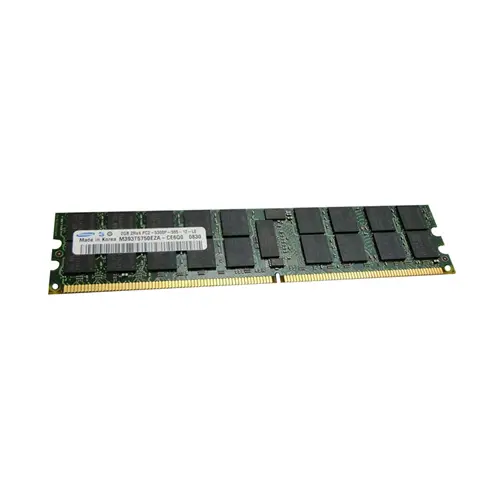
| Model | M393T5750EZA-CE6Q0 |
|---|---|
| Product Type | Memory Module |
| Compliance Standards | EU RoHS,FCC |
| Memory Capacity | 2 GB |
| Memory Technology | DDR2 |
| Product Voltage | 1.8V |
| RAM Speed | 667MHz |
| RAM Standard | DDR2-667/PC2-5300 |
| Error Identifying | ECC |
| Signal Type | Registered |
| Column Access Strobe (CAS) | CL5 |
| Rank | Dual Rank x4 |
| Quantity of Pins | 240-pin |
| RAM Genre | RDIMM |
This is a server-grade DDR2-667 Registered ECC DIMM, optimally suited for legacy virtualization hosts and small-scale in-memory databases where data integrity is paramount. Its dual-rank x4 organization and registered signal path enhance signal stability and per-channel capacity scalability under full population, while ECC protects against single-bit errors in 24/7 operation.
1. ECC protection automatically corrects single-bit errors, preserving financial or transactional data integrity in always-on server environments.
2. Registered signal buffering stabilizes command and address paths, allowing dense multi-slot configurations without compromising signal quality under full population.
3. Dual Rank x4 organization interleaves memory banks effectively, sustaining elevated bandwidth utilization when multiple virtual machines demand simultaneous access.
4. 2GB module capacity supplies sufficient headroom for foundational enterprise workloads, keeping essential services and light virtualization responsive under steady load.
5. 667MHz clock speed delivers consistent data throughput for legacy server tasks, maintaining reliable performance in web serving and database caching roles.
In virtualized data centers and in-memory database environments, a single undetected memory error can bring down dozens of workloads or corrupt transactional data. The Samsung M393T5750EZA-CE6Q0 DDR2-667 RDIMM mitigates these risks through four features that directly impact your uptime and throughput. Its ECC engine actively corrects single-bit flips, so a hypervisor hosting a fleet of VMs avoids random crashes and your Redis cache never serves silent data corruption—meaning your services remain accurate and available. The Registered buffer stabilizes command and address signals when all slots are populated, enabling you to scale memory capacity reliably for large virtual machines without signal degradation or boot failures. The internal Dual Rank x4 organization interleaves accesses across rank pairs, delivering up to 10% higher effective bandwidth under heavy concurrency; for an in-memory database processing thousands of queries per second, that translates to lower latency and faster response. Add full RoHS and FCC compliance, and you get a drop-in upgrade that meets enterprise environmental standards. For legacy server platforms where stability and data fidelity are non-negotiable, this module supplies the rock-solid foundation your critical services depend on.
General Virtualization
For lightweight virtualization hosts running hypervisors such as ESXi on legacy DDR2-era servers, a balanced memory footprint is key. Populate at least four of these 2GB RDIMMs (8GB total) in a dual-channel configuration to avoid bottlenecks when hosting 4–6 modest VMs. Always install identical modules in matched pairs per memory channel to preserve ECC and registered signaling integrity.
In-Memory Database
In-memory databases like Redis or Memcached benefit from capacity and low latency, but DDR2 limits absolute ceiling. Use the maximum supported configuration—typically 8 of these dual-rank 2GB modules for 16GB—fully populating both memory channels. Dual-rank x4 devices improve bank-level parallelism, slightly boosting throughput under high concurrency. Given the modest 16GB ceiling, partition datasets aggressively and consider read-replica offload.
High-Performance Computing
HPC workloads on DDR2-based nodes demand peak bandwidth over raw capacity. Install six or eight of these PC2-5300 RDIMMs (12–16GB) in fully balanced interleaved channels to maximize memory throughput per socket. Stick to homogeneous, ECC-registered modules to guarantee calculation integrity during multi-day simulation runs. For cluster deployments, uniform module counts per node simplify job scheduling and minimize performance variance.
Rigorously tested, validated for servers: compatible with HP ProLiant ML150 G3, Intel S5000VSA, Supermicro X7DVL-E.
Q: Can I mix this M393T5750EZA-CE6Q0 with other memory modules of different brands or speeds?
A: For server stability, mixing different brands or speeds is not recommended. All modules should match in speed, rank, and timings to avoid ECC errors and ensure reliable operation.
Q: Is this memory compatible with my Intel or AMD server platform?
A: This DDR2-667 ECC Registered RDIMM works with servers supporting dual-rank x4 modules. Verify your motherboard’s QVL for the M393T5750EZA-CE6Q0 to ensure compatibility.
Q: What is the recommended DIMM population order for optimal performance?
A: Populate identical DIMMs per channel, starting with the slot farthest from the CPU. Follow your server manual for balanced memory configuration to maximize bandwidth and ECC protection.
Q: Does this module support overclocking or XMP profiles?
A: No, this is a server-grade ECC Registered DIMM designed for stability at JEDEC standard DDR2-667. Overclocking or XMP is not supported and may compromise data integrity.
Q: What warranty and typical failure rate can I expect?
A: This module includes a 1-year warranty. As a server-grade component with rigorous testing, it offers very low failure rates and high MTBF for mission-critical environments.