











 Secure payments
Standard refund policy
Trade Assurance
Secure payments
Standard refund policy
Trade Assurance
| Model | M395T5750CZ4-CE61 |
|---|---|
| Product Type | Memory Module |
| Compliance Standards | EU RoHS,FCC |
| Memory Capacity | 2 GB |
| Memory Technology | DDR2 |
| Product Voltage | 1.8V |
| RAM Speed | 667MHz |
| RAM Standard | DDR2-667/PC2-5300 |
| Error Identifying | ECC |
| Signal Type | Fully Buffered |
| Column Access Strobe (CAS) | CL5 |
| Rank | Dual Rank x4 |
| Quantity of Pins | 240-pin |
| RAM Genre | FB-DIMM |
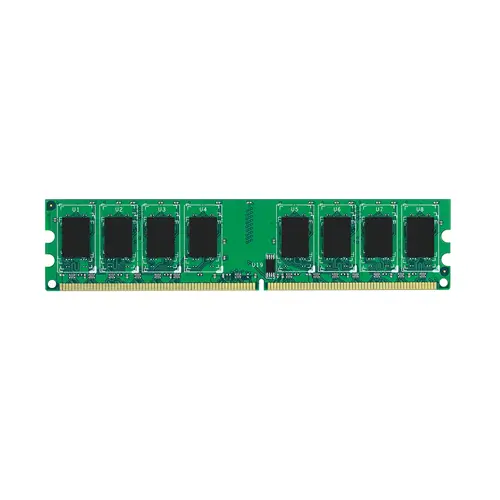
Designed for legacy server infrastructures, this M395T5750CZ4-CE61 2GB DDR2-667 FB-DIMM leverages Fully Buffered architecture and ECC to ensure signal integrity and data reliability across large memory populations. It is ideally suited for memory-dense virtualization hosts and database servers where dual-rank x4 organization maximizes capacity while maintaining critical error correction under sustained loads.
1. FB-DIMM architecture amplifies signal integrity across fully populated server chassis, enabling large memory configurations without compromising access reliability.
2. ECC error correction silently detects and repairs single-bit memory faults, preserving data integrity for mission-critical databases and financial transactions.
3. Fully Buffered signaling serializes data lanes to reduce electrical loading on the memory bus, which is vital when scaling to high DIMM counts in dense rack servers.
4. Dual Rank x4 organization interleaves memory access across two internal ranks, sustaining full channel throughput under heavy virtualization and multi-tenant workloads.
5. PC2-5300 bandwidth delivers a steady stream of data to keep legacy enterprise applications responsive during peak operational hours.
Understanding a component like the M395T5750CZ4-CE61 begins with recognizing its identity: this is a server-grade, Fully Buffered DDR2 ECC memory module. For IT professionals managing critical infrastructure, the module’s four standout traits translate directly into infrastructure resilience and performance where it matters most.
First, ECC error correction is non-negotiable. In a virtualized cluster running multiple VMs, a single-bit flip in memory can cascade into silent data corruption or an entire host failure. This module catches and corrects those errors in real time, directly safeguarding business continuity. Second, its Fully Buffered DIMM architecture moves from a parallel bus to a serial point-to-point interface, dramatically improving signal integrity and enabling dense memory configurations. For a memory database like Redis or an in-memory analytics engine, this means you can reliably populate all 16 or more DIMM slots, scaling capacity without signal degradation. Third, the dual-rank x4 organization enables rank interleaving, which boosts effective bandwidth by overlapping read/write commands. During a heavy transactional workload, that translates to lower latency for queries hitting your database—your customers wait less. Finally, the conservative CL5 latency at a stable 1.8V reflects a design optimized for predictability, not overclocking headroom. In a virtualization host running 24/7, that steady thermal and electrical profile prevents throttling and extends service life, keeping maintenance windows infrequent. Every aspect of this module is purpose-built to keep your server fleet stable, scalable, and accurate under load.
General Virtualization
For general virtualization hosts, populate all memory channels evenly to maximize throughput. With FB-DIMMs, install modules in matched sets across the available branches—typically six or eight identical 2 GB sticks per server—to ensure balanced interleaving and sufficient capacity for moderate VM density. Avoid mixing ranks or speeds, and keep at least one spare DIMM slot for future expansion.
In-Memory Database
In-memory databases demand both capacity and fault tolerance. Deploy the largest supported configuration using dual‑rank x4 2 GB FB‑DIMMs, filling every slot to reach 32 GB or more per host. ECC is mandatory to prevent silent data corruption, and fully buffered architecture allows high DIMM counts without signal degradation, making it suitable for caching entire datasets in RAM.
High‑Performance Computing (HPC)
HPC clusters require maximum bandwidth, so install a balanced set of modules across all memory channels—typically four or eight identical DIMMs per node. The 667 MHz speed and CL5 latency offer predictable timing for tightly‑coupled parallel workloads. When scaling out, maintain uniform DIMM population across nodes to ensure consistent performance, and consider reducing capacity per module slightly if higher‑clock FB‑DIMM alternatives are available for compute‑bound tasks.
Rigorously tested FB-DIMM, compatible with Dell PowerEdge 2900, HP ProLiant DL380 G5, IBM System x3650.
Q: Can I mix this M395T5750CZ4-CE61 with other memory modules of different brands or speeds?
A: Mixing FB-DIMMs with different brands or speeds is not recommended; it may cause instability. All modules should match in speed, rank, and chip organization for guaranteed ECC and fully buffered performance.
Q: Is this memory compatible with my system?
A: This FB-DIMM is designed for servers with a chipset supporting dual-rank DDR2-667 fully buffered memory. Verify your Intel® or AMD server platform specification requires 240-pin FB-DIMMs with ECC.
Q: What is the recommended DIMM population order for optimal performance?
A: Install in groups of four identical modules for quad-channel operation. Always populate channels farthest from the CPU first, matching the motherboard manual's branch order to maintain balanced FB-DIMM channels.
Q: Does this module support overclocking or XMP profiles?
A: No. Server-class FB-DIMMs operate at fixed JEDEC compliant timings for reliability. Overclocking or XMP is not supported; this module runs stably at PC2-5300 with CL5 per specification.
Q: What warranty and typical failure rate can I expect?
A: This module includes a one-year warranty. It is built to strict enterprise standards with low AFR, typically under 0.5% per year, ensuring long-term mission-critical reliability in supported server environments.