











 Secure payments
Standard refund policy
Trade Assurance
Secure payments
Standard refund policy
Trade Assurance
| Product Type | Memory Module |
|---|---|
| Compliance Standards | EU RoHS,FCC |
| Memory Capacity | 2 GB |
| Memory Technology | DDR2 |
| RAM Speed | 667 |
| RAM Standard | DDR2-667/PC2-5300 |
| Error Identifying | Non-ECC |
| Signal Type | Unbuffered |
| Column Access Strobe (CAS) | CL5 |
| Rank | Dual Rank x8 |
| Quantity of Pins | 200-pin |
| RAM Genre | SoDIMM |
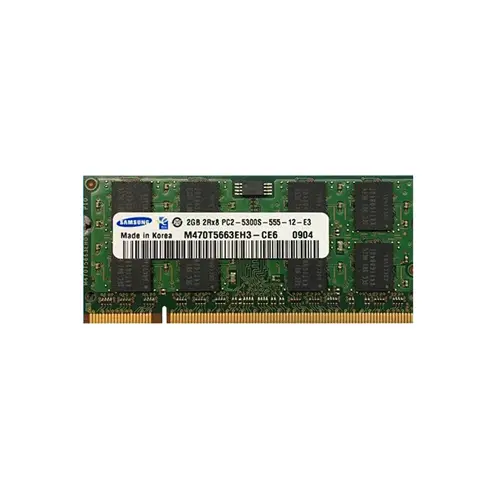
Designed as a notebook memory module in a 200-pin SoDIMM form factor, this DDR2-667 CL5 Non-ECC Unbuffered stick is optimized for upgrading legacy laptops and mobile workstations where plug-and-play compatibility and stable dual-rank x8 organization improve multi-tasking throughput. Its low operating voltage and industry-standard PC2-5300 compliance also help reduce power consumption and heat, making it a straightforward, reliable upgrade for aging portable systems still in service.
1. Modest capacity revitalizes vintage ultraportables, effortlessly hosting lightweight Linux environments or dedicated media playback without straining the aging chipset.
2. Power-sipping operating frequency keeps thermals in check within cramped notebook chassis, preserving battery runtime for untethered productivity.
3. Tight column access latency compensates for the generation’s lower clock ceiling, delivering responsive application switching during everyday mobile computing.
4. Universal SO-DIMM keying guarantees a drop-in upgrade path for mainstream laptops, requiring zero technical expertise to extend a system’s useful life.
5. Dual-rank interleaving subtly improves memory-level parallelism, smoothing out multitasking when juggling browser tabs, documents, and media on older platforms.
Upgrading an aging notebook often feels like a lost cause, but the M470T5663EH3-CE6 SODIMM proves a single component can restore everyday productivity. As an unbuffered, non‑ECC DDR2-667 module in the slim 200‑pin format, it drops straight into countless older laptops without clearance or compatibility battles. For a travelling consultant who runs email, spreadsheets, and a dozen browser tabs simultaneously, the 2 GB dual‑rank x8 organization keeps data flowing across both rank interleaves, visibly reducing the lag that plagues a 1 GB machine when Windows resorts to hard‑disk swapping. Meanwhile, a remote student relying on a five‑year‑old ultraportable sees genuine relief during video calls and cloud document editing: the unbuffered architecture sips power modestly, preserving precious battery minutes at the coffee shop or in a library carrel. The CL5 latency squeezes extra responsiveness out of the 667 MHz clock, so context switches feel crisp rather than sluggish. By sidestepping the cost and complexity of a full system replacement, this memory module turns a frustratingly slow notebook into a confident daily companion for essential work and learning.
Laptop Upgrade
For aging systems still using DDR2, a single 2GB SO-DIMM serves as a direct replacement for a failed or undersized 1GB stick. Pairing two identical modules enables dual-channel operation at 667 MT/s, giving a total of 4GB — a sensible ceiling for most DDR2-era laptops. This doubles the original capacity and noticeably improves responsiveness under Windows 7/10 light multitasking.
Mobile Workstation
Maximum practical capacity on DDR2 mobile platforms is typically 4GB using two 2GB modules. Engineers running CAD viewers, older GIS software, or localized databases should populate both SO-DIMM slots with these dual-rank x8 units to reach 4GB and benefit from interleaving. While 4GB SO-DIMMs exist, their rarity and cost make a matched 2×2GB kit the realistic sweet spot for professional use on this platform.
Ultrabook Power Saving
Although not a low-voltage variant, standard 1.8V DDR2 SO-DIMMs still draw modest power at idle. Using just one 2GB module leaves a slot empty, reducing total DRAM power versus a fully populated system — useful if battery runtime is paramount. Still, for typical ultraportable tasks, the dual-channel 4GB configuration represents a better balance, as the performance uplift from interleaving often avoids paging, indirectly saving energy by shortening active work intervals.
Rigorously validated DDR2 2GB SoDIMM, guaranteed for laptops: Dell Latitude D630, ThinkPad T61, HP Compaq 6710b.
Q: Can I mix this M470T5663EH3-CE6 with other memory modules of different brands or speeds?
A: Mixing is possible, but the system will downclock to the slowest module. For best stability, we strongly recommend pairing with another 2GB DDR2-667 SO-DIMM of identical specifications.
Q: Is this memory compatible with my laptop?
A: It fits laptops supporting DDR2 SO-DIMM. Confirm your system accepts 200-pin, non-ECC unbuffered PC2-5300 memory and a 2GB module per slot. Check your manual for chipset limitations.
Q: What is the recommended DIMM population order for optimal performance?
A: For dual-channel capable laptops, install matched pairs. If using a single module, place it in the primary slot (often marked DIMM 0). Consult your laptop service guide for slot numbering.
Q: Does this module support overclocking or XMP profiles?
A: No. This DDR2 SO-DIMM operates at JEDEC standard 667MHz with CL5. It does not support overclocking or XMP, ensuring reliable, validated performance within manufacturer specifications.
Q: What warranty and typical failure rate can I expect?
A: This module includes a one-year warranty. The typical annualized failure rate is extremely low (approximately 0.1–0.3%) under normal operating conditions, supported by rigorous product testing and quality control.