











 Secure payments
Standard refund policy
Trade Assurance
Secure payments
Standard refund policy
Trade Assurance
| Model | M391T5663DZ3-CF7 |
|---|---|
| Product Type | Memory Module |
| Compliance Standards | EU RoHS,FCC |
| Memory Capacity | 2 GB |
| Memory Technology | DDR2 |
| Product Voltage | 1.8V |
| RAM Speed | 800MHz |
| RAM Standard | DDR2-800/PC2-6400 |
| Error Identifying | ECC |
| Signal Type | Unbuffered |
| Column Access Strobe (CAS) | CL6 |
| Rank | Dual Rank x8 |
| Quantity of Pins | 240-pin |
| RAM Genre | UDIMM |
This DDR2-800 Unbuffered ECC UDIMM is best suited for legacy single-socket servers and entry-level workstations running memory-sensitive workloads like light virtualization or small-scale databases, where its ECC error correction ensures data integrity and system stability. Its dual-rank x8 organization and CL6 latency provide a reliable balance of capacity and responsiveness on older platforms, while the unbuffered signal type guarantees minimal latency overhead for critical operations.
1. ECC protection provides single-bit error correction and multi-bit detection, preserving data integrity for background financial reconciliation tasks that cannot risk silent memory corruption.
2. Dual Rank x8 organization interleaves memory banks to increase bandwidth utilization, helping a modest virtualization host handle several lightweight VMs without timing bottlenecks.
3. Unbuffered UDIMM design trims command path latency, giving entry-level servers quicker request-to-data turnaround for disk caching or directory services workloads.
4. 2 GB capacity offers a deterministic, low-overcommit footprint for purpose-built appliances where stability outweighs density and every megabyte is actively protected.
5. DDR2-800 speed delivers a consistent 6.4 GB/s per channel, comfortably supporting steady-state file-and-print sharing for small office collaboration environments.
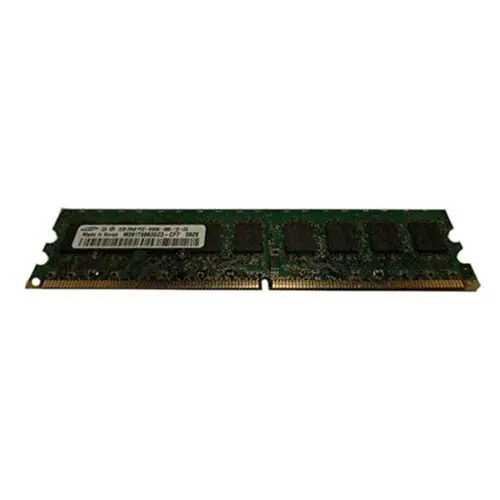
Judging by its UDIMM form factor with ECC and 240-pin layout, the Samsung M391T5663DZ3-CF7 is a server-grade memory module designed for legacy infrastructure where data integrity takes absolute priority over raw throughput. This is not a desktop or notebook part—its ECC engine and unbuffered design place it squarely in entry-level servers, dedicated network appliances, and long-lifecycle embedded systems.
When you run a lightweight virtualization host on aging dual-core Xeon or Opteron hardware, every bit flip becomes a tangible risk. A single undetected error in a virtual machine’s memory space can silently corrupt the guest operating system or scramble transactional logs. The ECC on this 2 GB DDR2-800 module catches and corrects single-bit errors in real time, so your hypervisor and its VMs remain stable even as background radiation increases the soft error rate. In a small database or file server scenario—such as a point-of-sale back-end or a network-attached storage controller—the same ECC protection guards your ZFS metadata and SQL indices against in-memory corruption. Unbuffered architecture keeps the electrical load low enough for simple motherboards, meaning you avoid the cost and power draw of a registered DIMM while still safeguarding your uptime. With a 1.8 V operating voltage and dual-rank x8 organization, this module runs cool and avoids excessive stress on legacy voltage regulators, letting you extend the life of a trusted system without compromising data correctness. That translates directly into fewer unexplained lockups, safer archival workloads, and a predictable total cost of ownership for businesses that cannot justify ripping out stable, validated server platforms.
General Virtualization
Populate at least eight modules (16GB total) across both memory channels to comfortably host multiple virtual machines. The ECC capability ensures data integrity during live migrations and sustained uptime, while the dual-rank x8 organization improves command interleaving for better consolidation ratios.
In-Memory Database
Maximize capacity by filling every available DIMM slot — for a typical dual-socket server, install sixteen 2GB modules (32GB total). This configuration keeps the entire dataset in RAM and minimizes swap latency. The CAS latency of 6 cycles at 800 MHz provides deterministic access times, and ECC guards against bit errors in mission-critical transactions.
High-Performance Computing
Install matched pairs across all memory channels to fully enable dual-channel interleaving and maximize bandwidth. For a dual-socket node, use eight identical modules (16GB) evenly split per CPU. The unbuffered design with dual-rank signaling reduces access latency, which benefits bandwidth-sensitive parallel workloads such as computational fluid dynamics and molecular modeling.
Rigorously tested server memory, compatible with Dell PowerEdge 840, HP ProLiant ML110 G5, and more.
Q: Can I mix this M391T5663DZ3-CF7 with other memory modules of different brands or speeds?
A: Mixing modules may cause instability. This is a DDR2-800 ECC UDIMM; combining with non-ECC or slower DIMMs forces the system to the lowest common speed and disables ECC protection.
Q: Is this memory compatible with my system?
A: It suits servers or workstations using dual-rank, 240-pin DDR2 ECC Unbuffered memory at 1.8V. Verify your motherboard supports x8 DRAM organization and ECC UDIMM architecture before purchase.
Q: What is the recommended DIMM population order for optimal performance?
A: Populate identical dual-rank UDIMMs in matched pairs per memory channel, starting with the slots farthest from the CPU. Follow your server board’s specific guide to maintain balanced ECC interleaving.
Q: Does this module support overclocking or XMP profiles?
A: No. This server-grade unbuffered ECC module adheres to JEDEC DDR2-800 (PC2-6400) standards with fixed CL6 timings. Overclocking and XMP are not supported, prioritizing data integrity over speed.
Q: What warranty and typical failure rate can I expect?
A: It includes a one-year warranty. Engineered for 24/7 operation, this ECC module has a very low annualized failure rate under nominal voltage and thermal conditions when installed in validated platforms.