











 Secure payments
Standard refund policy
Trade Assurance
Secure payments
Standard refund policy
Trade Assurance
| Model | M392B5773CH0-CF8 |
|---|---|
| Product Type | Memory Module |
| Compliance Standards | EU RoHS,FCC |
| Memory Capacity | 2 GB |
| Memory Technology | DDR3 |
| Product Voltage | 1.5V |
| RAM Speed | 1066MHz |
| RAM Standard | DDR3-1066/PC3-8500 |
| Error Identifying | ECC |
| Signal Type | Registered |
| Column Access Strobe (CAS) | CL7 |
| Rank | Single Rank x4 |
| Quantity of Pins | 240-pin |
| RAM Genre | VLP RDIMM |
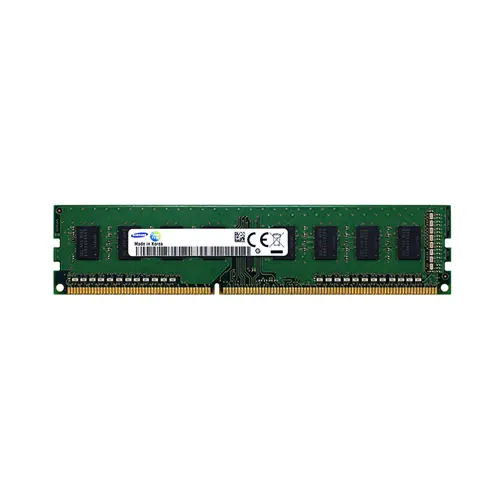
Engineered as a Very Low Profile Registered DIMM with ECC, the M392B5773CH0-CF8 is a server-grade DDR3-1066 module purpose-built for space-constrained 1U/2U rack servers and blade enclosures, where its 1.5V VLP form factor, single-rank x4 organization, and registered signal buffering maximize memory density and signal integrity in virtualization hosts and memory-intensive database applications. The combination of CL7 latency and error-correcting code ensures deterministic data integrity under sustained 24/7 workloads, making it ideal for in-memory caching layers and light compute nodes that demand absolute uptime without sacrificing thermal headroom.
1. Registered signal type ensures stable signal integrity across fully populated memory channels, preventing data corruption in multi-DIMM server configurations.
2. ECC error correction detects and corrects single-bit memory faults in real time, safeguarding critical business transactions and long-running analytics workloads.
3. Very Low Profile RDIMM form factor maximizes airflow in dense rack and blade servers, directly reducing thermal throttling risk during sustained cloud operations.
4. DDR3 technology provides a cost-effective memory foundation for legacy enterprise platforms, extending the operational life of existing server investments.
5. CL7 low latency at 1066MHz accelerates database query caching and response, delivering consistent snappiness under moderate virtualized workload pressure.
When you’re running a dense virtualization cluster or an in-memory database, the M392B5773CH0-CF8 isn’t just a module — it’s a safeguard for your data and a guarantee of steady platform performance. This DDR3-1066 VLP RDIMM is engineered specifically for server environments where downtime is not an option. Its four defining characteristics translate directly into operational resilience. First, ECC error correction actively detects and corrects single-bit memory errors caused by background radiation, preventing silent data corruption that could crash a virtual machine or write bad records into a financial database. Second, the registered signal type buffers the address and command signals, dramatically reducing electrical loading on the memory controller. That allows you to populate all channels with multiple DIMMs — essential for scaling up capacity in a virtualized host — without sacrificing signal integrity or triggering costly instability. Third, the very low profile (VLP) form factor is a lifesaver in 1U rack servers and blade chassis, where airflow is minimal and every millimeter counts; it lets you run cool, dense memory configurations without thermal throttling. Finally, a CAS latency of just 7 cycles at 1066MHz delivers tighter access timings, which directly accelerates the random read operations that an in-memory cache or a heavy transactional database depends on. What this means for you is fewer silent failures, predictable performance under full load, easier thermal management in cramped racks, and consistently snappy query responses — turning a spec sheet into real-world reliability.
General Virtualization
A single 2GB DDR3-1066 RDIMM is too small for modern hypervisors. For light-duty virtualization with 8–10 idle VMs, populate at least three identical modules per memory channel (e.g., 12 x 2GB for 24GB total) to enable triple-channel interleaving and ECC scrubbing. Avoid mixing densities; a homogenous 1.5V VLP RDIMM population keeps thermal profiles predictable in 1U pizza boxes.
In-Memory Database
In-memory datasets demand both capacity and low latency. With only 2GB per stick and CL7 timing at 1066MT/s, use these exclusively for dev/test Redis or Memcached instances requiring under 16GB. Fully load all available DIMM slots—aim for 24 or 32 identical units—to maximize rank interleaving, but recognize that real production in-memory engines will quickly outgrow this density and require at least 16GB RDIMMs.
High-Performance Computing
HPC workloads are bandwidth-starved on DDR3-1066. To minimize bottlenecks, install one module per channel and balance across both CPU sockets in a dual-socket Nehalem/Westmere era node. For embarrassingly parallel codes, a minimum of 18 modules (36GB) per node gives enough headroom, but consider retiring these 2GB VLP RDIMMs in favor of higher-speed DDR3-1600 or LRDIMMs to feed modern vector engines.
Strictly tested for reliable compatibility with servers including Dell PowerEdge R720, HP ProLiant DL380p Gen8, and Lenovo ThinkServer RD630.
Q: Can I mix this M392B5773CH0-CF8 with other memory modules of different brands or speeds?
A: Mixing different brands or speeds is not recommended in server environments. For guaranteed stability and error-free operation, use identical M392B5773CH0-CF8 modules in your configuration.
Q: Is this memory compatible with my system?
A: This module fits servers supporting DDR3 ECC Registered DIMMs, such as Intel Xeon E5-2400 v1/v2 or AMD Opteron 4200/4300 platforms. Always check your system’s qualified vendor list for confirmation.
Q: What is the recommended DIMM population order for optimal performance?
A: Follow your server motherboard manual. Typically, install identical modules in the first slot of each memory channel to enable balanced memory interleaving and achieve maximum throughput.
Q: Does this module support overclocking or XMP profiles?
A: No. As a server-grade Registered DIMM, it operates only at JEDEC standard DDR3-1066 with CL7 timings, prioritizing reliability over performance tuning. Overclocking and XMP are not supported.
Q: What warranty and typical failure rate can I expect?
A: This module includes a 1-year warranty. Built with Samsung single-rank x4 VLP technology, it exhibits a very low annualized failure rate consistent with demanding enterprise workloads.