











 Secure payments
Standard refund policy
Trade Assurance
Secure payments
Standard refund policy
Trade Assurance
| Model | M393B5670EH1-CF8 |
|---|---|
| Product Type | Memory Module |
| Compliance Standards | EU RoHS,FCC |
| Memory Capacity | 2 GB |
| Memory Technology | DDR3 |
| Product Voltage | 1.5V |
| RAM Speed | 1066MHz |
| RAM Standard | DDR3-1066/PC3-8500 |
| Error Identifying | ECC |
| Signal Type | Registered |
| Column Access Strobe (CAS) | CL7 |
| Rank | Single Rank x4 |
| Quantity of Pins | 240-pin |
| RAM Genre | RDIMM |
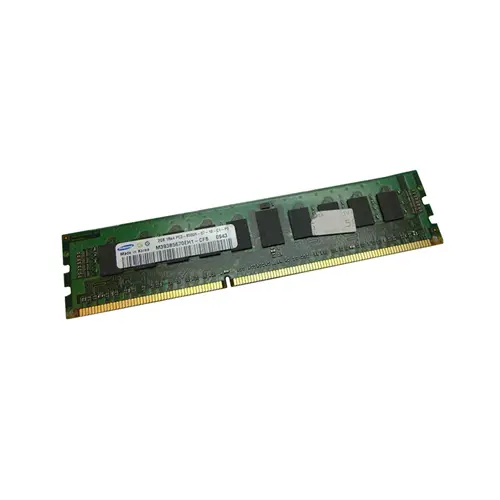
This Samsung M393B5670EH1-CF8 is a legacy DDR3-1066 Registered ECC RDIMM engineered for entry-level servers and workstations where data integrity takes priority over raw bandwidth, making it suitable for light virtualization or small-scale memory-resident cache applications. Its single-rank x4 organization with CL7 latency delivers stable, deterministic signal quality on a 240-pin registered bus, ensuring reliable 1.5V operation in platforms that require error correction to prevent silent data corruption.
1. ECC error correction silently detects and fixes single-bit memory faults, preserving transactional integrity in financial databases and virtualized environments where even one corrupted bit can bring down a guest node.
2. Registered signal buffering isolates the command and address lines from the chipset, enabling fully loaded server boards to maintain stable communication across all slots without signal degradation.
3. Two‑gigabyte capacity per module fits cost‑optimized edge servers or lightweight container hosts, where memory density is deliberately matched to modest application footprints to minimize idle power draw.
4. 1066MHz clock speed balances throughput with thermal discipline, supplying steady bandwidth for web front‑ends and content caching without pushing rack‑level cooling limits.
5. Single Rank x4 organization imposes the lowest possible bus loading per DIMM, so population‑heavy server configurations sustain their rated frequency and latency even when every channel is maximized.
When you’re managing a virtualization cluster or running an in-memory database, a single undetected bit flip doesn’t just corrupt data—it can silently crash hypervisors, poison financial transactions, or invalidate hours of analytics. The M393B5670EH1-CF8 is a server-grade DDR3 RDIMM designed to make that risk unacceptable. Its ECC engine corrects single-bit errors in flight, preserving data integrity for every VM and every database query without performance penalty. Because dense server configurations demand reliable signal quality across all 240-pin slots, the module uses registered logic to buffer command and address lines, stabilizing the memory bus when you fully populate a node with multiple DIMMs. That registered design lets you scale capacity for dozens of workloads while eliminating intermittent boot failures. The single-rank x4 architecture further strengthens error correction by spreading data across more devices, which is critical for in-memory databases like Redis or SAP HANA where even microsecond delays cascade. With a 1.5V operating voltage and CL7 latency, it fits existing thermal and power envelopes while delivering the deterministic low-latency response that transactional systems require. In both your VM farm and your real-time analytics tier, this module transforms unpredictable silent corruption into ironclad operational certainty.
Capacity Planning for M393B5670EH1-CF8
This is a server-grade DDR3 ECC Registered DIMM (RDIMM) built for legacy enterprise platforms. Its 2 GB capacity per module and 1066 MHz speed suit older multi-socket servers where large numbers of identical modules are deployed.
General Virtualization
Populate all memory channels symmetrically with identical 2 GB RDIMMs to sustain balanced performance and ECC protection. In a dual-socket triple-channel server, installing two modules per channel (twelve modules) yields 24 GB, enough for a modest set of VMs. For denser consolidation, consider scaling to the platform’s maximum DIMM count.
In-Memory Database
Maximize total capacity by filling every available slot with identical 2 GB modules—often 18 or 24 in multi-riser designs—to build a reliable, low-latency dataset workspace. Enabling memory mirroring or sparing adds protection against uncorrectable errors, while single-rank x4 organization keeps electrical loading light and CAS 7 latency consistent.
High-Performance Computing
Configure one DIMM per channel to maintain full 1066 MT/s speed and peak bandwidth. A dual-processor node with six channels filled uses six modules (12 GB), delivering maximum throughput per core. If greater capacity is required, install two modules per channel while monitoring possible speed reduction, and always keep population symmetric for NUMA balance.
Rigorously tested server memory, compatible with Dell PowerEdge R710/R720, HP DL380p Gen8, and similar DDR3 RDIMM systems.
Q: Can I mix this M393B5670EH1-CF8 with other memory modules of different brands or speeds?
A: Mixing Registered ECC modules of different brands or speeds is not recommended. It may cause signal integrity issues, forcing the memory controller to downshift to the lowest common speed or leading to system instability.
Q: Is this memory compatible with my system?
A: This RDIMM is designed for dual-processor servers using Intel Xeon 5500/5600 series or AMD Opteron 6100 platforms. It requires a server board with 240-pin DDR3 slots that specifically support registered ECC memory.
Q: What is the recommended DIMM population order for optimal performance?
A: For optimal performance, populate identical DIMMs per memory channel, starting with the slot farthest from the CPU. Always follow the server board’s manual; typically fill blue or white slots first to enable multi-channel interleaving.
Q: Does this module support overclocking or XMP profiles?
A: No, this enterprise-grade Registered ECC module does not support overclocking or XMP. It operates solely at JEDEC standard timings and speeds (1066MHz CL7) to guarantee maximum stability and data integrity in server environments.
Q: What warranty and typical failure rate can I expect?
A: This Samsung module offers a one-year warranty. As a server-grade component with rigorous binning and testing, it demonstrates exceptionally low annualized failure rates, ensuring reliable 24/7 operation in mission-critical deployments.