











 Secure payments
Standard refund policy
Trade Assurance
Secure payments
Standard refund policy
Trade Assurance
| Model | M393B5670FH0-CF8 |
|---|---|
| Product Type | Memory Module |
| Compliance Standards | EU RoHS,FCC |
| Memory Capacity | 2 GB |
| Memory Technology | DDR3 |
| Product Voltage | 1.5V |
| RAM Speed | 1066MHz |
| RAM Standard | DDR3-1066/PC3-8500 |
| Error Identifying | ECC |
| Signal Type | Registered |
| Column Access Strobe (CAS) | CL7 |
| Rank | Single Rank x4 |
| Quantity of Pins | 240-pin |
| RAM Genre | RDIMM |
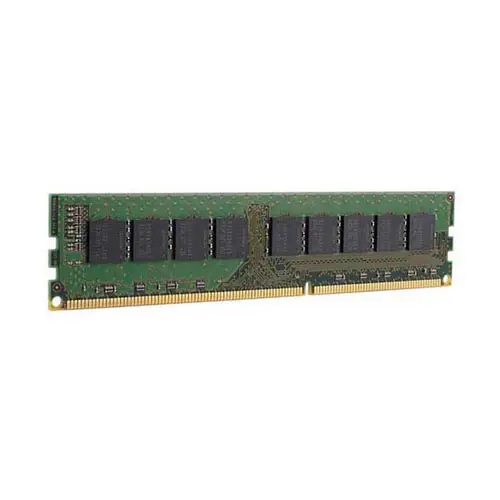
The M393B5670FH0-CF8 is a DDR3-1066 registered ECC RDIMM engineered for legacy enterprise servers and workstations, where its Registered signal type and ECC error correction provide superior signal integrity and data reliability critical for virtualization, memory-intensive databases, and 24/7 uptime environments. With a low CAS latency of CL7 and a single-rank x4 configuration, it reduces electrical loading on the memory bus while maintaining efficient command and data throughput, making it an optimal choice for platforms that demand stable, low-latency memory access without compromising error protection.
1. ECC detects and corrects single-bit memory errors in real time, preventing silent data corruption that could crash long-running virtualization hosts or transactional databases.
2. Registered signal buffering sharply reduces electrical loading on the memory controller, enabling fully populated channels for maximum capacity in dense rack servers without sacrificing stability.
3. Single Rank x4 organization keeps bus contention low while x4 DRAM width unlocks advanced chip-level error recovery, fortifying data integrity for mission-critical enterprise workloads.
4. A column access strobe of just seven clock cycles minimizes memory fetch latency, directly accelerating query response times in latency-sensitive financial or database applications.
5. Standard 1.5V operation ensures uniform power budgeting and predictable thermal behaviour across server fleets, lowering cooling overhead in always-on data centre deployments.
The Samsung M393B5670FH0-CF8 is a DDR3-1066 Registered ECC RDIMM engineered for servers. Its four crucial characteristics—ECC, registered buffering, single-rank x4 design, and CAS latency 7—translate directly into superior reliability and performance. In a virtualization cluster, ECC prevents single-bit errors from silently corrupting multiple VMs, a nightmare for multi-tenant uptime. The registered buffer regenerates command and address signals, allowing you to populate all memory slots without signal degradation, which is essential when you’re hosting dozens of VMs on a single host. For in-memory databases, the single-rank x4 configuration places a lighter electrical load on the memory controller, producing stable, low latency that avoids jitter during high-throughput queries. The CAS 7 latency then minimizes wait states, accelerating real-time analytics and financial transactions where every clock cycle matters. This module gives you the unshakeable data integrity and responsive caching that high-density data centers demand.
General Virtualization
For general virtualization hosts using this 2GB DDR3-1066 RDIMM, populate at least 12–18 identical modules across all memory channels to achieve 24–36 GB of total capacity. Use balanced dual- or quad-channel configurations, ensuring symmetrical DIMM population per CPU socket to maximize memory bandwidth and ECC reliability under moderate VM density.
In-Memory Database
In-memory databases demand capacity far beyond what a single 2GB DIMM can provide. Build a fully populated 24-slot server with these modules for a 48 GB footprint, which suits small test or development instances only. For production, this 2GB density is outdated—migrate to 8GB or 16GB RDIMMs while retaining the same registered ECC architecture, and still populate all channels to sustain low-latency data access.
High-Performance Computing (HPC)
HPC workloads benefit from maximum channel interleaving rather than raw capacity. Install one 2GB RDIMM per channel across all available memory controllers—typically 12 or 16 sticks—ensuring identical single-rank x4 configuration. This delivers uniform 1066 MHz speeds with CL7 timings, providing the consistent bandwidth and error correction essential for tightly coupled MPI jobs and scientific simulations.
Rigorously tested server memory compatible with Dell PowerEdge R710, HP ProLiant DL380 G7, and more.
Q: Can I mix this M393B5670FH0-CF8 with other memory modules of different brands or speeds?
A: Mixing registered ECC modules with different brands or speeds is not recommended. Inconsistent timing or signal parameters may cause server instability. Always deploy identical part numbers for guaranteed synchronous, error-free operation in mission-critical environments.
Q: Is this memory compatible with my system? I need to know supported Intel or AMD platforms.
A: This DDR3-1066 RDIMM is designed for servers using Intel Xeon 5500/5600 series or AMD Opteron platforms. It requires 240-pin slots and system BIOS support for registered ECC. Please confirm with your motherboard's qualified vendor list.
Q: What is the recommended DIMM population order for optimal performance?
A: Populate memory channels symmetrically according to the server board manual. Typically, install identical DIMMs in the first slot of each channel (e.g., DIMM_A1, DIMM_B1) to enable balanced interleaving, then fill subsequent slots for maximum bandwidth.
Q: Does this module support overclocking or XMP profiles?
A: No. This server-grade registered ECC memory operates strictly at JEDEC standard DDR3-1066 with CL7. Overclocking and XMP profiles are disabled to ensure absolute data integrity and reliability under continuous enterprise workloads.
Q: What warranty and typical failure rate can I expect?
A: The module carries a 1-year limited warranty. As a Samsung RDIMM built with carefully screened components, it exhibits an extremely low annualized failure rate typical of enterprise-class memory, ensuring long-term deployment confidence.