











 Secure payments
Standard refund policy
Trade Assurance
Secure payments
Standard refund policy
Trade Assurance
| Product Type | Memory Module |
|---|---|
| Memory Capacity | 2 GB |
| Memory Technology | DDR3 |
| Product Voltage | 1.5V |
| RAM Speed | 1066MHz |
| RAM Standard | DDR3-1066/PC3-8500 |
| Error Identifying | ECC |
| Signal Type | Unbuffered |
| Column Access Strobe (CAS) | CL7 |
| Rank | Dual Rank x8 |
| Quantity of Pins | 240-pin |
| RAM Genre | UDIMM |
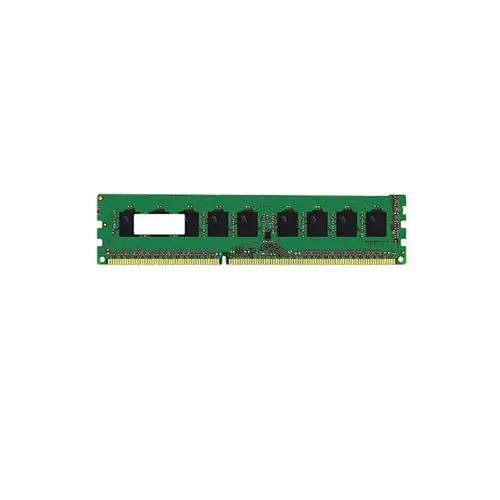
This UDIMM DDR3 module with ECC is designed for uniprocessor workstation or entry‑level server platforms where data integrity is critical for memory‑intensive applications such as small‑scale virtualization or financial computing. Its dual‑rank x8 organization maximizes 2 GB capacity on a single module while the CL7 latency minimizes access delay, and hardware ECC correction guards against single‑bit errors to maintain system stability under continuous operation.
1. ECC protection detects and corrects single-bit memory errors in real time, safeguarding transactional data integrity in always-on small business servers and NAS appliances.
2. Unbuffered signal architecture eliminates the register latency found in registered DIMMs, delivering the lowest possible memory access latency for latency-sensitive edge computing tasks.
3. Dual Rank x8 organization interleaves memory banks across two ranks, sustaining higher effective throughput under concurrent requests typical of multi-user file-sharing workloads.
4. CAS 7 low latency accelerates cache-line fetches, directly improving database lookup responsiveness and speeding up small-block I/O operations on entry-level storage servers.
5. 2 GB module capacity provides a cost-effective foundation for lightweight hypervisors or dedicated network-attached services, keeping per-VM overhead lean while preserving a stable operating footprint.
The M3931B5673EH1-CF8 is an ECC Unbuffered DDR3 module engineered for single-socket servers and workstations where data integrity and application responsiveness are non-negotiable. Its ECC capability actively prevents silent data corruption—vital when a legal firm’s document management system processes thousands of case files; a single bit flip could alter a contract reference, leading to compliance risks. The Unbuffered design removes the register delay, ensuring native compatibility with platforms like the Intel Xeon E3-1200 series and reducing overall platform cost, simplifying upgrades for a small business virtualization host. The Dual Rank x8 configuration interleaves memory banks to maximize bandwidth utilization, so when you run a virtualized NAS stack and a CRM simultaneously, rank-level parallelism keeps latency spikes at bay. Finally, a tight CL7 latency accelerates read operations. In a medical imaging workstation, this translates to faster preview rendering of DICOM scans, enabling clinicians to retrieve patient images almost instantly. This memory transforms routine reliability concerns into a silent, high-performance asset.
General Virtualization
This DDR3-1066 ECC UDIMM is suited for entry-level virtualization hosts. With only 2 GB per module, use six to eight identical modules in a balanced multi-channel configuration to reach 12–16 GB total, which supports a handful of light VMs. Always populate identical DIMMs in matched banks to maintain memory interleaving and ECC reliability.
In-Memory Database
For in-memory workloads, 2 GB modules are severely limiting. Deploy the maximum the board supports—typically four modules for 8 GB—and prioritize low-latency CL7 timing to reduce access delays. A dedicated server with this capacity can only cache small datasets, so reserve it for development or test environments.
High-Performance Computing (HPC)
HPC clusters using these UDIMMs should fill all channels per node to maximise bandwidth, usually four or six modules. Given the 1066 MT/s speed, pair them with CPUs that support ECC unbuffered memory and run symmetric configurations to avoid NUMA penalties. Even then, capacity-bound jobs will need node-level aggregation rather than per-node scaling.
Rigorously tested for servers; compatible with Dell PowerEdge T110 II, HP ProLiant MicroServer Gen8, Lenovo ThinkServer TS140.
Q: Can I mix this M3931B5673EH1-CF8 with other DDR3 modules of different brands or speeds?
A: Mixing is not recommended for server environments. This unbuffered ECC module requires identical rank and timing to avoid stability issues. All DIMMs will operate at the lowest common speed.
Q: Is this memory compatible with my server system using an Intel Xeon E3 or AMD Opteron 3000 series platform?
A: It is compatible with single-socket boards supporting DDR3-1066 unbuffered ECC UDIMMs. Please verify your motherboard's Qualified Vendor List (QVL) for the M3931B5673EH1-CF8 to ensure full validation.
Q: What is the recommended DIMM population order for optimal performance when installing this module?
A: Install identical DIMMs in matching channel slots, typically blue or black pairs first, to enable dual-channel interleaving. Consult your server board manual for the precise slot numbering to minimize reflective signaling.
Q: Does this DDR3 ECC UDIMM support overclocking or XMP profiles?
A: No. This JEDEC-compliant server memory operates strictly at 1066MHz with fixed CL7 timings. It does not support XMP or overclocking, as data integrity and stability are prioritized over speed.
Q: What warranty and typical failure rate can I expect with this module?
A: It includes a one-year warranty. Enterprise-grade ECC UDIMMs exhibit an extremely low annualized failure rate, typically under 0.2%, due to rigorous binning and error correction capability.