











 Secure payments
Standard refund policy
Trade Assurance
Secure payments
Standard refund policy
Trade Assurance
| Product Type | Memory Module |
|---|---|
| Compliance Standards | EU RoHS,FCC |
| Memory Capacity | 2 GB |
| Memory Technology | DDR3 |
| RAM Speed | 1066 |
| RAM Standard | DDR3-1066/PC3-8500 |
| Error Identifying | Non-ECC |
| Signal Type | Unbuffered |
| Column Access Strobe (CAS) | CL7 |
| Rank | Dual Rank x8 |
| Quantity of Pins | 204-pin |
| RAM Genre | SoDIMM |
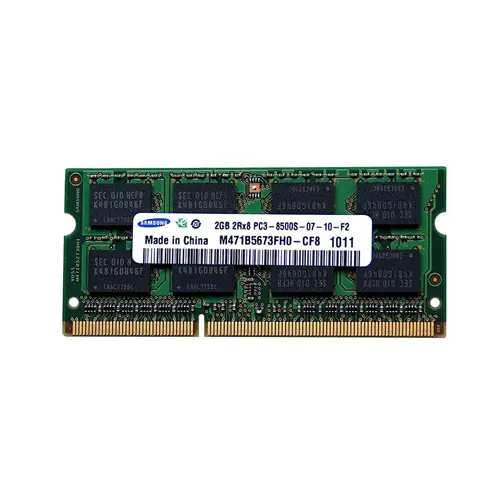
This 2GB DDR3-1066 SODIMM is tailored for notebook upgrades, ideally suited to revitalizing older mobile workstations or thin clients tasked with everyday productivity and light multi-tasking. Its Dual Rank x8 configuration with a low CL7 column access latency delivers improved memory interleaving and quick data access, while the unbuffered, non-ECC design ensures seamless plug-and-play compatibility across a broad range of 204-pin Intel and AMD platforms.
1. SoDIMM form factor allows a direct, tool-free insertion into slim notebook memory slots, instantly rejuvenating portable systems without adding extra bulk or complexity.
2. Non-ECC unbuffered operation trims unnecessary power overhead and controller delays, suiting battery-driven laptops that prioritize thermal efficiency and quiet mobility.
3. DDR3 technology baseline ensures seamless interoperability across a massive fleet of aging notebook chipsets, giving older machines a dependable upgrade avenue for everyday computing.
4. The 1066 MT/s data rate finds the sweet spot between smooth system responsiveness and modest energy draw, helping extend unplugged usage during web browsing and document work.
5. CL7 low-latency access shrinks the delay before data fetches, making common office applications and browser tabs feel more immediate without driving up heat in compact chassis.
Designed as a notebook SODIMM, the M471B5673FH0-CF8 addresses the real frustrations of laptop users who need a cost-effective, no-compromise memory upgrade. Its unbuffered, non-ECC architecture means it drops straight into virtually any consumer notebook or mobile workstation without compatibility headaches, avoiding the firmware conflicts that ECC modules often cause in systems not designed for them. The dual-rank x8 organization interleaves memory banks, keeping data flowing to the processor even during heavy multitasking. Imagine editing a large spreadsheet while a video call runs in the background on a thin-and-light laptop—the CL7 latency and DDR3-1066 speed ensure responsive task switching and prevent the stutter that kills productivity. For users reviving an aging ultrabook or upgrading a mobile workstation for field data collection, the 204-pin form factor guarantees a simple physical install in cramped chassis. With 2GB of capacity, it is the perfect drop-in solution to extend the usable life of a secondary laptop, delivering stable, energy-efficient operation that respects battery runtime while eliminating the swap-file thrashing that plagues under-equipped systems.
Laptop Upgrade
For older laptops limited to a single 2 GB DDR3-1066 SODIMM, doubling capacity with a second identical 2 GB module enables dual‑channel operation and smoother multitasking. If the system supports 4 GB per slot, replace the existing module outright with a 2×4 GB kit, though verify chipset limits first. The unbuffered, non‑ECC, dual‑rank x8 design ensures broad compatibility with mainstream notebooks from that era.
Mobile Workstation
Maximizing capacity is critical for CAD, large spreadsheets, or virtual machines. Populate both SODIMM slots with the highest supported density (often 4 GB or 8 GB sticks depending on chipset) to reach 8–16 GB total. Prioritize identical dual‑rank modules to maintain balanced memory interleaving; even though these are 2 GB parts, they can serve as a stopgap until a full higher‑density kit is sourced.
Ultrabook Power Saving
This DDR3-1066 SODIMM operates at the standard 1.5 V, but many ultrabooks require low‑voltage DDR3L (1.35 V) for extended battery life. Match the original module’s voltage exactly to avoid instability—if the OEM specified DDR3L, seek a low‑voltage variant instead. Running a single 2 GB stick in an ultrabook minimizes power draw, but a second module in dual‑channel can still preserve efficiency while notably improving integrated graphics performance.
Validated compatible with Lenovo ThinkPad T410, Dell Latitude E6410, HP EliteBook 8440p after strict testing.
Q: Can I mix this M471B5673FH0-CF8 with other memory modules of different brands or speeds?
A: Mixing modules is not recommended. This DDR3-1066 SO-DIMM will downclock to match the slowest installed module, potentially causing instability. For reliable dual-channel operation, use identical modules.
Q: Is this memory compatible with my laptop? I have an older Dell Latitude E series.
A: Compatibility depends on your specific model. This 204-pin DDR3-1066 SO-DIMM fits many laptops with Intel Core 2 Duo/1st gen Core platforms. Please verify your system accepts 2GB, Non-ECC, Unbuffered DDR3 memory.
Q: What is the recommended DIMM population order for optimal performance in a laptop with two slots?
A: For dual-channel performance, install identical modules in both slots. If using this single 2GB module, place it in the primary slot (usually 'Slot 0'), but performance will remain single-channel until paired.
Q: Does this module support overclocking or XMP profiles?
A: No. This is a JEDEC-standard DDR3-1066 CL7 SO-DIMM for laptops. It does not support XMP or overclocking. It will operate at its rated JEDEC profile for maximum stability and energy efficiency.
Q: What warranty and typical failure rate can I expect for this M471B5673FH0-CF8?
A: This original Samsung module carries a 1-year warranty. As an OEM-grade component with strict binning, its annualized failure rate is typically below 0.5% under normal notebook operating conditions.