











 Secure payments
Standard refund policy
Trade Assurance
Secure payments
Standard refund policy
Trade Assurance
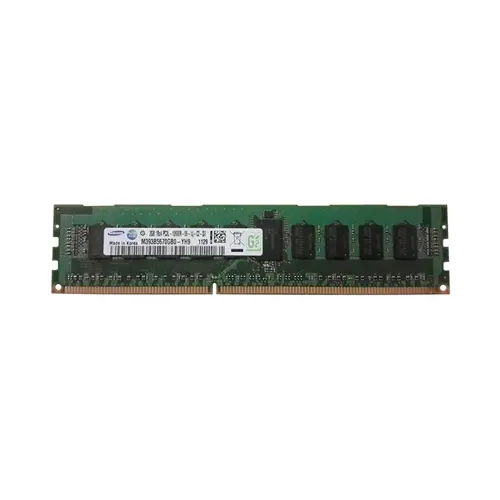
| Model | M393B5670GB0-YH9 |
|---|---|
| Product Type | Memory Module |
| Compliance Standards | CE,WEEE,RoHS |
| Memory Capacity | 2 GB |
| Memory Technology | DDR3 |
| Product Voltage | 1.35V |
| RAM Speed | 1333MHz |
| RAM Standard | DDR3-1333/PC3-10600 |
| Error Identifying | ECC |
| Signal Type | Registered |
| Column Access Strobe (CAS) | CL9 |
| Rank | Single Rank x4 |
| Quantity of Pins | 240-pin |
| RAM Genre | RDIMM |
This DDR3 Registered ECC RDIMM is purpose-built for server environments, delivering the data integrity and reliability required for virtualization, in-memory databases, and other mission-critical enterprise workloads. Its single-rank x4 configuration with registered signal buffering ensures stable signal integrity at 1333 MHz and CAS 9 latency, while the 1.35 V low-voltage operation reduces power consumption in high-density deployments.
1. 2 GB capacity provides a lean, power-efficient memory footprint for single-purpose edge appliances, reducing software licensing and energy costs in lightweight microservice deployments.
2. 1333 MHz clock speed guarantees stable 10.6 GB/s throughput, keeping latency-sensitive database queries and authentication services responsive under concurrent access.
3. 1.35 V low-voltage operation minimizes thermal stress inside dense rack enclosures, directly cutting data center cooling overhead without compromising registered signal integrity.
4. ECC error correction proactively detects and fixes single-bit memory faults, safeguarding transactional data and eliminating silent corruption risks in continuous 24/7 operations.
5. Registered signal buffering locks down command-address stability across multiple DIMM slots, enabling reliable memory expansion and preserving data consistency in high-capacity virtualized nodes.
The Samsung M393B5670GB0-YH9 is a server-grade DDR3 RDIMM, purpose-built for mission-critical enterprise workloads where downtime is not an option. Its ECC technology actively detects and corrects single-bit memory errors, a silent threat that in a dense virtualization cluster could corrupt a hypervisor’s state and crash dozens of guest VMs. Paired with the Registered signal buffer, the module stabilizes high-capacity configurations by minimizing electrical load on the memory controller, allowing you to confidently populate all channels in quad-socket servers without signal degradation. In an in-memory database like Redis or SAP HANA, the single rank x4 organization delivers predictable, low-latency access patterns that keep query response times tight under heavy concurrency. Operating at a low 1.35V, it also reduces thermal output in a fully loaded 2U rack, cutting cooling costs in a 24/7 data center. For virtualization clusters and memory-hungry analytics, this RDIMM translates directly into resilient uptime, consistent throughput, and lower total cost of ownership.
General Virtualization
A single 2GB RDIMM is insufficient for modern hypervisors; populate all available channels with identical modules to maximize interleaving. For light workloads (e.g., 10–15 VMs), install at least six modules (12GB) per socket, leveraging the low 1.35V to reduce power draw in dense racks. Always balance capacity across memory channels to avoid NUMA performance penalties.
In-Memory Database
In-memory datasets demand large capacity and data integrity, making ECC Registered DIMMs essential. Combine these 2GB sticks to reach the software’s minimum working set—typically 32GB or more per node. Populate 16 identical modules per dual-socket server, prioritizing rank uniformity (Single Rank x4) to maintain low latency under sustained 1333MHz, which helps predictable cache-miss response times.
High-Performance Computing (HPC)
HPC favors memory bandwidth over raw capacity; fully populate the memory channels with these low-voltage RDIMMs to exploit maximum interleaving. A common configuration uses eight modules (16GB) per node to feed dual-processor floating-point pipelines without throttling. The registered buffer and 1.35V operation limit thermal strain during multi-day simulations, sustaining stable CL9 timing across all DIMMs.
Strictly tested server memory, compatible with Dell PowerEdge R710/R720, HP ProLiant DL380p Gen8, Lenovo ThinkServer RD630.
Q: Can I mix this M393B5670GB0-YH9 with other memory modules of different brands or speeds?
A: Mixing is not recommended for registered server memory. Different brands, speeds, or ranks may cause instability, POST failures, or reduced reliability. Always use identical modules for validated system performance.
Q: Is this memory compatible with my server?
A: This is a DDR3-1333 ECC Registered RDIMM. It requires a server motherboard with 240-pin slots supporting Intel Xeon E5/E5 v2 or AMD Opteron 6300/4300 platforms that accept 1.35V registered DIMMs.
Q: What is the recommended DIMM population order for optimal performance?
A: For optimal performance, populate identical DIMMs per channel, starting with the number of memory channels supported by your CPU. Always consult the server motherboard manual for the exact slot numbering and population guidelines.
Q: Does this module support overclocking or XMP profiles?
A: No. This ECC Registered DIMM is engineered for 24/7 enterprise stability at JEDEC standard DDR3-1333 speeds. It does not support overclocking, XMP, or any performance profiles beyond its rated specifications.
Q: What warranty and typical failure rate can I expect?
A: This module includes a one-year warranty. Enterprise-class registered memory typically exhibits an annualized failure rate (AFR) well below 0.5% when operated within specified temperature and voltage limits.