











 Secure payments
Standard refund policy
Trade Assurance
Secure payments
Standard refund policy
Trade Assurance
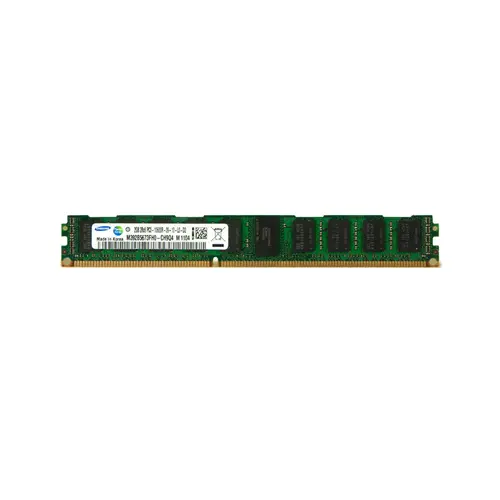
| Model | M392B5673FH0-CH9Q4 |
|---|---|
| Product Type | Memory Module |
| Compliance Standards | EU RoHS,FCC |
| Memory Capacity | 2 GB |
| Memory Technology | DDR3 |
| Product Voltage | 1.5V |
| RAM Speed | 1333MHz |
| RAM Standard | DDR3-1333/PC3-10600 |
| Error Identifying | ECC |
| Signal Type | Registered |
| Column Access Strobe (CAS) | CL9 |
| Rank | Dual Rank x8 |
| Quantity of Pins | 240-pin |
| RAM Genre | VLP RDIMM |
Designed for legacy server platforms, this Samsung DDR3-1333 VLP RDIMM with registered ECC and dual-rank x8 configuration delivers robust data integrity and stable operation under high-density memory configurations. It is ideally suited for virtualization hosts and in-memory databases in 1U/2U rack servers where its very low profile form factor maximizes airflow while maintaining 1.5V power efficiency.
1. ECC protection silently corrects single-bit errors in real time, preventing data corruption that could crash critical enterprise workloads or financial transactions.
2. Registered signal buffering isolates the memory controller from electrical loads, enabling massive module counts in a server without sacrificing signal integrity or uptime.
3. Very low profile form factor doubles the DIMM density along the airflow path, keeping rack servers cool and physically compact while maximizing memory slots.
4. Dual Rank organization interleaves access across internal banks, sustaining peak channel utilization and consistent throughput during heavy database or virtualization sessions.
5. Purpose-built modest capacity targets dedicated management controllers and lightweight appliances, eliminating excessive power draw and cost where high memory is unnecessary.
When you run virtualization clusters or in-memory databases, memory reliability directly impacts uptime and data integrity. The Samsung M392B5673FH0-CH9Q4, a VLP RDIMM, addresses these challenges head-on. Its ECC technology corrects single-bit errors in real time, preventing silent data corruption that could crash hypervisors or corrupt financial records. The Registered buffer reduces electrical loading on the memory controller, letting you fully populate all slots for large-scale consolidation without training errors or instability. The dual-rank x8 design interleaves banks to boost sustained bandwidth, which is critical for low-latency caching engines like Redis, where every microsecond counts. Finally, the Very Low Profile form factor slides easily into 1U blade servers and dense racks, maximizing capacity in space-constrained data centers while maintaining airflow. For your mission-critical environment, this RDIMM is not just a component; it is your baseline assurance against costly failures.
This is a legacy server memory module — a 2GB DDR3-1333 ECC Registered VLP RDIMM. Its small capacity limits modern deployments, but ECC reliability still suits carefully planned environments.
General Virtualization
With only 2GB per DIMM, maximizing socket fill is essential. Populate all memory channels identically — for dual-socket Nehalem/Westmere platforms, install 12 or 18 modules (24–36GB) to support a handful of light VMs. Avoid memory overcommit by matching total capacity to the aggregate working set size of your virtualized workloads.
In-Memory Database
In-memory databases demand large, contiguous memory spaces. A 2GB DIMM severely constrains dataset size; deploy the maximum count your server allows (e.g., 18–24 DIMMs) and restrict usage to small caching or testing instances. For production, upgrade to higher-density 8GB or 16GB DDR3 RDIMMs if the chipset permits — 2GB modules are a bottleneck for any serious in-memory engine.
High-Performance Computing
HPC favors bandwidth and ECC integrity. Install one DIMM per channel to unlock full memory interleaving — for example, six modules across the six channels of a dual-socket Xeon 5600 system. Keep ranks uniform (all dual-rank) and populate sockets symmetrically to maintain NUMA locality, delivering consistent low-latency throughput for compute-bound simulations.
Rigorously tested for server compatibility: Dell PowerEdge R210/R310, HP ProLiant DL360 G7, Lenovo ThinkServer RD330.
Q: Can I mix this M392B5673FH0-CH9Q4 with other memory modules of different brands or speeds?
A: Mixing is not recommended. Registered ECC memory demands matching timings and signal integrity. For guaranteed stability, install identical part numbers. Blending different speeds or ranks may cause POST failures or silent data corruption.
Q: Is this memory compatible with my system?
A: It is a DDR3-1333 Registered ECC VLP RDIMM for servers. Compatible platforms include Intel Xeon 5500/5600 series and AMD Opteron 4100/6100 series. Always verify your server's Qualified Vendor List for full support.
Q: What is the recommended DIMM population order for optimal performance?
A: Follow your server manual’s memory channel population guide. Typically, populate the farthest slot per channel first, and match dual-rank DIMMs within a channel to enable memory interleaving and maximum throughput.
Q: Does this module support overclocking or XMP profiles?
A: No. This is a JEDEC-compliant server module. It does not support XMP or overclocking. It is engineered to deliver rock-solid reliability and data integrity at its rated 1333MHz speed and CL9 timings.
Q: What warranty and typical failure rate can I expect?
A: It includes a one-year warranty. Enterprise-grade RDIMMs like this exhibit an extremely low annualized failure rate, typically under 0.5%, when operated within specified environmental conditions.