











 Secure payments
Standard refund policy
Trade Assurance
Secure payments
Standard refund policy
Trade Assurance
| Model | M393B5670GB0-CH9 |
|---|---|
| Product Type | Memory Module |
| Compliance Standards | EU RoHS,FCC |
| Memory Capacity | 2 GB |
| Memory Technology | DDR3 |
| Product Voltage | 1.5V |
| RAM Speed | 1333MHz |
| RAM Standard | DDR3-1333/PC3-10600 |
| Error Identifying | ECC |
| Signal Type | Registered |
| Column Access Strobe (CAS) | CL9 |
| Rank | Single Rank x4 |
| Quantity of Pins | 240-pin |
| RAM Genre | RDIMM |
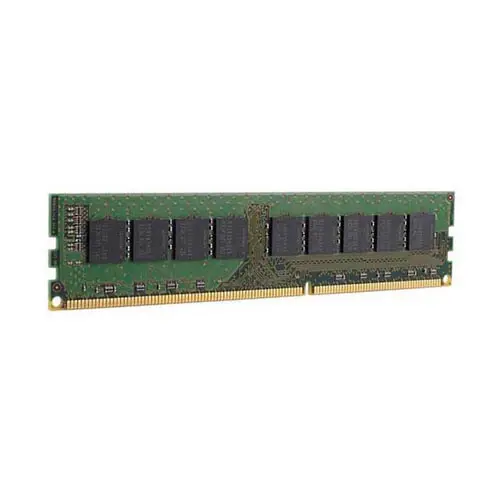
The M393B5670GB0-CH9 is a DDR3-1333 registered server memory module engineered for legacy enterprise platforms running virtualization, in-memory databases, or other mission-critical workloads that demand uncompromising data integrity. Its ECC and registered signal architecture, combined with a single-rank x4 configuration, delivers stable signal timing and robust error correction for reliable 24/7 operation in dense rack environments.
1. ECC actively detects and corrects single-bit memory faults in-line, safeguarding transactional data integrity and eliminating silent corruption risks in always-on server environments.
2. Registered signal buffering re-drives command and address buses, enabling stable high-capacity memory populations that underpin dense virtualization hosts.
3. Single Rank x4 organization minimizes per-DIMM electrical loading, preserving consistent signal integrity and reliable access timing when every memory slot is occupied.
4. The module’s rated throughput provides steady bandwidth headroom to handle simultaneous database queries and light container fleets without throttling.
5. Tight column access latency shrinks the request-to-data gap, elevating responsiveness for latency-critical enterprise applications such as in-memory caching and OLTP systems.
The M393B5670GB0-CH9 is a server DDR3 Registered DIMM engineered for enterprise environments where absolute data integrity and round‑the‑clock stability are non‑negotiable. Its ECC technology actively corrects single‑bit errors in real time, so in a high‑frequency transactional database a stray alpha particle never silently flips a financial record, preserving audit‑trail accuracy and avoiding expensive data corruption. The Registered buffer amplifies command and address signals, allowing you to fully populate every memory channel in a VMware cluster without signal degradation—this lets you densely pack more virtual machines per host with unwavering reliability. With a DDR3‑1333 frequency and a tight CAS latency of 9, the module delivers the responsive bandwidth that in‑memory caches like Redis demand, ensuring microsecond‑sensitive lookups and sorted set operations complete without perceptible lag for customer‑facing applications. The Single Rank x4 organization further lightens the electrical load on the memory bus, reducing access latency and sustaining consistent channel throughput under heavy multi‑threaded I/O. For IT architects, this combination translates directly into hardened platform stability, verified data correctness, and predictable performance that real‑time analytics and virtual desktop infrastructures can count on.
General Virtualization
For a modest virtualization host running 10–15 lightweight VMs, aim for at least 48–64 GB of RAM. Populate all memory channels evenly using 2GB RDIMMs, e.g., 24 modules (48GB) in a three-channel server or 12 modules (24GB) for dual-channel, ensuring balanced performance. Consider using all available DIMM slots to maximize capacity while maintaining ECC protection.
In-Memory Database
In-memory databases demand low latency and high capacity. For a Redis or Memcached node, start with 64–128 GB using 32 to 64 pieces of 2GB RDIMMs across all sockets and channels. Configure identical modules per channel for optimal memory interleaving, and leave no channel partially populated to avoid bandwidth bottlenecks.
HPC
High-performance computing clusters often require a large memory footprint per node. Equip each compute node with 128–256 GB using 64–128 registered 2GB DIMMs, fully populating all memory slots in a balanced configuration. This ensures maximum memory bandwidth for parallel applications while the ECC reliability prevents silent data corruption during long simulation runs.
Rigorously tested server RDIMM for Dell R710/R720, HP DL380 G7/Gen8, IBM x3650 M4.
Q: Can I mix this M393B5670GB0-CH9 with other memory modules of different brands or speeds?
A: Mixing is not recommended. This is a registered ECC DDR3 module with specific timings. Combining dissimilar modules may cause instability, ECC errors, or prevent the server from POSTing.
Q: Is this memory compatible with my system?
A: It is designed for servers using Intel Xeon 5500/5600 series or AMD Opteron 6100/6200 platforms with DDR3 Registered ECC support. Verify your motherboard/system manual for 1333MHz RDIMM qualification.
Q: What is the recommended DIMM population order for optimal performance?
A: Follow your server board’s memory population guide. Typically, populate identical sticks starting with the slot farthest from the CPU per channel, often marked DIMM_A1 or blue slots first.
Q: Does this module support overclocking or XMP profiles?
A: No. This is a JEDEC-compliant server RDIMM built for maximum data integrity and 24/7 reliability, not overclocking. XMP and speed modification are not supported.
Q: What warranty and typical failure rate can I expect?
A: This module comes with a 1-year limited warranty. Enterprise-grade Samsung RDIMMs have a very low annualized failure rate (AFR), typically well below 0.5% under specified conditions.