











 Secure payments
Standard refund policy
Trade Assurance
Secure payments
Standard refund policy
Trade Assurance
| Model | M393B5673GB0-CH9 |
|---|---|
| Product Type | Memory Module |
| Compliance Standards | CE,WEEE,RoHS |
| Memory Capacity | 2 GB |
| Memory Technology | DDR3 |
| Product Voltage | 1.5V |
| RAM Speed | 1333MHz |
| RAM Standard | DDR3-1333/PC3-10600 |
| Error Identifying | ECC |
| Signal Type | Registered |
| Column Access Strobe (CAS) | CL9 |
| Rank | Dual Rank x8 |
| Quantity of Pins | 240-pin |
| RAM Genre | RDIMM |
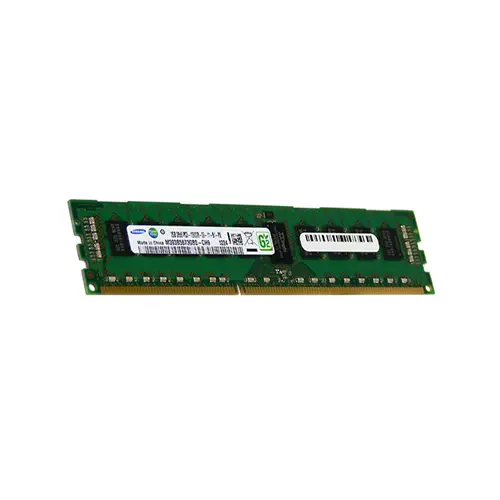
This is a server-class DDR3 RDIMM, purpose-built for platforms requiring registered ECC memory to ensure data integrity in virtualized environments, in-memory databases, and mission-critical workloads. Its dual-rank x8 organization enhances memory bandwidth utilization while the Registered signal type and ECC reliably stabilize multi-DIMM configurations at 1333MHz with CL9 latency.
1. RDIMM form factor ensures compatibility with server-class motherboards, enabling dense memory configurations for heavy multi-tenant workloads.
2. ECC protection detects and corrects single-bit errors in real time, preserving data integrity for financial transactions and mission-critical databases.
3. Registered signal buffering stabilizes command and address lines across fully populated memory channels, essential for maintaining uptime in large-scale virtualization clusters.
4. Dual Rank x8 organization interleaves accesses to keep the memory pipeline fed, boosting throughput for in-memory analytics without adding latency spikes.
5. 1333MT/s data rate delivers a balanced blend of bandwidth and power efficiency, sustaining steady VM response under concurrent user loads.
The M393B5673GB0-CH9 is a server DDR3 Registered DIMM purpose-built for always-on enterprise workloads. Its four defining characteristics directly solve the most pressing pain points in virtualized data centers and in-memory computing. ECC error correction continually repairs single-bit faults, so a cosmic-ray event or transient noise does not silently corrupt your hypervisor, crash guest virtual machines, or poison a transactional database record—preserving business continuity. The Registered buffer maintains clean command signals even when all memory slots in a dual-processor server are populated, making it feasible to scale to hundreds of gigabytes for memory-hungry platforms like SAP HANA or large Redis caches. The dual-rank x8 organization uses bank interleaving to boost effective bandwidth under concurrency, which is critical when dozens of VMs contend for storage and OLTP resources. Finally, the 1333 MHz clock and CL9 latency strike a predictable balance, ensuring that overnight analytics or financial settlements finish strictly within their backup windows. For IT architects, this DIMM turns raw capacity into guaranteed uptime and verifiably accurate data.
This is a server-class 2GB DDR3-1333 Registered ECC memory module. While 2GB density is modest, these capacity planning principles apply to similar RDIMMs.
General Virtualization
Populate all memory channels evenly. In a dual-socket server, install six identical 2GB modules per CPU (12GB) or twelve (24GB) for light VM hosting. Registered ECC ensures data integrity during multi-tenant operations, and uniform loading avoids performance bottlenecks. Always use identical DIMMs to prevent NUMA imbalances.
In-Memory Database
Maximize capacity by populating every DIMM slot—a dual-socket board can accept 18 modules for 36GB total. Enable memory interleaving and apply NUMA-aware settings to reduce latency. When 36GB is insufficient, scale out across additional nodes to hold larger datasets.
HPC
Bandwidth is critical: populate all memory channels symmetrically. For triple-channel architectures, install three or six 2GB DIMMs per processor to unlock the full aggregate bandwidth. Dual-rank x8 modules help maintain signal quality under heavy load; ensure both CPU sockets are fully populated to utilize all memory controllers.
Rigorously tested, compatible with Dell PowerEdge R710, HP ProLiant DL380 G7, IBM System x3650 M3, and more.
Q: Can I mix this M393B5673GB0-CH9 with other memory modules of different brands or speeds?
A: Mixing is not recommended. Registered ECC memory requires identical configuration. Modules run at the slowest common speed, potentially causing stability issues in server environments.
Q: Is this memory compatible with my system?
A: It is compatible with servers using Intel 5500/5600 series or AMD Opteron 6100/6200 platforms that support DDR3 Registered ECC memory at 1333MHz. Verify motherboard's Qualified Vendor List.
Q: What is the recommended DIMM population order for optimal performance?
A: Populate identical DIMMs per channel, starting with the slot farthest from the CPU. Follow the server board's manual for balanced memory configurations to utilize all memory channels.
Q: Does this module support overclocking or XMP profiles?
A: No. As a server-grade Registered ECC module, it adheres strictly to JEDEC standards for reliability. Overclocking and XMP are not supported and would compromise data integrity.
Q: What warranty and typical failure rate can I expect?
A: This module carries a 1-year warranty. Enterprise-class DDR3 RDIMMs exhibit very low failure rates, typically under 0.4% annually, ensuring high reliability for critical server workloads.