











 Secure payments
Standard refund policy
Trade Assurance
Secure payments
Standard refund policy
Trade Assurance
| Model | M393B5773DH0-CH9 |
|---|---|
| Product Type | Memory Module |
| Compliance Standards | CE,WEEE,RoHS |
| Memory Capacity | 2 GB |
| Memory Technology | DDR3 |
| Product Voltage | 1.5V |
| RAM Speed | 1333MHz |
| RAM Standard | DDR3-1333/PC3-10600 |
| Error Identifying | ECC |
| Signal Type | Registered |
| Column Access Strobe (CAS) | CL9 |
| Rank | Single Rank x8 |
| Quantity of Pins | 240-pin |
| RAM Genre | RDIMM |
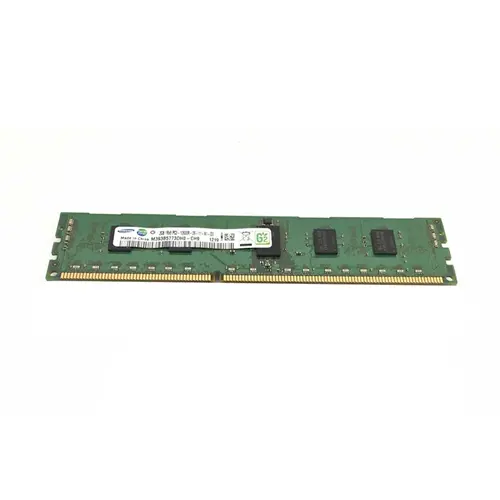
This Samsung M393B5773DH0-CH9 is a DDR3-1333 Registered ECC RDIMM, optimized for server platforms running memory-intensive workloads such as virtualization and in-memory databases, where its ECC and registered signal architecture ensure critical data integrity and stable operation under fully populated multi-DIMM configurations. The single-rank x8 design with CL9 latency offers a balanced combination of low electrical loading and predictable access times, making it a reliable choice for maintaining consistent performance in enterprise environments.
1. ECC error correction continuously detects and corrects single-bit memory faults, preserving data integrity in long-running virtualization hosts and preventing silent corruption in financial transaction logs.
2. Registered signal buffering decouples the memory controller from DRAM loading, letting fully populated 24-DIMM servers scale without degraded command bus stability under heavy consolidation.
3. 1333 MHz speed provides a predictable bandwidth envelope per channel, efficiently supporting concurrent mid-tier web containers and lightweight in-memory caching without oversubscribing the memory controller.
4. 2 GB capacity offers a granular provisioning unit for embedded hypervisor footprints or dedicated management partitions, keeping overhead low in massively parallel scale-out nodes.
5. Single Rank x8 organization draws lighter electrical load per channel, ensuring clean signal margins when all six slots per CPU are populated in dense 1U hosting appliances.
The Samsung M393B5773DH0-CH9 is a server-grade DDR3 Registered DIMM engineered for mission-critical environments, and its four defining characteristics translate directly into operational resilience. The ECC technology actively detects and corrects single-bit errors, a non-negotiable safeguard when you are running dense virtualization clusters. Without it, cosmic-ray-induced bit flips in a hypervisor's memory space can silently corrupt dozens of guest VMs or crash an entire node mid-transaction, leading to costly downtime. The registered buffer isolates the memory controller from the electrical load of multiple modules, allowing you to fully populate all memory channels and scale capacity without compromising signal integrity. This stability is vital for in-memory databases like Redis or SAP HANA, where even intermittent data loss is unacceptable. Its single-rank x8 design further reduces bus loading, helping the module reliably sustain its 1333MHz frequency at CL9 latency under constant, heavy I/O. Whether consolidating virtual machines or accelerating real-time analytics, these features mean the difference between a platform you trust with your data and one that introduces silent risk into your infrastructure.
Based on its ECC, Registered, and 240-pin RDIMM characteristics, this is a server DDR3 memory module.
General Virtualization
Symmetrically populate memory channels across all sockets to optimize NUMA performance. Start with one DIMM per channel for maximum clock speed; when capacity demands grow, install two matched 2 GB RDIMMs per channel, achieving 32–48 GB. Note that a 2 DPC configuration may downclock to 1066 MHz, so balance capacity with speed.
In-Memory Database
Use identical 2 GB single-rank RDIMMs in all slots for rank interleaving and lower latency. A 24-slot server provides 48 GB, suitable for small Redis or memcached instances. Be aware: two DIMMs per channel forces 1066 MHz, which may impact transaction throughput.
High-Performance Computing (HPC)
For maximum memory bandwidth, populate one single-rank DIMM per channel to sustain 1333 MHz. Twelve modules deliver 24 GB, enough for many compute-bound workloads. Only add a second DIMM per channel when working sets exceed RAM, tolerating the downclock to 1066 MHz.
Rigorously tested DDR3-1333 RDIMM, compatible with Dell PowerEdge R710/R720, HP ProLiant DL380 G7, and Lenovo ThinkServer RD630.
Q: Can I mix this M393B5773DH0-CH9 with other memory modules of different brands or speeds?
A: Mixing modules is not recommended for server environments. Use identical part numbers to ensure signal integrity, rank parity, and reliable operation under ECC Registered constraints.
Q: Is this memory compatible with my Intel Xeon or AMD Opteron server?
A: This DDR3-1333 ECC Registered DIMM supports platforms with compatible 240-pin slots, such as Intel Xeon E5-2600/E5-2400 series and AMD Opteron 4300/6300 series. Verify the server board’s QVL for exact qualification.
Q: What is the recommended DIMM population order for optimal performance?
A: Always follow your server motherboard manual. Typically, populate identical DIMMs per channel, starting from the farthest slot from the CPU, balancing loads across memory controllers for dual-processor configurations.
Q: Does this module support overclocking or XMP profiles?
A: No. Registered server memory adheres strictly to JEDEC standards for maximum reliability. Overclocking and XMP profiles are not supported, ensuring 24/7 data integrity in mission-critical workloads.
Q: What warranty and typical failure rate can I expect?
A: Covered by a one-year warranty. Built with Samsung’s enterprise-grade components, it delivers an extremely low annualized failure rate, enhanced by extensive burn-in and system-level validation for stable server operations.