











 Secure payments
Standard refund policy
Trade Assurance
Secure payments
Standard refund policy
Trade Assurance
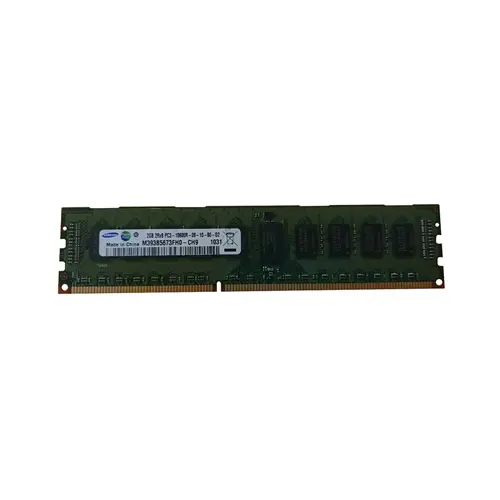
| Model | M393B5673FHO-CH9 |
|---|---|
| Product Type | Memory Module |
| Compliance Standards | CE,WEEE,RoHS |
| Memory Capacity | 2 GB |
| Memory Technology | DDR3 |
| Product Voltage | 1.5V |
| RAM Speed | 1333MHz |
| RAM Standard | DDR3-1333/PC3-10600 |
| Error Identifying | ECC |
| Signal Type | Registered |
| Column Access Strobe (CAS) | CL9 |
| Rank | Dual Rank x8 |
| Quantity of Pins | 240-pin |
| RAM Genre | RDIMM |
This DDR3 Registered ECC DIMM, with its 2GB capacity and 1333MHz speed at CL9, is engineered for legacy server platforms where data integrity and stability are critical. Its dual-rank x8 organization and registered signaling make it particularly suited for memory-dense virtualization hosts and small database servers, delivering reliable error correction and reduced electrical load on the memory controller.
1. ECC error correction detects and fixes single-bit memory faults in real time, preventing silent data corruption that could compromise financial transactions or database integrity.
2. Registered clock buffering amplifies command signals across fully loaded server boards, sustaining rock-solid stability as DIMM population scales up for heavy virtualization hosts.
3. Dual-rank organization interleaves internal banks to boost effective bandwidth, reducing latency under concurrent VM memory pressure without adding physical modules.
4. The mainstream DDR3 frequency delivers consistent throughput for legacy enterprise workloads, keeping power and cooling demands predictable in always-on data centers.
5. Compact module capacity suits lightweight edge services and dedicated network appliances, trimming idle power and per-node licensing costs where massive memory is not required.
The Samsung M393B5673FHO-CH9 is a 2GB DDR3-1333 Registered DIMM engineered specifically for server environments where data integrity and uptime are non-negotiable. Its ECC technology continuously detects and corrects single-bit memory errors, a critical safeguard against silent data corruption that can crash virtual machines or poison financial transaction logs. When you are running a dense virtualization cluster hosting dozens of tenants, that protection means the difference between flawless live migration and a cascading failure. The registered signal buffer governs the electrical load on the memory bus, allowing IT architects to populate all 24 DIMM slots on a dual-socket board without sacrificing stability. This directly enables large-scale in-memory databases or VDI deployments where capacity scalability is the bottleneck. Combined with its dual‑rank x8 organization delivering balanced bandwidth at CL9 latency, this module keeps latencies predictable under heavy simultaneous read/write workloads. In a Redis or Memcached farm where microseconds impact user experience, those consistent access times ensure your caching layer performs reliably even as concurrency spikes. All of this comes with full compliance to WEEE and RoHS standards, so server refreshes stay sustainable across the lifecycle.
General Virtualization
For general virtualization hosts, this 2GB RDIMM is merely a basic building block. Configure with at least six identical modules per CPU to populate triple-channel memory architectures common in DDR3-era servers, reaching 12GB per processor. Prioritize populating all memory channels evenly to maximize bandwidth, and plan for a total of 48GB to 96GB across the system to comfortably run a moderate number of virtual machines.
In-Memory Database
In-memory databases demand large capacity and fault tolerance. Given the 2GB density, you will need to fully populate all DIMM slots to reach meaningful totals—aim for 128GB or more using 16 or 24 modules in a multi-socket server. The ECC and registered features are critical here to prevent data corruption, so never mix this with unbuffered modules; strict population order per motherboard manual is mandatory to maintain signal integrity.
High-Performance Computing
HPC clusters value memory bandwidth over raw capacity for many workloads. Deploy these DIMMs in balanced sets across all memory channels—typically three or four modules per socket—to achieve peak interleaved bandwidth. For dense compute nodes, 24GB or 48GB per node using 12 or 24 modules keeps power consumption manageable while providing enough headroom for MPI processes and shared memory parallelism without wasting ranks.
Rigorously tested for compatibility with Dell PowerEdge R710, R610, T610, HP DL380 G7, DL360 G7, IBM x3550 M3, and more.
Q: Can I mix this M393B5673FHO-CH9 with other memory modules of different brands or speeds?
A: Mixing is not recommended for server environments. Different RDIMM brands or speeds may cause instability or ECC errors. For guaranteed reliability, use identical Samsung modules with the same rank and CAS latency across all channels.
Q: Is this memory compatible with my system?
A: This DDR3-1333 Registered ECC module is designed for Intel Xeon 5500/5600 series and AMD Opteron 6100/6200/G34 platforms. Confirm your server board supports 1.5V RDIMMs and a 240-pin DDR3 interface before ordering.
Q: What is the recommended DIMM population order for optimal performance?
A: Populate identical RDIMMs in sets of three (for triple-channel) or four (for quad-channel), starting with the slots farthest from the CPU. Always follow your server motherboard’s specific memory population guide for balanced interleaving.
Q: Does this module support overclocking or XMP profiles?
A: No. As an enterprise RDIMM, M393B5673FHO-CH9 adheres strictly to JEDEC DDR3-1333 standards. Overclocking and XMP are not supported; the module is engineered for maximum stability and data integrity at rated speed.
Q: What warranty and typical failure rate can I expect?
A: This module is covered by a 1-year warranty. Samsung server memory exhibits an industry-leading low AFR (annualized failure rate) well below 1%, ensuring dependable 24/7 operation in mission-critical environments.