











 Secure payments
Standard refund policy
Trade Assurance
Secure payments
Standard refund policy
Trade Assurance
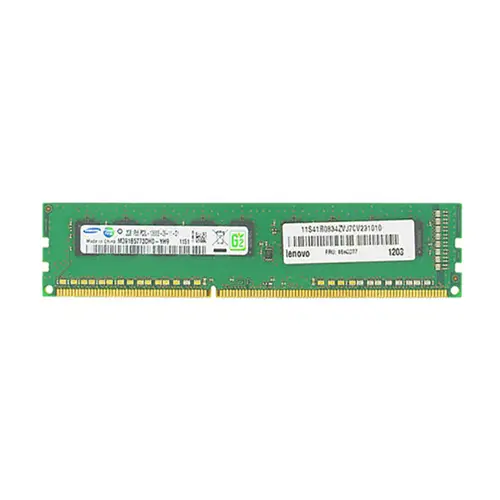
| Model | M391B5773DH0-YH9 |
|---|---|
| Product Type | Memory Module |
| Compliance Standards | EU RoHS,FCC |
| Memory Capacity | 2 GB |
| Memory Technology | DDR3 |
| Product Voltage | 1.35V |
| RAM Speed | 1333MHz |
| RAM Standard | DDR3-1333/PC3-10600 |
| Error Identifying | ECC |
| Signal Type | Unbuffered |
| Column Access Strobe (CAS) | CL9 |
| Rank | Single Rank x8 |
| Quantity of Pins | 240-pin |
| RAM Genre | UDIMM |
This is an ECC Unbuffered DIMM (UDIMM) for entry-level server and workstation platforms that require data integrity without the cost of registered memory. Its Single Rank x8 organization and low 1.35V DDR3L operation deliver reliable 1333MHz performance with CL9 latency, making it ideal for small business servers, NAS units, or proof-of-concept virtualization environments where error correction and power efficiency are critical.
1. ECC protection corrects single-bit memory errors in real time, preserving financial calculations or archival integrity that entry-level servers cannot afford to lose.
2. Unbuffered signaling eliminates registered clock delays, delivering the lowest possible latency for lightweight edge services where every microsecond counts.
3. Operating at just 1.35V keeps thermal output and electricity draw to a minimum, which directly lowers lifetime cooling costs in dense microserver deployments.
4. 1333MHz bandwidth supplies steady throughput for moderate concurrent connections, ensuring a responsive experience on small business web hosts.
5. A compact two-gigabyte capacity matches dedicated embedded controllers or lean container hosts perfectly, keeping idle power consumption and acquisition cost strictly in check.
Designed for entry-level servers, workstations, and always-on embedded systems, the Samsung M391B5773DH0-YH9 is an ECC Unbuffered DDR3 memory module built to prioritize reliability over raw speed. Its quartet of features directly addresses the pain points of IT administrators and system integrators who simply cannot afford silent data corruption or unplanned downtime.
The ECC capability is non-negotiable. In a small-business file server or a medical imaging archive, a single-bit error in a cached metadata structure can silently corrupt patient records or financial transactions. This module detects and corrects those single-bit flips, preserving data integrity without crashing the application. The 1.35V low-voltage operation becomes critical in a sealed network appliance or a 24/7 edge device with restricted airflow. It reduces thermal stress by up to 20% compared to standard 1.5V DDR3, extending the lifespan of the motherboard and cutting energy costs across a fleet of remote units.
Meanwhile, the single‑rank x8 organization and Unbuffered design mean you get rock‑stable signal quality and lower latency. For a lightweight virtualized host running a pfSense firewall and a small database, no register delay translates into snappier response under mixed workloads. The 1333MHz speed at CL9 rounds out the profile, providing consistent bandwidth for legacy industrial controllers that demand deterministic timing. Every parameter here is a safeguard—not a spec sheet bullet point, but a promise that your system stays up, your data stays accurate, and your maintenance stays minimal.
Server Memory Identification
The module M391B5773DH0-YH9 is a DDR3-1333 ECC Unbuffered DIMM (UDIMM). Its ECC support, 1.35V low voltage, and 240-pin form factor mark it as memory for single-socket servers or entry-level workstations using platforms like Intel Xeon E3-1200 series. Because it is unregistered, it relies on the CPU’s memory controller directly, limiting maximum module count per channel. The base capacity is only 2 GB per DIMM, which is very small by modern standards—capacity planning must account for this low density.
General Virtualization
With a small 2 GB module, populate all available channels in pairs to maximize memory interleaving and bandwidth. For a four-channel platform, install eight identical DIMMs (16 GB total) to avoid bottlenecks while running lightweight virtual machines. Use identical ranks and timings to ensure stable ECC operation; mixing capacities will cause the hypervisor to drop to non-interleaved mode and reduce VM density.
In-Memory Database
In-memory databases demand both capacity and reliability. Scale by filling every DIMM slot with the largest supported ECC UDIMMs—using multiple 8 GB DIMMs if the board allows—to store hot datasets entirely in RAM. Given the 2 GB base, replace all modules with higher-density ECC UDIMMs to reach at least 64 GB for small Redis or Memcached instances. Always install matched kits and enable hardware memory scrubbing to guard against correctable errors.
High-Performance Computing
HPC workloads need peak memory bandwidth and ECC integrity. Configure one DIMM per channel (1DPC) with the fastest supported speed to avoid loading the memory bus. Eight 2 GB DIMMs in a quad-channel board deliver 16 GB and maximum bandwidth for lightweight computational kernels. For larger working sets, upgrade to high-density ECC UDIMMs while strictly keeping one module per channel, and tune sub-NUMA clustering in the BIOS if available to reduce latency.
Rigorously validated server memory, fully compatible with Dell PowerEdge T110 II, HP ProLiant MicroServer Gen8, and Lenovo ThinkServer TS140.
Q: Can I mix this M391B5773DH0-YH9 with other memory modules of different brands or speeds?
A: Mixing is not recommended. Mismatched modules can cause instability or ECC errors. For reliable operation, use identical modules with the same speed, voltage, and rank.
Q: Is this memory compatible with my system?
A: This ECC UDIMM targets single-socket servers and workstations using Intel Xeon E3 or AMD Opteron 3000 series. Verify your board supports DDR3 ECC Unbuffered 240-pin DIMMs.
Q: What is the recommended DIMM population order for optimal performance?
A: Populate slots starting farthest from the CPU per your manual. Use matched pairs per channel for dual-channel operation. ECC UDIMMs require identical modules in each channel for reliability.
Q: Does this module support overclocking or XMP profiles?
A: No. This server ECC module runs at JEDEC standard DDR3-1333 without XMP support. Overclocking is not supported and may compromise data integrity.
Q: What warranty and typical failure rate can I expect?
A: This product carries a 1-year warranty. The typical annualized failure rate is under 0.5% under normal conditions. ECC actively corrects single-bit errors for enhanced reliability.