











 Secure payments
Standard refund policy
Trade Assurance
Secure payments
Standard refund policy
Trade Assurance
| Product Type | Memory Module |
|---|---|
| Memory Capacity | 2 GB |
| Memory Technology | DDR3 |
| RAM Speed | 1333 |
| RAM Standard | DDR3-1333/PC3-10600 |
| Error Identifying | Non-ECC |
| Signal Type | Unbuffered |
| Column Access Strobe (CAS) | CL9 |
| Rank | Single Rank x8 |
| Quantity of Pins | 204-pin |
| RAM Genre | SoDIMM |
This DDR3-1333 SO-DIMM is purpose-built for notebook upgrades and mobile workstations, leveraging a single-rank x8 layout and 1.5V operating voltage to deliver enhanced power efficiency and broad platform compatibility in thermally constrained chassis. Its unbuffered, Non-ECC design with CL9 latency achieves responsive, low-overhead data access ideal for office productivity, web-based workloads, and embedded applications requiring stable plug-and-play installation.
1. SoDIMM form factor guarantees effortless drop-in installation into ultra-thin notebook chassis, eliminating any physical compatibility concerns during an upgrade.
2. A 2 GB capacity provides a cost-effective lift for aging laptops, bringing just enough memory to revitalize basic multitasking and web browsing without breaking the bank.
3. 1333 MT/s speed achieves the optimal balance of responsive application launches and minimal power draw, ideal for extending battery runtime on mobile DDR3 platforms.
4. CL9 latency ensures crisp data retrieval that reduces wait times during everyday productivity, enhancing the feel of snappiness on older systems.
5. Single Rank x8 organization minimizes electrical loading and heat generation, a crucial benefit for fanless or tightly packed notebook thermals.
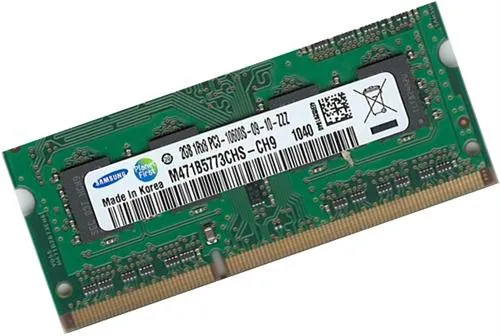
When upgrading an aging notebook, every watt and every millimeter counts. The Samsung M471B5773CHS-CH9 is a 2 GB DDR3-1333 SoDIMM built specifically for the thermal and power constraints of laptops, and its four defining characteristics directly solve real frustrations for mobile users. First, the 1333 MT/s speed paired with a CL9 latency keeps applications responsive during multitasking—imagine a field engineer running diagnostic software while referencing schematics on a single lightweight machine; stuttering disappears because the memory feeds the CPU without delay. Second, the single-rank x8 architecture and unbuffered, non-ECC design draw significantly less power than multi-rank or registered alternatives. For a travelling consultant squeezing extra battery life out of an ultrabook between client meetings, lower power draw translates to tangible additional working minutes. Third, the compact 204-pin SoDIMM form factor guarantees a drop-in fit in tight chassis, from thin-and-light notebooks to mobile workstations, eliminating clearance surprises during an upgrade. Finally, its strict JEDEC compliance ensures flawless compatibility on older Intel and AMD platforms where many generic modules fail to boot. Choosing this memory means restoring a reliable, energy-conscious portable workhorse instead of wrestling with unpredictable hardware—a decisive advantage for IT managers and home upgraders alike.
Laptop Upgrade
For aging notebooks originally equipped with a single 2 GB DDR3-1333 SO-DIMM, the simplest upgrade is to add a second identical module to enable dual-channel operation and reach 4 GB total. This configuration boosts responsiveness under Windows 10/11 and light multitasking without replacing the existing stick. If the system supports it, swapping both slots with a matched pair of 4 GB modules (8 GB total) delivers a significant headroom improvement for modern web browsing and office applications, while maintaining the same 1.5 V, CL9 timing and unbuffered non-ECC profile.
Mobile Workstation
Professional workloads such as CAD, 3D rendering, or large dataset analysis demand headroom far beyond the original 2 GB. Populate both SO-DIMM slots with high-capacity 8 GB DDR3-1333 modules to achieve 16 GB dual-channel – the practical maximum for most DDR3-era mobile workstations. Ensure replacement kits match the 204-pin, 1.5 V, CL9, single-rank specification to avoid compatibility issues. This configuration prevents excessive swapping and keeps memory-intensive applications stable during extended sessions.
Ultrabook Power Saving
Standard 1.5 V DDR3 modules can waste precious battery life in ultra-thin portables. To improve runtime, replace existing memory with pin-compatible DDR3L-1333 SO-DIMMs operating at 1.35 V, while keeping the same CL9 latency and unregistered non-ECC design. A single 8 GB low-voltage module offers both a capacity boost and reduced platform power consumption, or a 2×4 GB dual-channel DDR3L kit preserves balanced performance with longer battery endurance, ideal for road-warriors who prioritize all-day productivity.
This laptop SODIMM is rigorously tested, compatible with Dell Latitude E6420, Lenovo ThinkPad T420.
Q: Can I mix this M471B5773CHS-CH9 with other memory modules of different brands or speeds?
A: Mixing brands or speeds is not recommended, as mismatched timings and chip characteristics may cause instability. For best reliability, install identical modules with the same part number and specifications.
Q: Is this memory compatible with my system?
A: This 2GB DDR3-1333 non-ECC unbuffered SoDIMM fits most laptops with DDR3 slots, such as Intel HM55 series or AMD A-series platforms. Verify your notebook supports 204-pin and non-ECC memory.
Q: What is the recommended DIMM population order for optimal performance?
A: Most laptops have one or two slots. Populate available slots with identical modules to enable dual-channel mode for a slight performance gain. Single module operation is also fully supported.
Q: Does this module support overclocking or XMP profiles?
A: No. This module adheres to JEDEC DDR3-1333 CL9 specifications and does not support XMP or overclocking. It runs at a fixed frequency and latency to ensure stable operation in laptops.
Q: What warranty and typical failure rate can I expect?
A: This Samsung original module includes a 1-year warranty. Typical annualized failure rate is well under 1%, backed by rigorous testing to ensure long-term reliability in mobile environments.