











 Secure payments
Standard refund policy
Trade Assurance
Secure payments
Standard refund policy
Trade Assurance
| Model | M392B5670GB0-YH9 |
|---|---|
| Product Type | Memory Module |
| Compliance Standards | EU RoHS,FCC |
| Memory Capacity | 2 GB |
| Memory Technology | DDR3 |
| Product Voltage | 1.35V |
| RAM Speed | 1333MHz |
| RAM Standard | DDR3-1333/PC3-10600 |
| Error Identifying | ECC |
| Signal Type | Registered |
| Column Access Strobe (CAS) | CL9 |
| Rank | Single Rank x4 |
| Quantity of Pins | 240-pin |
| RAM Genre | VLP RDIMM |
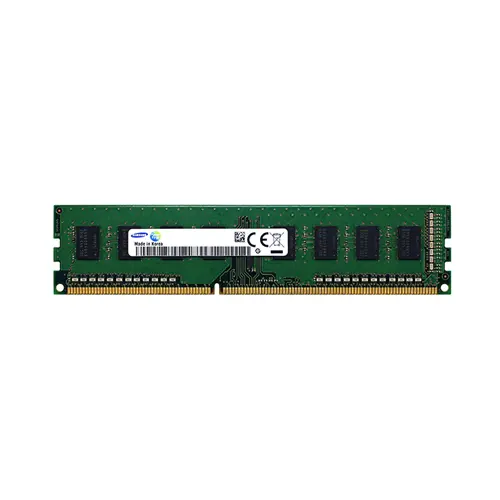
Designed for dense server deployments, this Samsung VLP RDIMM’s 1.35V ultra-low profile form factor and single-rank x4 configuration maximize airflow and signal integrity in space-constrained chassis. With registered ECC and a CAS latency of 9 at 1333MHz, it delivers rock-solid data integrity for memory-intensive workloads such as virtualization and in-memory databases, where even single-bit errors are unacceptable.
1. Registered signal type buffers command and address lines, enabling higher memory density per channel and rock-solid signal integrity in multi-DIMM server configurations.
2. ECC error correction detects and corrects single-bit memory faults in real time, directly preventing silent data corruption in mission-critical database and virtualization workloads.
3. Very Low Profile RDIMM form factor fits seamlessly into blade servers and dense rack enclosures where vertical clearance is severely restricted, maximizing airflow and compute density.
4. 1.35V low-voltage operation reduces thermal dissipation at the DIMM level, cutting overall data center cooling costs while maintaining reliable performance under constant load.
5. 1333MHz clock speed delivers a balanced throughput ideal for entry-level server applications, ensuring consistent bandwidth for web serving and light virtualization without unnecessary power draw.
The M392B5670GB0-YH9 is a DDR3-1333 Very Low Profile Registered DIMM purpose‑built for dense server deployments. Its ECC technology protects data integrity by correcting single‑bit errors on the fly—something that matters acutely when a cosmic‑ray‑induced flip disrupts an in‑memory database like Redis or corrupts a VM snapshot during a live migration. The registered signal buffer stabilizes command and address lines, letting you populate all 24 slots of a dual‑socket virtualization host without signal degradation; this means reliable operation when you consolidate hundreds of tenants onto a single node. Operating at 1.35 V, the module trims power consumption by over 10% compared to older 1.5 V parts, which lowers cooling requirements in crowded racks and extends the life of shared power supplies. Finally, the very‑low‑profile design fits into 1U chassis where standard DIMMs would collide with CPU heatsinks, preserving airflow while giving you room to scale capacity. In a VMware farm balancing dozens of virtual machines or in a response‑critical Memcached tier, these four traits—error resilience, dense‑rack stability, energy efficiency, and physical compatibility—translate directly into higher uptime and a lower total cost of ownership.
General Virtualization
For general virtualization hosts, balance capacity and reliability across all available memory channels. Populate each channel identically with one or two of these 2GB VLP RDIMMs per channel to maintain symmetric multi-channel operation — for example, 12 modules (24GB total) in a dual-socket, triple-channel server. The ECC and registered design ensure data integrity under multi-VM workloads, while the 1.35V low-voltage operation helps control overall power consumption in dense virtualized environments.
In-Memory Database
In-memory databases demand the lowest possible latency and maximized capacity within a single node. Although the 2GB density per module is modest, install the maximum supported number of these DIMMs — populate every slot across all memory channels to aggregate capacity (e.g., 18 modules for 36GB on a dual-socket, three-DIMM-per-channel board). The registered, single-rank x4 organization delivers predictable CL9 latency and stable high-frequency access, and the very-low-profile form factor eases airflow in fully populated chassis, which is critical for sustained in-memory processing.
High-Performance Computing
HPC clusters benefit from the high bandwidth achieved by saturating all memory channels uniformly. Deploy one DIMM per channel in a balanced configuration — such as eight modules (16GB) across eight channels in a dual-socket system — to maximize parallel data throughput. The ECC protection guards against silent data corruption during long-running simulations, and the 1.35V VLP RDIMM design minimizes thermal footprint in dense, rack-mounted compute nodes, helping maintain clock stability at 1333MHz in clustered environments.
Rigorously tested, this 2GB DDR3L VLP RDIMM is compatible with Dell PowerEdge R720, HPE DL380p Gen8, IBM x3650 M4.
Q: Can I mix this M392B5670GB0-YH9 with other memory modules of different brands or speeds?
A: For server stability, mixing different brands, speeds, or part numbers is not recommended. Uniform modules prevent signal integrity issues and ensure reliable 24/7 operation. Always use identical sticks.
Q: Is this memory compatible with my system?
A: This DDR3-1333 ECC Registered VLP RDIMM is designed for dual-processor servers with Intel Xeon E5-2400 series or AMD equivalent platforms supporting these specs. Verify your motherboard’s QVL for exact compatibility.
Q: What is the recommended DIMM population order for optimal performance?
A: Populate memory channels symmetrically per your server manual: typically fill slot 1 in each channel first with identical DIMMs to enable multi-channel interleaving and maximize bandwidth.
Q: Does this module support overclocking or XMP profiles?
A: No, this is a server-grade module strictly following JEDEC specifications. It does not support overclocking or XMP. Reliability and stability under constant load are prioritized over speed tuning.
Q: What warranty and typical failure rate can I expect?
A: This module includes a 1-year warranty. With rigorous testing and ECC technology, the annualized failure rate is very low, ensuring enterprise-class reliability when operated within specifications.