











 Secure payments
Standard refund policy
Trade Assurance
Secure payments
Standard refund policy
Trade Assurance
| Product Type | Memory Module |
|---|---|
| Compliance Standards | EU RoHS,FCC |
| Memory Capacity | 2 GB |
| Memory Technology | DDR3 |
| RAM Speed | 1333MHz |
| RAM Standard | DDR3-1333/PC3-10600 |
| Error Identifying | Non-ECC |
| Signal Type | Unbuffered |
| Column Access Strobe (CAS) | CL9 |
| Rank | Dual Rank x8 |
| Quantity of Pins | 240-pin |
| RAM Genre | UDIMM |
This unbuffered, non-ECC DDR3 UDIMM is best suited for upgrading older desktop platforms used for productivity and light content creation, where its Dual Rank x8 organization improves memory interleaving and sustained bandwidth under mixed workloads. The true-standard 1333MHz speed and CL9 latency ensure straightforward plug-and-play compatibility with mainstream LGA1155/LGA1150 systems, delivering stable system responsiveness without requiring manual tuning.
1. An unbuffered UDIMM form factor ensures effortless compatibility with consumer desktop boards, enabling straightforward DIY upgrades for better system responsiveness.
2. Non-ECC memory eliminates server-class overhead, minimizing latency for snappier application launches and more fluid desktop multitasking.
3. High-speed DDR3 clocking sustains ample throughput for smooth high-definition video playback and responsive everyday computing.
4. Tight CAS latency accelerates data retrieval, reducing micro-stutters in casual gaming and speeding up file compression tasks.
5. Dual-rank configuration interleaves memory banks to increase effective bandwidth, noticeably improving integrated graphics frame consistency in light gaming.
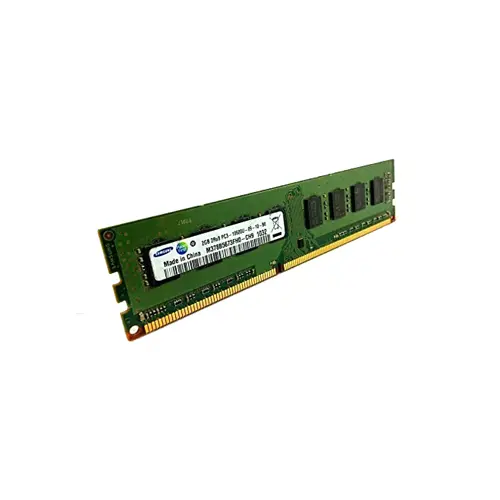
Built for desktops, the Samsung M378B5673FH0-CH9 UDIMM (240-pin, unbuffered, non-ECC) may be a DDR3 module, but its design directly addresses real user frustrations. First, operating at 1333MHz with a 10.6 GB/s bandwidth, it eliminates sluggishness when jumping between browser tabs, office applications, and a 1080p video render. Second, a CAS latency of 9 means the memory controller waits minimal cycles for data; in competitive gaming, that delivers snappier weapon switches and faster level loads. Third, the dual-rank x8 organization uses two internal ranks that interleave commands, parallelizing data access—essential for video editors scrubbing through a timeline without dropped frames. Finally, the unbuffered, non-ECC signal path avoids extra buffering delays, preserving the low latency desktop CPUs require and ensuring drop-in compatibility with numerous LGA1155 and AM3+ boards. For anyone revitalizing an older PC, these four features translate directly to a responsive, stutter-free experience at an excellent value.
Gaming Build
For a budget dual-channel setup, install two 2 GB modules for a total of 4 GB; however, this only supports very light eSports titles and falls short of modern gaming’s 16 GB recommendation. Achieving 16 GB would require eight such DIMMs, exceeding typical motherboard slots, making these modules impractical for serious gaming. Replacing them with higher‑density 8 GB DDR3 sticks is strongly advised.
Content Creation
Video editing and 3D rendering demand large capacities, often 64 GB for smooth timeline scrubbing. With 2 GB UDIMMs, reaching 64 GB would need 32 modules—physically impossible on standard desktop platforms. These modules are unsuitable for content creation; reserve them for basic test benches or legacy systems only.
General Productivity
A pair of 2 GB modules (4 GB total) in dual‑channel mode delivers acceptable performance for web browsing, email, and office documents. For heavier multitasking with dozens of browser tabs and spreadsheets, installing four modules (8 GB) extends usability while keeping costs minimal. This remains a sensible, low‑budget configuration for everyday computing.
Rigorously tested for compatibility with desktops like Dell Optiplex 790 and HP Compaq 8200 Elite.
Q: Can I mix this M378B5673FH0-CH9 with other memory modules of different brands or speeds?
A: Mixing is possible but not recommended. The system will downclock to the slowest module. For best stability, match identical speed, timings, and voltage. Dual-channel configurations perform best with identical sticks.
Q: Is this memory compatible with my system?
A: This 240-pin DDR3 UDIMM fits desktop motherboards with DDR3 slots. It works with Intel 6/7/8 Series chipsets (e.g., H61, Z77) and AMD 9 Series/FM1/AM3+ platforms. Verify your board supports 1333MHz Non‑ECC unbuffered memory.
Q: What is the recommended DIMM population order for optimal performance?
A: Install pairs of identical modules in the same-colored slots to enable dual‑channel mode. For a single 2GB stick, use the primary slot (often DIMM_A1). Refer to your motherboard manual for slot numbering and channel architecture.
Q: Does this module support overclocking or XMP profiles?
A: No, this module operates at standard JEDEC DDR3-1333 CL9. It does not include XMP profiles or support overclocking. It is designed for reliable operation at the specified speed.
Q: What warranty and typical failure rate can I expect?
A: This memory comes with a 1‑year warranty. Typical failure rate is extremely low under normal usage, with an annualized failure rate well below 0.5%. It meets rigorous Samsung quality and reliability standards.