











 Secure payments
Standard refund policy
Trade Assurance
Secure payments
Standard refund policy
Trade Assurance
| Product Type | Memory Module |
|---|---|
| Compliance Standards | CE,WEEE,RoHS |
| Memory Capacity | 2 GB |
| Memory Technology | DDR3 |
| RAM Speed | 1333MHz |
| RAM Standard | DDR3-1333/PC3-10600 |
| Error Identifying | Non-ECC |
| Signal Type | Unbuffered |
| Column Access Strobe (CAS) | CL9 |
| Rank | Dual Rank x8 |
| Quantity of Pins | 240-pin |
| RAM Genre | UDIMM |
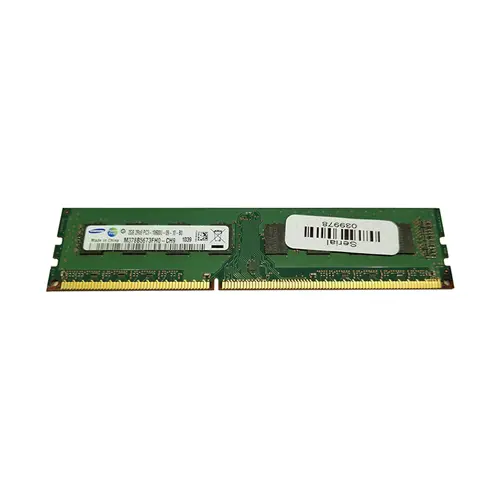
This DDR3-1333 UDIMM with a CL9 latency and dual-rank x8 organization is a desktop memory module well-suited for mainstream productivity, gaming, and content creation on platforms like Intel LGA 1155/1150 or AMD AM3+ systems. Its dual-rank configuration improves interleaving efficiency for a slight bandwidth boost in memory-intensive tasks, while the 1333MHz speed and standard 1.5V operation deliver straightforward plug-and-play stability without requiring ECC support.
1. 1333MHz frequency delivers steady throughput for legacy desktop multitasking, keeping browser tabs and office apps fluid without micro-stutter.
2. CL9 low-latency timing accelerates command execution, granting competitive edge in classic esports titles where every millisecond counts.
3. Dual Rank x8 interleaving maximizes bandwidth utilization, noticeably reducing render times in entry-level content creation workloads.
4. Unbuffered signal design eliminates buffer overhead, offering enthusiasts cleaner overclocking headroom and reduced electrical latency on aging platforms.
5. A 2GB capacity module serves as a plug-and-play boost for dual-channel setups, revitalizing old desktops for smooth everyday productivity.
Your Samsung module, as a 240-pin DDR3 UDIMM with Non-ECC unbuffered signal, is engineered for desktop performance. In real-world use, four features stand out. The unbuffered non-ECC design eliminates parity checking overhead, giving you the lowest memory access latency for snappy system responsiveness. This directly benefits competitive gamers who demand instant reaction times in AAA shooters and strategy games. The CL9 CAS latency further tightens data retrieval, keeping frame timing steady during intense firefights or 3D scene previews. The dual-rank x8 configuration uses interleaving to maximize bandwidth; for video editors rendering a 1080p timeline, it accelerates the streaming of large texture and effect files, reducing render waits. Finally, the standard 240-pin UDIMM form factor guarantees drop-in compatibility with a vast range of desktop motherboards, making upgrades effortless. Together, these specifications transform this 2GB DDR3-1333 stick into a trusty workhorse that elevates multitasking, gaming and creative workflows on mainstream PCs.
Capacity Planning for DDR3-1333 Non-ECC UDIMM
This 2 GB DDR3-1333 CL9 Dual Rank UDIMM is a desktop-class memory module, identified by its 240-pin layout and unbuffered, non-ECC design. For modern capacity planning, treat this as a legacy component best used in older platforms or tight budget builds. Below are targeted configuration strategies.
Gaming Build
For dual-channel performance, avoid single modules. Pair at least two 2 GB sticks for 4 GB, or combine up to four for 8 GB—enough for older titles. For modern gaming, migrate to 16 GB or 32 GB kits using higher-density 4/8 GB DDR3 DIMMs, always in matched pairs to enable dual-channel architecture.
Content Creation
Video editing and 3D rendering demand large capacity. A 64 GB ceiling on DDR3 boards typically requires four 16 GB DIMMs. A single 2 GB stick is only useful for testing; populate all slots with the largest supported modules to minimize memory bottlenecks during rendering and live preview workloads.
General Productivity
Cost-effective office builds can use two of these modules in dual-channel for 4 GB, acceptable for light multitasking and web apps. For better responsiveness with spreadsheets and multiple tabs, install four matched 2 GB sticks to reach 8 GB, which keeps an aging system usable without excessive investment.
Rigorously tested desktop DDR3 memory: compatible with Dell OptiPlex 790, HP Compaq 8200 Elite.
Q: Can I mix this M378B5673FHO-CH9 with other memory modules of different brands or speeds?
A: Mixing is possible but not recommended. The system will default to the slowest module’s speed and loosest timings. Identical sticks ensure dual-channel stability on desktop platforms.
Q: Is this memory compatible with my system?
A: This DDR3-1333 UDIMM fits desktop motherboards with 240-pin slots and Intel 5/6/7 Series or AMD 8/9 Series chipsets. Verify your board supports non-ECC, unbuffered DDR3 memory.
Q: What is the recommended DIMM population order for optimal performance?
A: For dual-channel operation, populate identical modules in matching colored slots (usually A2 and B2 on 4-slot boards). Refer to your motherboard manual for the exact pairing layout.
Q: Does this module support overclocking or XMP profiles?
A: No. This is a standard JEDEC DDR3-1333 CL9 module without XMP. It operates at default voltage and timings. Stability-oriented overclocking is not guaranteed and may void the warranty.
Q: What warranty and typical failure rate can I expect?
A: The module includes a 1-year warranty. Failure rate is extremely low under normal operation—typically less than 0.2% annually. Proper handling and compatible installation ensure long-term reliability.