











 Secure payments
Standard refund policy
Trade Assurance
Secure payments
Standard refund policy
Trade Assurance
| Product Type | Memory Module |
|---|---|
| Compliance Standards | CE,WEEE,RoHS |
| Memory Capacity | 2 GB |
| Memory Technology | DDR3 |
| RAM Speed | 1333MHz |
| RAM Standard | DDR3-1333/PC3-10600 |
| Error Identifying | Non-ECC |
| Signal Type | Unbuffered |
| Column Access Strobe (CAS) | CL9 |
| Rank | Single Rank x8 |
| Quantity of Pins | 240-pin |
| RAM Genre | UDIMM |
Ideal for mainstream desktop upgrades and basic productivity builds, this single-rank x8 UDIMM ensures broad compatibility and stable signal integrity across older platforms. Its low CL9 latency and DDR3-1333 speed deliver reliable responsiveness for everyday multitasking and light content creation, while the single-rank topology minimizes electrical loading for easier integration on legacy motherboards.
1. DDR3-1333/PC3-10600 mainstream speed provides ample bandwidth for smooth multitasking and responsive system operation during everyday desktop productivity and media consumption.
2. CL9 latency strikes a practical balance between access time and compatibility, enhancing frame pacing and reducing micro-stutters in casual and competitive gaming rigs.
3. Unbuffered architecture allows the memory controller to drive modules directly, trimming signal latency and giving overclockers cleaner timing headroom for manual tuning.
4. Single Rank x8 organization puts less load on the memory controller compared to dual-rank sticks, helping entry-level and mid-range desktop boards achieve stable high-frequency operation.
5. 2 GB capacity offers a cost-effective drop-in upgrade for older DDR3 desktop systems, revitalizing legacy PCs for light content creation and browsing without excessive power draw.
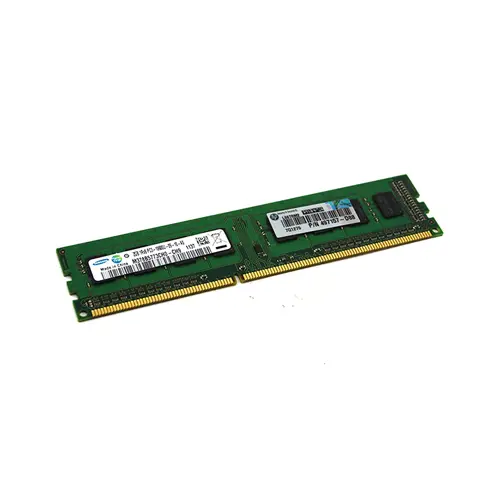
Designed as a desktop UDIMM, the Samsung M378B5773CH0-CH9 is purpose-built for responsive home and professional PC systems, not for servers or laptops. Its four defining characteristics directly address the real-world demands of gaming and content creation.
The Non-ECC, Unbuffered architecture eliminates the additional cycle of error correction and register buffering, translating into lower latency and a slight speed advantage over buffered memory. For competitive 3A gamers, this means every frame and command reaches the CPU with minimal delay—critical when reaction times decide the round. The DDR3-1333 clock paired with a CAS latency of CL9 delivers a balanced bandwidth-to-response ratio, keeping texture streaming smooth in open-world titles and preventing stutter during heavy scene loads. In a video rendering scenario, the Single Rank x8 configuration excels because single-rank modules typically put less stress on the memory controller, allowing higher clock stability when all four DIMM slots are populated for maximum capacity. That stability becomes vital during hour-long 4K exports where a single memory error could corrupt an entire project. Meanwhile, compliance with CE, WEEE, and RoHS ensures you are not sacrificing environmental safety or regulatory peace of mind for performance. In short, this module gives desktop enthusiasts a lean, compatible, and latency-conscious foundation where every nanosecond and every stable frame counts.
Gaming Build
For dual-channel gaming rigs, pair two or four of these 2 GB DDR3-1333 UDIMMs to achieve 4 GB or 8 GB total capacity. While 4 GB is the bare minimum for older titles, an 8 GB (4x2 GB) kit enables smoother multitasking and background application handling. Consider retiring these modules in favor of 4 GB or 8 GB sticks if aiming for 16 GB or 32 GB for modern AAA games.
Content Creation
Content creators using video editing or 3D rendering software should avoid these 2 GB modules due to restrictive capacity. A 64 GB configuration would require an impractical 32 DIMMs, far beyond consumer motherboard limits. Instead, use these only as temporary filler in legacy systems while budgeting for high-density 8 GB or 16 GB DDR3 modules to meet demanding memory footprints.
General Productivity
For basic office tasks, web browsing, and email, a single 2 GB module or a 4 GB (2x2 GB) dual-channel setup offers a cost-effective, bare-minimum configuration for Windows 7 or lightweight Linux distributions. Two modules in dual-channel mode provide a slight integrated graphics boost and snappier responsiveness. Given current software requirements, however, upgrading to an 8 GB kit is strongly recommended to prevent paging and slowdowns during moderate multitasking.
Rigorously tested DDR3 desktop UDIMM, compatible with Intel 6/7 Series and AMD 900 Series platforms.
Q: Can I mix this M378B5773CH0-CH9 with other memory modules of different brands or speeds?
A: Mixing is possible but not recommended. The system will run all modules at the lowest common speed and timings, potentially causing instability. For best results, use identical modules.
Q: Is this memory compatible with my system?
A: This is a standard 240-pin DDR3 UDIMM for desktop platforms. Verify your motherboard supports DDR3 1333MHz and 2GB single-rank modules. Consult the qualified vendor list for guaranteed compatibility.
Q: What is the recommended DIMM population order for optimal performance?
A: For dual-channel performance, install this UDIMM in the primary slot of each memory channel. Typically, use alternating slots (e.g., slots 1 and 3) as indicated in your motherboard manual.
Q: Does this module support overclocking or XMP profiles?
A: No, this JEDEC-compliant DDR3-1333 CL9 module does not support XMP or overclocking. It operates at fixed standard timings for maximum stability and broad compatibility.
Q: What warranty and typical failure rate can I expect?
A: This module includes a one-year warranty. It is built to stringent standards and has a very low annualized failure rate under normal operating conditions, ensuring reliable long-term use.