











 Secure payments
Standard refund policy
Trade Assurance
Secure payments
Standard refund policy
Trade Assurance
| Product Type | Memory Module |
|---|---|
| Compliance Standards | CE,WEEE,RoHS |
| Memory Capacity | 2 GB |
| Memory Technology | DDR3 |
| RAM Speed | 1600 |
| RAM Standard | DDR3-1600/PC3-12800 |
| Error Identifying | Non-ECC |
| Signal Type | Unbuffered |
| Column Access Strobe (CAS) | CL11 |
| Rank | Single Rank x8 |
| Quantity of Pins | 204-pin |
| RAM Genre | SoDIMM |
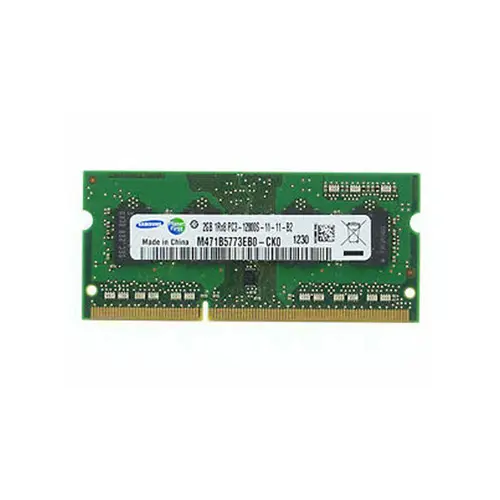
This DDR3-1600 SoDIMM is a notebook-grade memory module ideally suited for upgrading legacy laptops and mobile workstations where low power draw and broad platform compatibility are critical. Its single-rank x8 organization minimizes electrical loading on the memory controller for reliable operation, while the unbuffered, non-ECC design ensures straightforward, plug-and-play installation at a CAS latency of 11 cycles.
1. SoDIMM form factor guarantees a straightforward plug-and-play upgrade, fitting securely into tight notebook memory slots without compatibility headaches.
2. A modest 2GB capacity provides an energy-efficient footprint that keeps power draw and heat generation minimal for lightweight office tasks and web browsing on older laptops.
3. DDR3-1600 speed delivers responsive application launches and smooth document handling, matching the bandwidth needs of everyday mobile productivity.
4. CL11 latency minimizes access delays, so the system feels snappier when switching between multiple browser tabs or editing text on the go.
5. Single Rank x8 organization lowers electrical load on the memory controller, helping preserve battery life and keeping the notebook cooler during extended use.
For notebook users seeking to upgrade, the M471B5773EB0-CK0 module delivers four essential benefits that directly tackle real-world frustrations. Its low-voltage DDR3 operation at just 1.35V dramatically cuts power draw, significantly extending battery life when you are presenting reports on a business-class laptop or rendering CAD imagery on a mobile workstation away from an outlet. The compact SoDIMM form factor fits snugly into the tight confines of ultra-slim designs, guaranteeing broad compatibility without physical interference. As an unbuffered, non-ECC stick, installation is a true plug-and-play experience — simply click it in and the system recognizes it immediately, making it the perfect DIY upgrade for anyone who wants to rejuvenate a sluggish notebook. Paired with a 1600MT/s data rate and CL11 latency, the single-rank x8 configuration drives responsive multitasking; you will switch effortlessly between video conferencing, complex spreadsheets, and heavy browser research. For a student bringing new life to an aging ultrabook for online classes and collaborative projects, this memory strikes the ideal balance between energy efficiency and the everyday snappy performance that transforms a frustrating machine into a dependable daily driver.
Laptop Upgrade
For older laptops with a single 2GB DDR3 SODIMM, adding an identical 1.35V/1.5V module enables dual‑channel mode, doubling bandwidth and improving integrated graphics performance. Replace the existing 2GB stick with a matched pair of 4GB or 8GB modules to reach 8GB or 16GB total—this is the most cost‑effective way to extend a system’s usable life. Always verify the maximum supported capacity per slot before purchasing.
Mobile Workstation
Professional workloads like 3D CAD, video editing, or large datasets demand the highest possible density; populate both SODIMM slots with 8GB DDR3-1600 modules for a 16GB ceiling, if the chipset allows. Stability under sustained load matters more than overclocking, so choose JEDEC‑compliant, non‑ECC Unbuffered sticks identical in speed and rank to avoid compatibility issues. If a single 8GB module is all that fits, pair it with a matching unit later to regain dual‑channel performance.
Ultrabook Power Saving
Ultrabooks and thin‑and‑light notebooks benefit from low‑voltage (DDR3L-1600) Unbuffered SODIMMs, which draw less power and generate less heat. A single 2GB or 4GB module can already prolong battery life; configuring two identical low‑voltage sticks in dual‑channel mode further lowers per‑bit energy consumption without sacrificing idle runtime. Ensure the system firmware supports DDR3L, and stick to CL11 timings for consistent power behavior.
Rigorously tested, this 2GB DDR3-1600 SODIMM is compatible with Dell Latitude E6430, Lenovo ThinkPad T430, and HP EliteBook 8570p.
Q: Can I mix this M471B5773EB0-CK0 with other memory modules of different brands or speeds?
A: Mixing is possible but not recommended. The system will downclock all modules to the slowest speed and may face stability issues. For optimal reliability, use identical modules.
Q: Is this memory compatible with my system?
A: This DDR3 SoDIMM fits notebooks with 204-pin slots and 3rd/4th Gen Intel or AMD platforms. Verify your laptop supports DDR3-1600 and a 2GB single-rank unbuffered non-ECC module.
Q: What is the recommended DIMM population order for optimal performance?
A: For dual-channel notebooks, install a matching pair in the two available slots. Populate both channels with identical capacity and rank modules to enable symmetric dual-channel mode.
Q: Does this module support overclocking or XMP profiles?
A: No, this module does not support XMP or overclocking. It operates at standard JEDEC DDR3-1600 timings (CL11) to ensure stable, compliant performance in notebook platforms.
Q: What warranty and typical failure rate can I expect?
A: This module includes a one-year warranty. It is built to JEDEC standards with a very low annualized failure rate under normal operating conditions, ensuring long-term reliability.