











 Secure payments
Standard refund policy
Trade Assurance
Secure payments
Standard refund policy
Trade Assurance
| Product Type | Memory Module |
|---|---|
| Compliance Standards | CE,WEEE,RoHS |
| Memory Capacity | 2 GB |
| Memory Technology | DDR3 |
| RAM Speed | 1600MHz |
| RAM Standard | DDR3-1600/PC3-12800 |
| Error Identifying | Non-ECC |
| Signal Type | Unbuffered |
| Column Access Strobe (CAS) | CL11 |
| Rank | Single Rank x8 |
| Quantity of Pins | 240-pin |
| RAM Genre | UDIMM |
This unbuffered, non-ECC UDIMM DDR3-1600 module employs a single-rank x8 organization to reduce electrical loading on the memory controller, delivering low-latency performance ideal for desktop gaming, content creation, and productivity workloads. Its CL11 timing and JEDEC-compliant PC3-12800 specification ensure stable 1600MT/s throughput and broad compatibility with mainstream desktop platforms, making it a cost-effective upgrade for responsive multitasking and media editing.
1. 2GB capacity offers a budget-friendly boost for desktop office tasks, allowing a dozen browser tabs and light spreadsheets to coexist without sluggish swap-file thrashing.
2. 1600MHz speed supplies enough throughput to eliminate micro-stutter in casual gaming and HD video playback, keeping visible frame pacing smooth.
3. CL11 low latency tightens the command-to-data gap, giving creative hobbyists snappier previews when scrubbing timelines or applying live photo filters.
4. Single Rank x8 organization lowers electrical load on the CPU memory controller, improving drop-in compatibility across mainstream desktop boards and leaving mild overclocking margin.
5. Non-ECC operation dispenses with server-style error checking overhead, dedicating every cycle to raw rendering throughput and real-time physics in competitive titles.
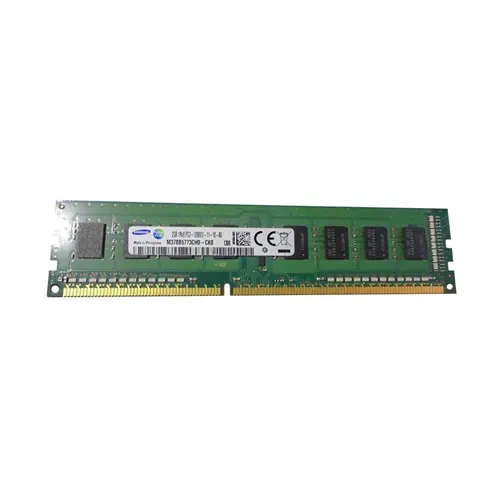
The Samsung M378B5773CH0-CK0 is a desktop UDIMM purpose-built for users who demand responsive, uninterrupted performance in scenarios like immersive AAA gaming and high-resolution video rendering. Its non-ECC design means the module skips the extra parity checking cycle found in server memory, shaving precious nanoseconds off every data transaction; in a fast-paced open-world title, that translates directly to fewer micro-stutters when texture streaming and quicker weapon-swap reactions. The unbuffered architecture connects the DRAM directly to the CPU’s memory controller without any intermediary chip, preserving signal integrity and enabling the low command latency that keeps a video editor’s timeline scrubbing fluid, even while a complex 4K project with layered effects hammers the subsystem. Working at 1600MHz, the module delivers exactly the bandwidth needed to feed a quad-core processor during simultaneous gaming and streaming, preventing framerate dips under load. The single-rank x8 configuration further refines this advantage by lowering the electrical load on the memory bus, greatly improving compatibility with older budget motherboards and ensuring stable long-duration rendering sessions where a crashed system means lost hours of work. CE, WEEE, and RoHS compliance guarantee that this reliability is backed by strict environmental and safety standards for peace of mind.
Based on the specifications, this is a standard desktop DDR3 2GB non‑ECC unbuffered UDIMM, ideal for older platforms such as LGA1155 or AM3+ systems. Below are capacity planning recommendations tailored to typical desktop usage scenarios using this module.
Gaming Build
For a legacy dual‑channel gaming rig, install two modules (2×2GB) to enable 4GB of dual‑channel memory, which is sufficient for light or classic titles. A 16GB pool is unrealistic with 2GB sticks—it would require eight DIMMs, exceeding most motherboard slots. Instead, use these modules only as a short‑term stepping stone while planning an upgrade to larger capacity DIMMs for modern gaming.
Content Creation
Content creation workloads demand high capacity and bandwidth. With only 2GB per module, even populating all four slots yields just 8GB—far below the 64GB recommended for serious video editing or 3D rendering. These modules are inadequate for professional software; serious creators should opt for 8GB or 16GB DIMMs. The 2GB UDIMM can only serve light photo editing or as temporary buffer while awaiting a full memory overhaul.
General Productivity
A cost‑effective configuration for everyday office tasks pairs two of these modules (2×2GB) in dual‑channel for 4GB, providing smooth web browsing and document editing. Upgrading to four modules (8GB total) improves multitasking with numerous browser tabs and light spreadsheets. This approach breathes life into aging desktops without significant investment, making it an excellent budget‑conscious upgrade path.
Rigorously tested, compatible with DDR3 desktops e.g., Dell OptiPlex 790, HP Compaq 8200 Elite.
Q: Can I mix this M378B5773CH0-CK0 with other memory modules of different brands or speeds?
A: Mixing is possible but not recommended for stability. The system will downclock all modules to the slowest speed, and mismatched brands may cause incompatibility or instability.
Q: Is this memory compatible with my system?
A: This 2GB DDR3-1600 UDIMM fits desktop boards with 240-pin DDR3 slots supporting non-ECC, unbuffered memory. Confirm your motherboard supports single-rank x8 modules and PC3-12800 standard.
Q: What is the recommended DIMM population order for optimal performance?
A: For dual-channel platforms, install identical pairs in the same-colored slots (often A2 and B2). With a single module, use the slot recommended in your motherboard manual to ensure proper recognition.
Q: Does this module support overclocking or XMP profiles?
A: No, this module runs at its native JEDEC-standard DDR3-1600 CL11 and does not include XMP profiles. It is not designed for overclocking and performs best at rated specifications.
Q: What warranty and typical failure rate can I expect?
A: This module is backed by a one-year warranty. The typical annualized failure rate is extremely low, generally under 0.5%, when operated within standard voltage and temperature limits.