











 Secure payments
Standard refund policy
Trade Assurance
Secure payments
Standard refund policy
Trade Assurance
| Product Type | Memory Module |
|---|---|
| Compliance Standards | EU RoHS,FCC |
| Memory Capacity | 2 GB |
| Memory Technology | DDR3 |
| RAM Speed | 1600MHz |
| RAM Standard | DDR3-1600/PC3-12800 |
| Error Identifying | Non-ECC |
| Signal Type | Unbuffered |
| Column Access Strobe (CAS) | CL11 |
| Rank | Single Rank x8 |
| Quantity of Pins | 240-pin |
| RAM Genre | UDIMM |
Designed as an unbuffered, non-ECC UDIMM for mainstream desktop platforms, this 2 GB DDR3-1600 module is ideal for upgrading older office PCs or building budget productivity and light multimedia systems. Its single-rank x8 organization and CL11 timing ensure strong electrical compatibility and stable dual-channel operation on legacy chipsets, delivering reliable everyday performance.
1. Unbuffered UDIMM form factor ensures broad compatibility with consumer desktop boards, delivering a straightforward plug-and-play upgrade for DIY builders without requiring specialized firmware tweaks.
2. Non-ECC design eliminates error-correction overhead, directly lowering memory access latency to give gamers and streamers near-instantaneous system responsiveness under bursty workloads.
3. Elevated data rate feeds the processor with high bandwidth, translating into faster level loads, smoother timeline scrubbing in editing software, and less micro-stutter in open-world titles.
4. Tight CAS latency keeps read commands moving with minimal wait states, enabling quick task switching and a perceptibly snappier desktop experience during heavy multitasking.
5. Single Rank x8 configuration reduces electrical load on the platform’s memory controller, offering improved overclocking stability and cooler operation for enthusiasts pushing performance limits.
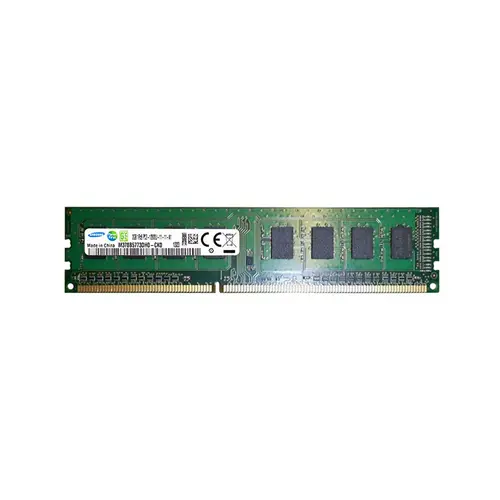
The Samsung M378B5773DH0-CK0 is a desktop memory module, clearly defined by its 240-pin UDIMM form factor, unbuffered architecture, and Non-ECC operation. For users still extracting value from mature platforms, four of its core characteristics translate directly into everyday usability. The 1600MHz PC3-12800 bandwidth becomes a lifeline during mixed workloads, accelerating texture streaming in classic AAA titles and keeping the timeline fluid when you are remuxing 1080p footage for a family project, because higher data throughput means less stuttering. Its CL11 latency proves equally critical in fast-paced competitive games like Counter-Strike, where that responsive command-to-data turnaround can mean noticing an opponent a millisecond sooner. The single-rank x8 design brilliantly sidesteps a common upgrade headache: it imposes a lighter electrical load on aging memory controllers, guaranteeing rock-solid stability in older H61 or B75 boards that might stumble with denser ranks. Finally, the 2GB capacity is far from a limitation; it is a deliberate, cost-effective enabler of dual-channel mode when paired with an existing stick, unlocking twice the memory bandwidth and making a heavily depreciated system feel genuinely agile again for office multitasking or entry-level creative work.
This non-ECC, unbuffered, 240-pin UDIMM identifies as standard desktop memory. Capacity planning for this 2GB DDR3-1600 CL11 single-rank module targets typical desktop workloads.
Gaming Build
Install two identical modules in dual-channel mode for 4 GB. Populating all four slots with 2 GB sticks yields 8 GB, which handles many older and esports titles smoothly at 1600 MHz. Though limited by capacity, it provides an affordable upgrade path for DDR3 gaming rigs.
Content Creation
Maximise capacity by filling all four DIMM slots for 8 GB—adequate for light photo and video editing. Because the 2 GB density caps total RAM, this is a temporary solution; move to 8 GB DIMMs for serious 3D rendering. For budget workstations, 4×2 GB is a practical first step before larger investments.
General Productivity
A single 2 GB module is a budget starting point, but 4 GB via two modules in dual-channel significantly improves multitasking for office suites, browsers, and communication apps. This balanced configuration leaves two slots free for future expansion or an SSD upgrade.
Rigorously tested, this desktop memory is compatible with Dell Optiplex 790, HP Compaq 8200 Elite, and Lenovo ThinkCentre M91p.
Q: Can I mix this M378B5773DH0-CK0 with other memory modules of different brands or speeds?
A: Mixing is possible but not recommended. The system will downclock all modules to the slowest common speed and may face stability issues due to mismatched timings or voltage tolerances.
Q: Is this memory compatible with my system?
A: This is a standard DDR3 desktop UDIMM. It is compatible with motherboards using Intel 6/7/8 series or AMD 9-series chipsets that support non-ECC unbuffered 240-pin DDR3 memory. Verify your board’s QVL list.
Q: What is the recommended DIMM population order for optimal performance?
A: For dual-channel performance, install this single-rank module in the slot farthest from the CPU, paired with an identical module in the corresponding channel. Consult your motherboard manual for specific slot numbering.
Q: Does this module support overclocking or XMP profiles?
A: No. This module runs at JEDEC standard DDR3-1600 CL11. It does not include an XMP profile and is not designed for overclocking. It operates reliably at its native programmed speed.
Q: What warranty and typical failure rate can I expect?
A: This module is backed by a 1-year warranty. It is built to JEDEC standards with a very low annualized failure rate under normal operating conditions, typical for tier-one OEM DRAM.