











 Secure payments
Standard refund policy
Trade Assurance
Secure payments
Standard refund policy
Trade Assurance
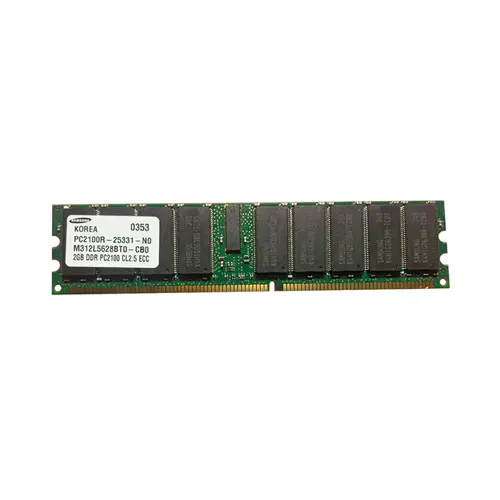
| Model | M312L5628BT0-CB0 |
|---|---|
| Product Type | Memory Module |
| Compliance Standards | EU RoHS,FCC |
| Memory Capacity | 2 GB |
| Memory Technology | DDR |
| Product Voltage | 2.5V |
| RAM Speed | 266MHz |
| RAM Standard | DDR-266/PC-2100 |
| Error Identifying | ECC |
| Signal Type | Registered |
| Column Access Strobe (CAS) | CL2.5 |
| Rank | Dual Rank x4 |
| Quantity of Pins | 184-pin |
| RAM Genre | RDIMM |
The M312L5628BT0-CB0 is a legacy server-grade DDR-266 Registered DIMM with ECC, ideally suited for aging but mission-critical rackmount servers running memory-intensive workloads like virtualization and in-memory databases where data integrity is non-negotiable. Its dual-rank x4 organization and Registered signaling enhance signal stability under fully populated configurations, while the CL2.5 latency and ECC engine work together to deliver deterministic access speeds and single-bit error correction across 2 GB of capacity.
1. Registered buffering decouples command signals from the memory bus load, allowing stable operation with densely populated channels needed for large-scale virtualization hosts.
2. ECC error correction silently detects and fixes single-bit upsets, preserving data accuracy in transactional databases and file systems around the clock.
3. Dual rank interleaving keeps banks busy while others are precharging, delivering sustained throughput that prevents stutter in multi-tenant application servers.
4. Low column access latency shortens the time to first word after a command, directly accelerating query responses on cache-sensitive relational databases.
5. PC-2100 bandwidth supplies steady, predictable throughput for foundational infrastructure roles like domain controllers and legacy print services without oversubscription.
The M312L5628BT0-CB0 is an RDIMM engineered for server platforms where uptime and data integrity are uncompromising. Its four defining characteristics directly answer the real-world demands of virtualized clusters and in-memory databases.
First, ECC error correction silently detects and corrects single-bit memory errors caused by background radiation before they cascade into database corruption or unplanned node failures. In a 24/7 virtualized environment, that means your hypervisor stack avoids mysterious crashes that would otherwise trigger costly VM failovers. Second, the registered buffer isolates the memory controller from the electrical load of multiple DIMMs, allowing you to fully populate server banks without signal degradation—critical when scaling a dense virtualization host from 128 GB to 512 GB without sacrificing stability. Third, the dual-rank x4 organization enables parallel rank interleaving; while one rank completes a refresh or I/O cycle, the other stays available for read and write commands, reducing access latency under the heavy concurrent requests generated by dozens of active VMs. Fourth, the tight CL2.5 CAS latency accelerates in-memory database transactions such as Redis lookups or SAP HANA analytical queries, where each nanosecond shaved directly raises throughput. Together, these features translate into fewer errors, linear scalability, and consistently responsive performance for your mission-critical server workloads.
Capacity Planning Guide for M312L5628BT0-CB0
The M312L5628BT0-CB0 is a server-grade DDR-266/PC-2100 ECC Registered RDIMM with 2 GB capacity per module. Its registered signalling, ECC, and dual-rank x4 design target legacy server platforms. Below are configuration recommendations for typical server workloads.
General Virtualization
For light virtualization hosts, install 4 to 8 identical modules (8–16 GB total) across balanced memory channels. This supports 10–20 undemanding VMs while maintaining interleaved access and ECC protection. Always populate in matched pairs across CPU sockets to preserve NUMA balance.
In-Memory Database
Maximize capacity by filling all available DIMM slots—typically 8 to 16 modules for 16–32 GB total. Though limited by the 2 GB per stick, fully populating channels with these dual-rank x4 RDIMMs improves bandwidth and leverages ECC for data integrity. Ensure identical modules in every channel to avoid timing conflicts.
High-Performance Computing (HPC)
Populate every memory channel with identical 2 GB RDIMMs to achieve the maximum aggregate bandwidth a platform allows. A multi-socket server with 16 or more modules (32+ GB) provides fast, error-corrected data paths for MPI or batch workloads. Enable bank interleaving by installing modules in sets that match the channel grouping.
Rigorously tested server memory, compatible with Dell PowerEdge 2650, HP ProLiant DL380 G4, IBM xSeries 345.
Q: Can I mix this M312L5628BT0-CB0 with other memory modules of different brands or speeds?
A: Mixing with different brands or speeds is not recommended for this registered server DIMM. Mismatched ranks, timings, or DRAM loads can cause POST failures or data integrity issues in mission-critical platforms.
Q: Is this memory compatible with my system?
A: This DDR-266 Registered ECC module targets early 2000s server platforms, typically Intel E7500/E7501 or AMD-760MPX chipsets. Please verify your motherboard supports 2.5V, 184-pin RDIMM and single-rank x4 organization.
Q: What is the recommended DIMM population order for optimal performance?
A: Install identical modules in pairs per memory channel to enable dual-channel interleaving. For this dual-rank x4 RDIMM, populate slots furthest from the CPU first. Always consult your server board's population guide for balanced configurations.
Q: Does this module support overclocking or XMP profiles?
A: No. This is a JEDEC-standard registered ECC server module clocked at 266MHz (PC-2100). Overclocking and XMP are not supported, as stability and data integrity take priority over frequency adjustments in server environments.
Q: What warranty and typical failure rate can I expect?
A: This module comes with a one-year warranty. With proper cooling and voltage, the AFR (annualized failure rate) is typically below 0.5%, reflecting the high reliability of fully-buffered/registered components operating within JEDEC specs.