











 Secure payments
Standard refund policy
Trade Assurance
Secure payments
Standard refund policy
Trade Assurance
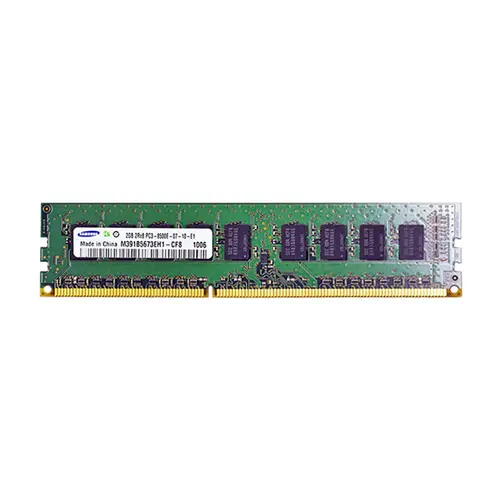
| Model | M391B5673EH1-CF8 |
|---|---|
| Product Type | Memory Module |
| Compliance Standards | EU RoHS,FCC |
| Memory Capacity | 2 GB |
| Memory Technology | DDR3 |
| Product Voltage | 1.5V |
| RAM Speed | 1066MHz |
| RAM Standard | DDR3-1066/PC3-8500 |
| Error Identifying | ECC |
| Signal Type | Unbuffered |
| Column Access Strobe (CAS) | CL7 |
| Rank | Dual Rank x8 |
| Quantity of Pins | 240-pin |
| RAM Genre | UDIMM |
This DDR3 UDIMM with ECC is optimally suited for entry-level servers and workstations running light virtualization or NAS applications, where data integrity is paramount. Its dual-rank x8 configuration combines low-latency CL7 timing with unbuffered signal integrity to deliver stable, error-corrected performance in 24/7 operating environments.
1. ECC error detection and correction silently remedies single-bit flips in real time, protecting critical server data integrity during continuous operation of lightweight network or storage services.
2. Unbuffered signal path eliminates register-induced delay, granting single-socket entry servers and microservers lower access latency for faster per-request processing.
3. Dual Rank x8 organization interleaves two rank arrays on each channel, effectively saturating memory bandwidth and stabilizing transaction throughput under concurrent virtualized workloads.
4. CL7 reduced column access latency tightens the gap between request and response, enabling snappier database queries and caching operations on latency-bound server applications.
5. 1066MT/s sustained transfer rate aligns with entry server chipset limits, delivering consistent, power‑efficient bandwidth for always‑on infrastructure without thermal throttling risk.
For your entry-level server or data-critical workstation, the Samsung M391B5673EH1-CF8 isn’t just another DDR3 module—it’s a deliberate safeguard for your uptime and data integrity. As an unbuffered ECC UDIMM with a 2GB dual-rank x8 organization and CL7 latency, it addresses real-world vulnerabilities that generic desktop memory simply ignores.
When running a virtualization cluster, a single-bit error in a non-ECC module can silently corrupt a guest operating system or trigger a host crash, forcing you to hunt down an invisible culprit. The integrated ECC engine on this module detects and corrects single-bit flips on the fly, transforming a potential hour of forensic troubleshooting into a non-event—your VMs stay healthy and your SLAs remain intact. In a memory database like Redis or a busy SQL instance, data structures reside entirely in RAM; consistency is everything. The dual-rank design boosts bandwidth by allowing interleaved accesses across two internal 1GB ranks, which means more concurrent queries served without stalling, while the unbuffered architecture keeps access latency at a tight CL7. No register buffering delay, just direct, fast signaling to the memory controller when every microsecond counts. That translates to snappier transaction processing and faster analytical queries on the same familiar DDR3 platform. Together, these features mean you’re not just buying capacity—you’re investing in silent error protection, sustained throughput under load, and the kind of reliability that keeps a small business server or a home lab humming through the night.
General Virtualization
This 2GB DDR3-1066 ECC UDIMM is suited for light-duty virtualization hosts. Deploy modules in multiples of three to populate triple-channel memory architectures common on older server platforms, ensuring balanced memory bandwidth. For hosting a small set of low-overhead VMs, six or nine modules (12–18 GB total) provide adequate headroom without oversubscribing the memory controller.
In-Memory Database
In-memory databases demand capacity and fault resilience, which makes this module’s ECC essential. However, the 2 GB density limits its role to caching layers or small test instances. Populate all DIMM slots with identical modules to maximize capacity while maintaining single-bit error correction; expect to install eight or more modules for a functional dataset.
High-Performance Computing (HPC)
HPC nodes benefit more from bandwidth than raw capacity for many MPI workloads. Use the maximum number of identical UDIMMs per channel to match the CPU’s memory interleaving design, typically installing six to twelve modules per dual-socket node. Prioritize uniform configurations to avoid NUMA imbalances and ensure consistent latency across compute ranks.
Rigorously tested for server compatibility: Dell PowerEdge R210 II, HP ProLiant ML110 G7, Lenovo ThinkServer TS140.
Q: Can I mix this M391B5673EH1-CF8 with other memory modules of different brands or speeds?
A: Mixing is not recommended. For ECC server memory, all modules should match in speed, rank, and latency to maintain system stability and prevent data integrity issues.
Q: Is this memory compatible with my system?
A: It suits Intel Xeon E3-1200 series or AMD AM3+ platforms that support unbuffered DDR3 ECC UDIMMs. Please consult your server board’s qualified vendor list for guaranteed compatibility.
Q: What is the recommended DIMM population order for optimal performance?
A: Follow your motherboard manual. For dual-rank x8 modules, typically populate like-colored slots first, balancing channels evenly to maximize memory bandwidth and ECC efficiency.
Q: Does this module support overclocking or XMP profiles?
A: No. This server-grade ECC UDIMM strictly adheres to JEDEC DDR3-1066 standards and does not support overclocking or XMP profiles, prioritizing long-term stability and error-free operation.
Q: What warranty and typical failure rate can I expect?
A: It comes with a 1-year warranty. ECC memory exhibits very low failure rates due to rigorous screening and built-in error correction, offering dependable 24/7 enterprise reliability.