











 Secure payments
Standard refund policy
Trade Assurance
Secure payments
Standard refund policy
Trade Assurance
| Product Type | Memory Module |
|---|---|
| Memory Capacity | 32 GB |
| Memory Technology | DDR4 |
| Product Voltage | 1.2 V |
| RAM Speed | 2933 MHz |
| RAM Standard | DDR4-2933/PC4-23400 |
| Error Identifying | ECC |
| Signal Type | Registered |
| Column Access Strobe (CAS) | CL21 |
| Rank | Dual Rank x4 |
| Quantity of Pins | 288-pin |
| RAM Genre | RDIMM |
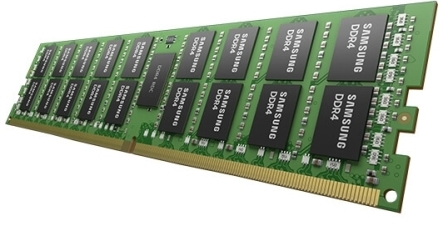
This 32GB DDR4-2933 Registered ECC module, configured as dual-rank x4 with CL21 latency, is engineered for enterprise servers and workstations where data integrity and stability under heavy load are non-negotiable. Its dual-rank organization maximizes memory bandwidth in multi-slot configurations, making it ideal for memory-intensive virtualization and in-memory database workloads while ECC and registered signaling ensure error-free operation and reliable signal integrity.
1. ECC error correction detects and corrects single-bit memory errors in real time, safeguarding financial transactions and preventing silent data corruption in mission-critical server environments.
2. Registered signal buffering stabilizes high-capacity memory channels, allowing dense server deployments to maintain signal integrity across all populated DIMM slots under full load.
3. 32GB capacity per module maximizes memory density per server node, enabling far more virtual machines to run concurrently without swapping to slower storage.
4. Dual Rank x4 construction utilizes bank interleaving to boost effective memory bandwidth, keeping latency-sensitive enterprise applications responsive even during peak data throughput.
5. 2933 MT/s speed provides substantial throughput for data-intensive workloads, accelerating database queries and in-memory analytics where every cycle counts.
When your virtualization cluster hosts dozens of business‑critical VMs on a single node, silent data corruption is not an option. The M393A4K40DB2-CVFBQ is a 32GB DDR4‑2933 RDIMM that hardens your server against exactly this threat. Its ECC engine detects and corrects single‑bit errors in real time, preserving the integrity of financial transactions or customer records stored in an in‑memory database like Redis or SAP HANA. Equally important is the Registered signal‑buffering architecture: it stabilizes the electrical load when densely populating dual‑socket servers, so you can pack more VMs per host without risking signal degradation or unexpected reboots. The dual‑rank x4 organization then steps in under heavy concurrency, using rank interleaving to sustain higher bandwidth. For a database processing thousands of concurrent queries, this means markedly lower latency and faster cache flushes. At 2933MT/s, the module feeds the CPU quickly enough to eliminate memory bottlenecks, ensuring that your Virtual Desktop Infrastructure boots in seconds and your OLTP workloads won’t stutter under peak load. Every feature translates directly into longer uptime, consistent performance, and safer data—exactly what enterprise memory demands.
General Virtualization
For a typical virtualization host running multiple VMs, memory capacity and reliability are paramount. Equip a dual-socket server with 8 to 12 of these 32GB RDIMMs (256–384GB total), populating an equal number of channels per CPU to balance capacity with bandwidth and take full advantage of ECC protection for stable VM uptime.
In-Memory Database
In-memory databases like Redis or SAP HANA demand the lowest latency and maximum reliability. Configure all memory channels identically with one 32GB RDIMM per channel, achieving 256GB on an 8-channel platform, which delivers balanced throughput and sufficient headroom for large datasets while dual-rank x4 organization boosts signal integrity under heavy write loads.
High-Performance Computing (HPC)
HPC workloads favor raw memory bandwidth to feed many cores. Populate every memory channel with a single dual-rank 32GB RDIMM to maximize interleaving and achieve peak bandwidth per socket—384GB across 12 channels—enabling fast collective operations in MPI jobs without exceeding typical node budgets. For memory-capacity-bound simulations, scale to two DIMMs per channel but note the slight clock-speed trade-off.
Rigorously tested server RDIMM compatible with Dell PowerEdge R750, HPE ProLiant DL380 Gen10 Plus, Lenovo ThinkSystem SR650 V2.
Q: Can I mix this M393A4K40DB2-CVFBQ with other memory modules of different brands or speeds?
A: Mixing with different brands or speeds is not recommended for RDIMM servers. It may cause instability or fail to boot. Always use identical modules to ensure reliable, validated performance in multi-slot configurations.
Q: Is this memory compatible with my server system?
A: This DDR4-2933 registered ECC RDIMM is designed for scalable Intel Xeon and AMD EPYC platforms. Confirm your server board supports 1.2V, 288-pin RDIMM and 2933 MT/s. Check the vendor’s QVL list for validated compatibility.
Q: What is the recommended DIMM population order for optimal performance?
A: Populate channels evenly per CPU memory guide, typically filling white slots first. For dual-processor servers, balance memory across both CPUs. Follow your motherboard manual to maximize interleaving and bandwidth while honoring 2DPC configurations.
Q: Does this module support overclocking or XMP profiles?
A: No. This registered ECC server memory adheres to JEDEC standards at 2933 MT/s. XMP profiles and overclocking are not supported, as enterprise workloads demand absolute data integrity and stability over marginal speed gains.
Q: What warranty and typical failure rate can I expect?
A: This module includes a one-year warranty. Enterprise-grade RDIMMs demonstrate very low annualized failure rates, typically under 0.5%, thanks to rigorous screening and error-correcting code functionality ensuring reliable 24/7 operation.