











 Secure payments
Standard refund policy
Trade Assurance
Secure payments
Standard refund policy
Trade Assurance
| Product Type | Memory Module |
|---|---|
| Memory Capacity | 32 GB |
| Memory Technology | DDR4 |
| Product Voltage | 1.2V |
| RAM Speed | 2933MHz |
| RAM Standard | DDR4-2933/PC4-23400 |
| Error Identifying | ECC |
| Signal Type | Unbuffered |
| Column Access Strobe (CAS) | CL21 |
| Rank | Dual Rank x8 |
| Quantity of Pins | 288-pin |
| RAM Genre | UDIMM |
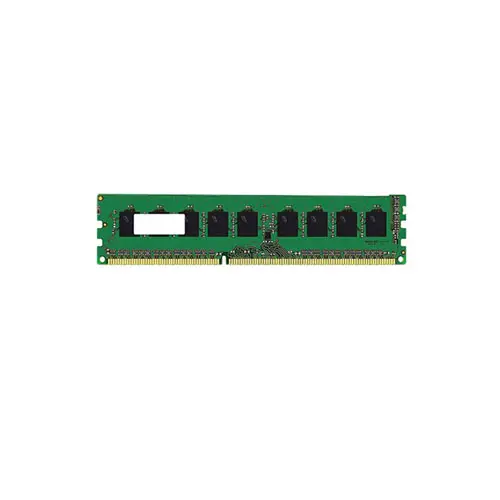
This is an unbuffered ECC DDR4 UDIMM designed for entry-level servers and workstations, where its dual-rank x8 organization boosts memory bandwidth through rank interleaving while ECC error correction ensures data integrity for critical workloads such as file serving and light virtualization. Operating at 1.2 V with CL21 latency on a 288-pin interface, it delivers reliable, low-power performance in platforms that require unbuffered memory with hardware-level fault tolerance.
1. Error Correction Code detects and corrects single-bit errors in real time, safeguarding transactional databases and critical file systems from silent data corruption in always-on server environments.
2. Generous 32 GB capacity per module maximizes DIMM slot utilization, enabling denser virtualization footprints and accommodating memory-hungry in-memory analytics platforms without expanding hardware.
3. Dual Rank x8 organization leverages rank interleaving to saturate memory channels, which boosts sustained throughput for highly consolidated container and VM workloads.
4. The 2933 MHz data rate raises memory bandwidth, shrinking response times for concurrent client queries and accelerating data-heavy enterprise applications.
5. Unbuffered signal path reduces access latency compared to registered alternatives, giving latency-sensitive edge computing and light HPC tasks a responsive edge inside cost-optimized server nodes.
The M391A4G43AB1-CVFQY is a 32GB DDR4-2933 UDIMM with ECC, clearly built for workstations and entry-level servers where data integrity and application uptime are non-negotiable. In a virtualisation cluster running multiple VMs on a single host, a single undetected bit flip in memory can cascade into corrupted guest states, silent data loss, or unexpected reboots. The onboard ECC actively corrects single-bit errors and detects multi-bit faults, directly shielding your hypervisor and critical workloads from what would otherwise be random, costly failures. That protection becomes even more vital when you combine it with the Dual Rank x8 organisation: while you provision dense 32GB capacity for memory-hungry database instances, the dual-rank interleaving keeps latency in check and sustains aggregate bandwidth under concurrent access, so an in-memory cache like Redis delivers consistent sub-millisecond responses even as data sets swell. Its 1.2V operation and 2933 MT/s speed further reduce power draw and thermal stress in 24/7 environments, meaning your storage server or analytics node can scale capacity without a punishing increase in cooling overhead. For the engineer managing financial modelling or real-time analytics, this module translates to uninterrupted calculation integrity and predictable throughput when results cannot be late.
General Virtualization
For a typical hypervisor hosting mixed workloads, populate the server with eight of these 32 GB ECC UDIMMs (256 GB total) to balance VM density and cost. Distribute modules evenly across all memory channels using a balanced DIMM-per-channel configuration, which maximizes bandwidth and ensures reliable memory interleaving for moderate overcommitment ratios.
In-Memory Database
Achieve maximum capacity by filling every available slot, ideally targeting 512 GB or more with 32 GB DIMMs to keep entire datasets in RAM. A symmetrical population across all memory channels is critical to sustain the high throughput and low latency that in‑memory engines demand, while dual‑rank x8 DIMMs help maintain signal integrity at full load.
High‑Performance Computing (HPC)
Deploy six or eight identical modules per node (192–256 GB) in a fully balanced configuration, one DIMM per channel, to deliver peak memory bandwidth to each core. The 2933 MT/s speed with CL21 latency provides a stable base for bandwidth‑sensitive HPC workloads, and the ECC protection guards against silent data corruption during long‑running parallel simulations.
Rigorously tested server memory, compatible with Dell PowerEdge T350, HP ProLiant ML30 Gen10, Lenovo ThinkSystem ST250, and similar ECC UDIMM platforms.
Q: Can I mix this M391A4G43AB1-CVFQY with other memory modules of different brands or speeds?
A: Mixing is not advised for server environments. Unbuffered ECC requires identical modules to ensure data integrity and prevent system instability. Use same brand, speed, and rank for best reliability.
Q: Is this memory compatible with my system?
A: This DDR4-2933 ECC UDIMM fits servers/workstations with Intel Xeon E-2300/E-2200 or AMD Ryzen PRO platforms. Verify your board supports 32GB unregistered ECC before purchase.
Q: What is the recommended DIMM population order for optimal performance?
A: Populate slots starting with the channel farthest from the CPU, matching dual-rank guidelines. As a rule, fill identical colored slots first; consult your motherboard manual for exact order.
Q: Does this module support overclocking or XMP profiles?
A: No. This is a JEDEC-compliant server module built for stability. ECC UDIMMs do not support overclocking or XMP, prioritizing error correction over speed.
Q: What warranty and typical failure rate can I expect?
A: It includes a 1-year warranty. Genuine Samsung server DRAM exhibits very low annualized failure rates due to rigorous binning, ensuring dependable 24/7 operation.