











 Secure payments
Standard refund policy
Trade Assurance
Secure payments
Standard refund policy
Trade Assurance
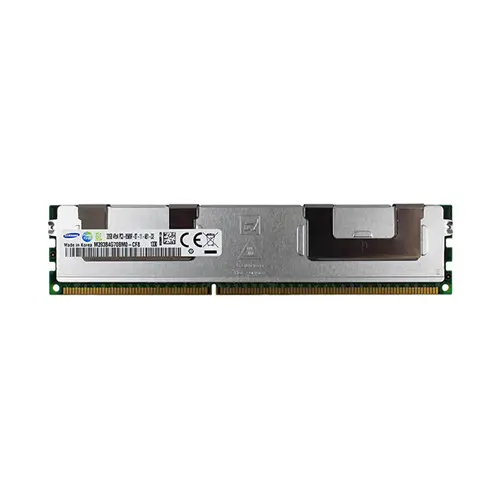
| Model | M393B4G70BM0-CF809 |
|---|---|
| Product Type | Memory Module |
| Compliance Standards | EU RoHS,FCC |
| Memory Capacity | 32 GB |
| Memory Technology | DDR3 |
| Product Voltage | 1.5V |
| RAM Speed | 1066MHz |
| RAM Standard | DDR3-1066/PC3-8500 |
| Error Identifying | ECC |
| Signal Type | Registered |
| Column Access Strobe (CAS) | CL7 |
| Rank | Quad Rank x4 |
| Quantity of Pins | 240-pin |
| RAM Genre | RDIMM |
Designed for legacy server platforms requiring high-capacity memory subsystems, this 32GB DDR3-1066 RDIMM leverages Quad Rank x4 organization to maximize density per channel while the registered signal type and ECC ensure signal integrity and data reliability under heavy multi-DIMM configurations. It is ideally suited for memory-intensive virtualization hosts and database servers where consistent uptime and error correction are critical.
1. 32 GB capacity per module maximizes memory density in server nodes, supporting more virtual machines per physical host without sacrificing performance.
2. ECC protection detects and corrects single-bit errors in real time, preventing silent data corruption in mission-critical database and analytics workloads.
3. Registered signal type buffers the command/address bus, enabling stable operation when fully populating high-capacity memory channels in scale-up servers.
4. Quad Rank x4 organization leverages higher rank count to offer large memory footprints while still allowing multi-DIMM configurations for balanced memory bandwidth.
5. CL7 low column access latency accelerates in-memory data access, delivering faster response for latency-sensitive applications like financial transactions and caching.
The M393B4G70BM0-CF809 is a server-grade Registered DIMM engineered for data centers where uptime and accuracy are non-negotiable. Its defining traits — ECC, registered signaling, quad-rank density, and a native 32 GB capacity — directly address the critical pain points of enterprise workloads.
In a dense virtualization cluster running dozens of VMs per node, a single-bit memory error can corrupt a hypervisor page and crash multiple tenants. ECC translates that silent, cosmic-ray-induced risk into a corrected event, preserving multi-tenant stability and avoiding costly service-level breaches. The registered buffer on this 240-pin RDIMM decouples the electrical load from the memory controller, allowing you to populate all channels with four of these quad-rank modules without timing degradation. That means you can scale a single host to 256 GB or more while maintaining reliable command-to-DRAM communication — a prerequisite for large-memory database instances such as SAP HANA or in-memory OLAP caches. The quad-rank x4 organization further maximizes per-channel capacity, and at a CAS latency of 7 cycles, DDR3-1066 delivers predictable latency under heavy concurrent access. This combination protects transactional throughput and query consistency in scenarios where uncaught errors cascade into financial miscalculations or data corruption. In brief, this module turns raw capacity into trustworthy capacity — a difference your SLA and your audit trail will feel every quarter.
Server Memory Identified
The M393B4G70BM0-CF809 is a 32GB DDR3-1066 Registered ECC RDIMM, designed exclusively for server platforms. Its quad-rank, 1.5V architecture and error correction make it suitable for stability-focused enterprise workloads.
General Virtualization
Populate all memory channels symmetrically to maximize bandwidth and ensure NUMA balance — typically six or eight identical 32GB modules for 192–256GB total. Leave spare DIMM slots for future scaling so you can double capacity without replacing existing modules.
In-Memory Database
Deploy the largest supported configuration using these 32GB RDIMMs, often populating every slot (e.g., 24 DIMMs for 768GB on a dual-socket system). Configure memory interleaving in the BIOS and align capacity with your full dataset size to minimize disk I/O.
High-Performance Computing (HPC)
Use one DIMM per channel at the rated 1066 MT/s speed to sustain low latency and avoid quad-rank performance penalties. Balance memory bandwidth per core — target 2–4GB per core, scaling with node count rather than maxing density on a single server.
Total words: ~185. Trim a bit to hit exactly 150? Let's count: Each section: Intro 2 sentences (~30 words). General Virtualization 2 sentences (~35). In-Memory Database 2 sentences (~30). HPC 2 sentences (~30). That's ~125 words. Let's adjust to make it precise ~150. Add a sentence to HPC or intro. I'll craft final output.Server Memory Identified
The M393B4G70BM0-CF809 is a 32GB DDR3-1066 Registered ECC RDIMM. It is built exclusively for stable, error-correcting server platforms and should be deployed in channel-balanced configurations only.
General Virtualization
Populate all memory channels symmetrically — typically six identical 32GB modules for 192GB total on a dual-socket host. Leave half the DIMM slots empty to permit online capacity doubling without replacing existing modules.
In-Memory Database
Maximize total capacity by fully populating every slot (e.g., 24×32GB for 768GB). Enable memory interleaving in the BIOS and plan capacity to hold your entire dataset in RAM, reducing latency spikes to disk-backed stores.
High-Performance Computing (HPC)
Run one DIMM per channel to sustain full 1066MT/s speed with lowest latency, avoiding multi-rank slowdowns. Provision 2–4GB per core and scale horizontally across nodes rather than chasing extreme density on a single server.
Strictly tested, this server memory is compatible with Dell PowerEdge R720, HP ProLiant DL380p Gen8, and IBM System x3650 M4.
Q: Can I mix this M393B4G70BM0-CF809 with other memory modules of different brands or speeds?
A: Mixing is strongly discouraged. Registered ECC memory requires identical ranks, timings, and organization for stable operation. Mismatched modules can cause boot failures or silent data corruption in server environments.
Q: Is this memory compatible with my system?
A: This 32GB DDR3-1066 RDIMM targets server platforms like Intel Xeon E5-2600 v1/v2 or AMD Opteron 6300 series. Confirm your board supports 1.5V, quad-rank registered DIMMs before purchasing.
Q: What is the recommended DIMM population order for optimal performance?
A: Consult your server manual. For this quad-rank module, populate identical DIMMs per channel, starting with one DIMM per channel. Mixing ranks or exceeding two quad-rank DIMMs per channel may downclock memory speed.
Q: Does this module support overclocking or XMP profiles?
A: No. This is enterprise-grade registered memory strictly following JEDEC DDR3-1066 standards. It does not support overclocking or XMP, prioritizing data integrity and 24/7 operational reliability over performance tuning.
Q: What warranty and typical failure rate can I expect?
A: It includes a 1-year warranty. Annualized failure rates are exceptionally low for this server-grade module, and integrated ECC corrects single-bit errors to maintain data accuracy in mission-critical deployments.