











 Secure payments
Standard refund policy
Trade Assurance
Secure payments
Standard refund policy
Trade Assurance
| Model | M393B4G70BM0-YF8 |
|---|---|
| Product Type | Memory Module |
| Compliance Standards | EU RoHS,FCC |
| Memory Capacity | 32 GB |
| Memory Technology | DDR3 |
| Product Voltage | 1.35V |
| RAM Speed | 1066MHz |
| RAM Standard | DDR3-1066/PC3-8500 |
| Error Identifying | ECC |
| Signal Type | Registered |
| Column Access Strobe (CAS) | CL7 |
| Rank | Quad Rank x4 |
| Quantity of Pins | 240-pin |
| RAM Genre | RDIMM |
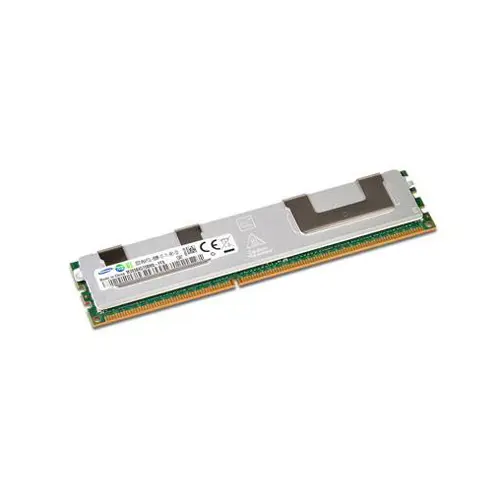
This Samsung 32GB DDR3-1066 registered ECC RDIMM is engineered for legacy server platforms, where its quad‑rank x4 organization maximizes memory density per channel while registered logic ensures signal integrity in multi‑DIMM configurations. It is ideally deployed in virtualization hosts and memory‑intensive database servers that demand 24/7 data integrity, with ECC and a low CL7 latency providing reliable error correction and responsive access under sustained workloads.
1. ECC error correction silently detects and fixes single-bit memory faults, preserving data integrity and preventing costly downtime in transactional database operations.
2. Registered signal buffering isolates the memory controller from electrical load, allowing fully populated server channels to maintain rock‑solid stability under heavy memory traffic.
3. 32GB per module maximizes memory footprint per CPU socket, supporting high‑density virtualization clusters where every gigabyte translates directly into additional billable virtual machines.
4. Quad Rank x4 organization packs the maximum number of DRAM dies onto a single stick, delivering extreme capacity depth without introducing timing penalties thanks to the register’s retiming function.
5. 1.35V low‑voltage operation reduces overall server power consumption and waste heat, lowering facility energy bills and enabling higher‑density rack deployments without exceeding cooling budgets.
The M393B4G70BM0-YF8 is a 32GB DDR3 Registered ECC DIMM built for the relentless demands of enterprise servers, where unplanned downtime is measured in lost revenue. Its four defining characteristics directly address critical pain points in real-world data center environments. The combination of ECC and Registered technology is your first line of defense against silent data corruption and signal degradation. In a virtualization cluster hosting dozens of VMs, a single bit-flip in memory can crash a production database; ECC detects and corrects those errors in-flight, while the register buffers address commands to maintain rock-solid electrical stability across the quad-rank x4 configuration, even when all 24 DIMM slots are populated. The quad-rank design itself enables this module to deliver 32GB of capacity in a single socket, which is transformative for memory-intensive applications like in-memory databases (SAP HANA, Redis) and large-scale private cloud stacks. Finally, the 1.35V operating voltage significantly reduces thermal output and power draw across a fleet of hundreds of servers, lowering cooling costs and improving total cost of ownership without sacrificing the 1066MHz speed. This memory turns your server from a potential liability into a proven, energy-conscious workhorse.
General Virtualization
For virtualized environments balancing density, uptime, and energy cost, deploy one 32 GB quad-rank RDIMM per memory channel. A typical dual‑socket server using four channels per CPU can achieve 256 GB with eight modules, fully leveraging the 1.35 V low‑voltage spec to reduce power draw. Always install identical ECC Registered DIMMs to maintain error correction and stability across all VMs.
In-Memory Database
Maximize capacity by fully populating all slots with these 32 GB RDIMMs—a 16‑module configuration delivers 512 GB for large dataset caching. Be aware that loading three quad‑rank DIMMs per channel may force the memory bus speed down from 1066 MT/s; verify platform rules. Where speed is secondary to capacity, this dense, low‑voltage setup cuts thermal overhead in always‑on database nodes.
High‑Performance Computing
Install one 32 GB RDIMM per channel to keep the memory controller at the full 1066 MT/s rate, preserving bandwidth‑sensitive HPC kernel performance. In a dual‑socket system with quad‑channel architecture, eight modules provide 256 GB of registered ECC memory at maximum speed. The 1.35 V operation helps control cluster‑wide power and cooling, critical for sustained compute runs.
Proven server-grade compatibility: rigorously tested with Dell PowerEdge R710, HP DL380 G7, Lenovo RD630, and similar systems.
Q: Can I mix this M393B4G70BM0-YF8 with other memory modules of different brands or speeds?
A: Mixing is strongly discouraged. Registered ECC DDR3 requires identical rank, speed, and timings per channel. Mismatched DIMMs often cause boot failures or data corruption in server environments.
Q: Is this memory compatible with my system?
A: This RDIMM targets servers with DDR3 ECC Registered support, such as Intel Xeon E5-2600 v1/v2 or AMD Opteron 6300 series platforms. Always consult your system’s qualified vendor list for confirmation.
Q: What is the recommended DIMM population order for optimal performance?
A: Populate identical DIMMs starting with the slot farthest from the CPU per channel. Due to the quad-rank design, most servers limit two DIMMs per channel. Refer to your motherboard manual for precise slot mapping.
Q: Does this module support overclocking or XMP profiles?
A: No. As a server-grade Registered ECC module, it strictly follows JEDEC standards for 24/7 data integrity. Overclocking and XMP are disabled to guarantee mission-critical stability.
Q: What warranty and typical failure rate can I expect?
A: This unit carries a 1-year warranty. Enterprise DDR3 ECC RDIMMs demonstrate an annualized failure rate below 0.5% under specified thermal and voltage conditions, ensuring excellent long-term reliability.