











 Secure payments
Standard refund policy
Trade Assurance
Secure payments
Standard refund policy
Trade Assurance
| Model | M393B4G70BM0-CF8 |
|---|---|
| Product Type | Memory Module |
| Compliance Standards | EU RoHS,FCC |
| Memory Capacity | 32 GB |
| Memory Technology | DDR3 |
| Product Voltage | 1.5V |
| RAM Speed | 1066MHz |
| RAM Standard | DDR3-1066/PC3-8500 |
| Error Identifying | ECC |
| Signal Type | Registered |
| Column Access Strobe (CAS) | CL7 |
| Rank | Quad Rank x4 |
| Quantity of Pins | 240-pin |
| RAM Genre | RDIMM |
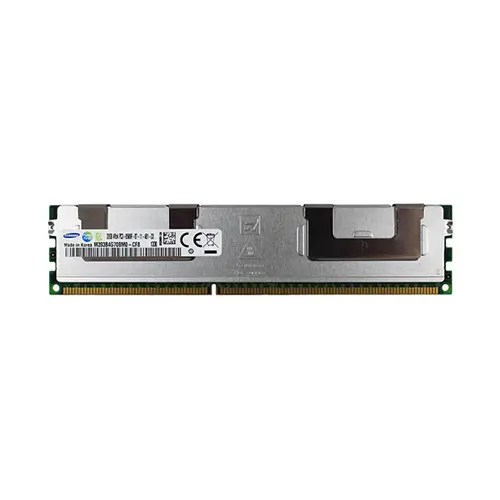
This Samsung 32GB DDR3-1066 Registered ECC memory module (M393B4G70BM0-CF8) is a server-grade RDIMM purpose-built for legacy enterprise platforms running memory-intensive workloads such as virtualization and in-memory databases, where data integrity is paramount. Its Quad Rank x4 organization with CL7 latency maximizes capacity density in multi-DIMM configurations while the registered signal topology ensures stable operation under heavy channel loading.
1. ECC protection corrects single-bit errors and detects multi-bit faults, safeguarding data integrity for transaction-heavy databases where even a silent memory error could cause financial discrepancies.
2. Registered signal buffering reduces the electrical load on the memory controller, enabling fully populated server boards to run stably at maximum DIMM counts for vast virtualization clusters.
3. Quad Rank x4 architecture packs substantial density into a single module while leveraging x4 DRAM width for enhanced error resilience and balanced channel utilization under continuous operation.
4. The 32GB capacity fuels higher VM consolidation ratios, allowing a single physical host to support more tenants and services without hitting memory bottlenecks.
5. CL7 low-latency timing accelerates data retrieval cycles, giving real-time analytics and in-memory caching platforms the rapid response required for split-second decision engines.
The M393B4G70BM0-CF8 is a server‑grade 32 GB DDR3 Registered DIMM, purpose‑built for data‑center workloads where uptime and integrity are non‑negotiable. Its ECC circuitry actively corrects single‑bit errors and detects multi‑bit faults, which means a flipped bit inside a financial database or a virtualized guest will not silently corrupt a transaction or crash the hypervisor — a critical safeguard in memory‑intensive environments like SAP HANA or VMware clusters. The Registered buffer re‑drives address and command signals, stabilizing the electrical load so you can fully populate all 24 DIMM slots per server without signal degradation; this is what allows a single host to deliver the massive, reliable memory pools required for smooth live‑migration of dozens of virtual machines. With a 32 GB capacity per stick and a Quad‑Rank x4 organization, the module packs high density while interleaving access across internal banks, which improves effective bandwidth during sustained heavy‑database scanning or large‑in‑memory analytics. For IT managers who need to extend the life of legacy DDR3 servers or build dense virtualization nodes, these four characteristics translate directly into fewer crashes, predictable performance under load, and a lower total cost of ownership.
Based on the given specifications—DDR3 Registered ECC RDIMM at 32GB capacity—this is clearly server-class memory designed for stability and data integrity in multi-slot configurations. Below are capacity planning guidelines for typical server workloads.
General Virtualization
Virtualized hosts rely on dense, reliable memory to run multiple VMs. Deploy a minimum of six to eight identical modules (192–256 GB) per dual-socket server to populate half the memory channels, balancing cost and NUMA node performance. Always install modules in matched sets per processor to maintain memory interleaving and avoid performance penalties from using only a single quad-rank DIMM per channel.
In-Memory Database
In-memory databases demand maximum capacity and fault tolerance. Fill all available DIMM slots with these 32 GB RDIMMs, leveraging their ECC and registered architecture for large-memory consistency. A configuration of 24 modules (768 GB) or more per server is typical, with careful attention to the drop in operating speed when multiple quad-rank DIMMs are installed per channel—expect clock-downs to 800 MHz in fully populated systems.
High-Performance Computing (HPC)
HPC clusters prioritize memory bandwidth alongside capacity. Use a balanced configuration—one 32 GB DIMM per channel across all memory channels—to deliver full 1066 MHz speed and peak throughput. For dual-socket nodes, eight modules (256 GB) is a baseline; increase to 16 modules (512 GB) only if the workload shows high memory residency, always validating that quad-rank loading does not restrict the required parallel filesystem or MPI buffer speeds.
Rigorously tested, certified compatible with Dell PowerEdge R720, HP DL380p Gen8, Lenovo ThinkServer RD430.
Q: Can I mix this M393B4G70BM0-CF8 with other memory modules of different brands or speeds?
A: Mixing is not recommended. Registered ECC DDR3 modules must match speed, rank, and timings for stability. Different brands or speeds may cause POST failures or data integrity issues on server platforms.
Q: Is this memory compatible with my system?
A: This 32GB DDR3-1066 quad-rank RDIMM requires a server motherboard with a C600-series chipset (Intel Xeon E5-2600 v1/v2) or equivalent AMD platform. Verify 240-pin RDIMM ECC support in your manual.
Q: What is the recommended DIMM population order for optimal performance?
A: For quad-rank RDIMMs, populate identical modules per channel starting with the farthest slot from the CPU. Balance memory channels evenly and respect platform-specific population rules to avoid rank reduction or underclocking.
Q: Does this module support overclocking or XMP profiles?
A: No. This is a registered JEDEC-compliant ECC memory module designed for data integrity, not overclocking. It operates only at the specified 1066MHz with fixed CL7 timings and does not support XMP profiles.
Q: What warranty and typical failure rate can I expect?
A: This module includes a one-year warranty. With strict JEDEC standards and ECC technology, its annualized failure rate (AFR) is typically under 0.5% in proper server environments with adequate cooling.