











 Secure payments
Standard refund policy
Trade Assurance
Secure payments
Standard refund policy
Trade Assurance
| Model | M386B4G70BM0-YH921 |
|---|---|
| Product Type | Memory Module |
| Compliance Standards | EU RoHS,FCC |
| Memory Capacity | 32 GB |
| Memory Technology | DDR3 |
| Product Voltage | 1.35V |
| RAM Speed | 1333MHz |
| RAM Standard | DDR3-1333/PC3-10600 |
| Error Identifying | ECC |
| Signal Type | Registered |
| Column Access Strobe (CAS) | CL9 |
| Rank | Quad Rank x4 |
| Quantity of Pins | 240-pin |
| RAM Genre | RDIMM |
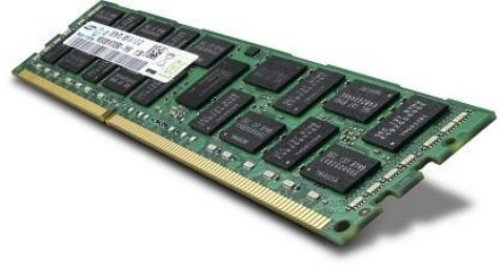
This Samsung M386B4G70BM0-YH921 is a 32 GB DDR3-1333 Registered ECC RDIMM operating at a low 1.35 V, making it ideally suited for legacy server platforms handling memory-intensive workloads like virtualization and in-memory databases. Its Quad Rank x4 organization and CL9 latency provide a dense, stable memory configuration with end-to-end data integrity, critical for maintaining uptime in enterprise environments.
1. Generous memory capacity enables dense server virtualization, allowing significantly more VMs per node without swapping to slower storage.
2. ECC protection automatically corrects single-bit errors, defending critical in-memory data from corruption in always-on enterprise environments.
3. Registered signaling stabilizes heavy memory loads, making it possible to pack maximum RAM into servers supporting large-scale database and analytics workloads.
4. Quad Rank x4 configuration achieves extreme capacity per module, essential for memory-bound applications like big data processing while preserving channel balance.
5. Low 1.35V operation reduces overall data center power draw and cooling demands, directly lowering TCO in dense rack deployments.
The M386B4G70BM0-YH921 is a 32GB DDR3 Registered DIMM, purpose-built for servers where downtime is not an option. Its four defining characteristics directly address the most critical pain points in the data center. First, the Error Correcting Code (ECC) continuously detects and corrects single-bit memory errors caused by background radiation or cosmic particles. In a virtualization cluster hosting dozens of virtual machines, an undetected bit flip can silently corrupt a database index or hypervisor state, leading to cascading failures across the entire business. ECC turns these catastrophic silent errors into logged, corrected events, safeguarding data integrity. Second, the registered buffer stabilizes the electrical load on the memory controller, enabling this module’s high 32GB capacity and Quad Rank x4 organization to function reliably. This is essential for memory-hungry in-memory databases like SAP HANA or large Redis caches; without the register, the system would fail to recognize the full capacity or experience signal instability during heavy analytical workloads. The Quad Rank architecture itself allows extreme density in a single slot, maximizing RAM per server without sacrificing stability. Finally, the 1.35V low-voltage operation reduces power consumption and thermal output, a direct benefit for dense rack deployments where every watt of cooling counts. Together, these features ensure that your mission-critical applications run with uncompromising reliability, consistent performance, and lower total cost of ownership.
General Virtualization
For moderately dense VM hosting, deploy one 32GB RDIMM per populated memory channel to balance cost and capacity. A dual-socket server with six channels per CPU benefits from twelve modules, yielding 384GB total—sufficient for 40–60 light-to-medium VMs while leaving DIMM slots free for future scaling.
In-Memory Database
Maximize capacity and interleaving by installing identical quad-rank 32GB modules across all memory channels—typically 24 DIMMs in a two-socket system with three DIMMs per channel. This 768GB configuration reduces latency through rank interleaving and satisfies demanding datasets like Redis or SAP HANA, though at slightly reduced speed due to quad-rank loading.
High-Performance Computing
Populate one DIMM per channel to maintain the highest clock frequency under quad-rank constraints, aiming for 192GB across six channels per CPU. This layout keeps memory bandwidth high for MPI workloads while providing ample headroom for large simulation meshes. Scale capacity by moving to two DIMMs per channel only if per-node memory pressure limits job throughput.
Rigorously tested server memory: compatible with Dell PowerEdge R720, HP DL380p Gen8, and Lenovo System x3650 M4.
Q: Can I mix this M386B4G70BM0-YH921 with other memory modules of different brands or speeds?
A: Mixing is not recommended. This is a registered ECC RDIMM; mixed brands, speeds, or ranks may cause instability, force lower speed, or even prevent booting on server platforms.
Q: Is this memory compatible with my system?
A: This 32GB DDR3-1333 registered ECC RDIMM is built for Intel Xeon E5 series and AMD Opteron 6300/8300 platforms. Verify your server motherboard supports quad-rank 1.35V RDIMMs before purchase.
Q: What is the recommended DIMM population order for optimal performance?
A: Refer to your server motherboard manual. Typically, populate identical quad-rank RDIMMs starting with the slots furthest from the CPU per channel to balance memory interleaving and maximize signal integrity.
Q: Does this module support overclocking or XMP profiles?
A: No. This is an enterprise-grade registered ECC DIMM built for compliance with JEDEC DDR3-1333 standards. Overclocking or XMP is not supported and would compromise reliability in server environments.
Q: What warranty and typical failure rate can I expect?
A: This module is backed by a one-year warranty. Enterprise-class RDIMMs with ECC typically yield an AFR below 0.5% under specified operating conditions, ensuring dependable 24/7 server operation.